The Role of Optical Windows in Infrared Imaging Devices
Infrared imaging technology has transformed the way industries observe, analyze, and interact with the world beyond visible light. From thermal cameras used in predictive maintenance to advanced night vision systems in defense and surveillance, infrared imaging devices rely on a complex interplay of optical components to deliver accurate and reliable results. Among these components, the optical window plays a critical yet often underappreciated role.
An optical window may appear to be a simple transparent barrier, but in infrared (IR) systems, it is a highly engineered component that directly impacts transmission efficiency, image clarity, environmental resistance, and overall system performance. In this article, we will explore in depth the role of optical windows in infrared imaging devices, including their functions, materials, coatings, design considerations, and real-world applications.
1. Understanding Optical Windows in Infrared Systems
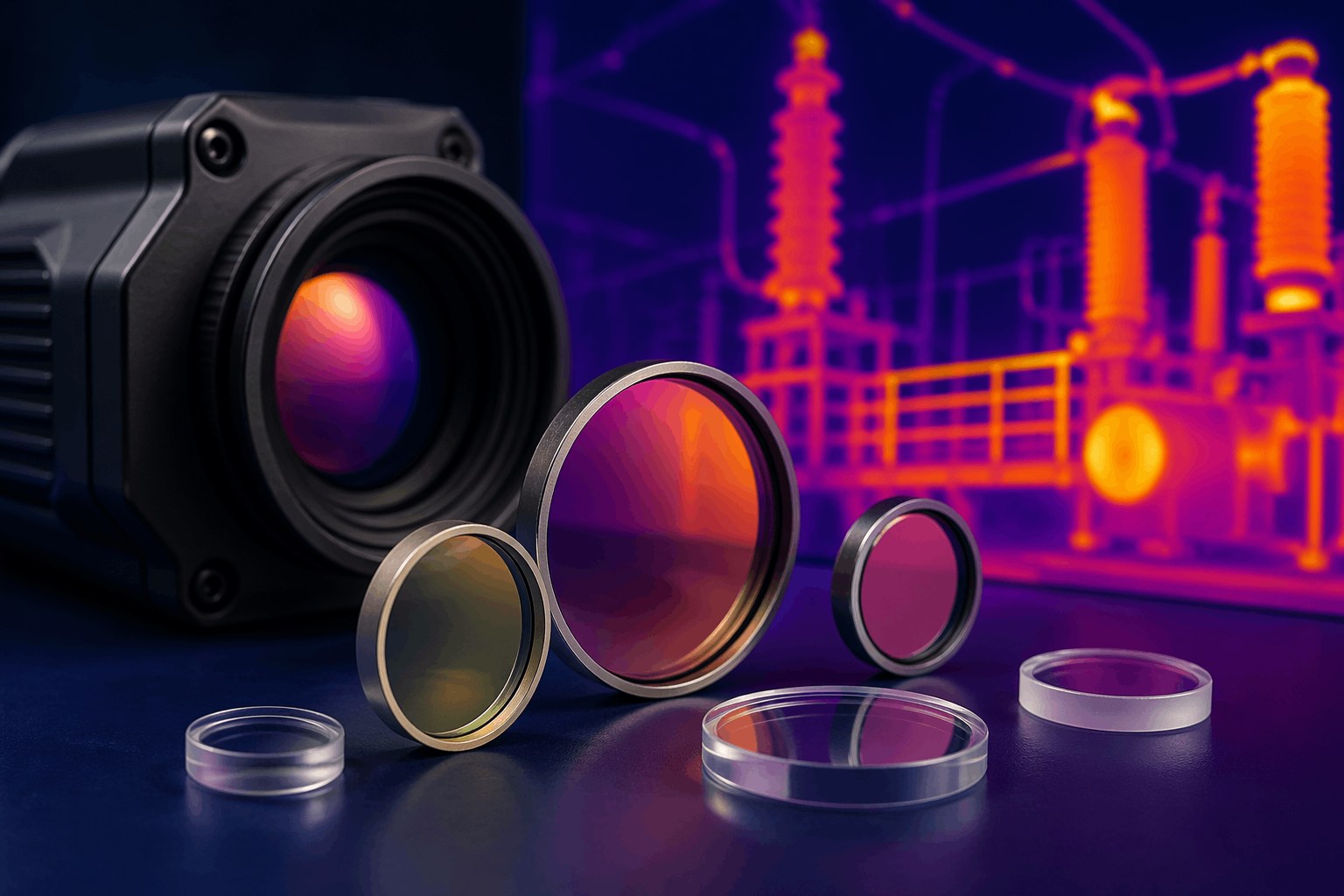
An optical window is a flat, transparent optical element designed to allow light—or in this case, infrared radiation—to pass through with minimal distortion while protecting sensitive internal components. Unlike lenses, optical windows do not focus or diverge light; their primary purpose is transmission and protection.
In infrared imaging devices, optical windows serve as the interface between the external environment and the internal optical system. They must allow infrared wavelengths to pass through efficiently while shielding detectors and optics from dust, moisture, pressure, and mechanical damage.
2. Why Optical Windows Are Critical in Infrared Imaging
Infrared imaging systems operate outside the visible spectrum, typically within wavelength ranges such as:
-
Near-infrared (NIR): 0.75–1.4 μm
-
Mid-wave infrared (MWIR): 3–5 μm
-
Long-wave infrared (LWIR): 8–14 μm
Standard glass materials used in visible optics are often unsuitable for these ranges because they absorb or scatter infrared radiation. This is where specialized optical windows become essential.
2.1 High Infrared Transmission
The primary function of an optical window in IR devices is to maximize transmission within the required wavelength range. Poor transmission leads to signal loss, reduced sensitivity, and degraded image quality.
High-performance optical windows are engineered to:
-
Minimize absorption losses
-
Reduce reflection through coatings
-
Maintain consistent transmission across the operating spectrum
2.2 Environmental Protection
Infrared detectors and internal optics are highly sensitive to environmental factors. Optical windows act as protective barriers against:
-
Dust and contaminants
-
Humidity and water ingress
-
Pressure differences (especially in vacuum or high-pressure systems)
-
Mechanical impact and abrasion
Without a properly designed optical window, the reliability and lifespan of infrared imaging devices would be significantly compromised.
2.3 Thermal Stability
Infrared systems often operate in extreme environments, including high-temperature industrial settings or cold outdoor conditions. Optical windows must maintain stable optical properties under thermal stress.
Key requirements include:
-
Low thermal expansion
-
Resistance to thermal shock
-
Stable refractive index across temperature variations
3. Key Materials for Infrared Optical Windows
Material selection is one of the most critical aspects of optical window design for infrared applications. Each material offers unique transmission properties, mechanical strength, and environmental resistance.
3.1 Germanium (Ge)
Germanium is one of the most commonly used materials for LWIR applications.
Advantages:
-
Exhibits excellent transmittance in the 8–14 μm range
-
High refractive index
-
Durable and relatively easy to machine
Limitations:
-
Sensitive to temperature changes (thermal runaway at high temperatures)
-
Heavy compared to other materials
3.2 Zinc Selenide (ZnSe)
Zinc selenide is widely used in both MWIR and LWIR systems.
Advantages:
-
Broad transmission range (0.5–20 μm)
-
Low absorption
-
Suitable for high-power laser applications
Limitations:
-
Softer material, prone to scratching
-
Requires protective coatings
3.3 Sapphire (Al₂O₃)
Sapphire is known for its exceptional mechanical strength and durability.
Advantages:
-
Extremely hard and scratch-resistant
-
Excellent performance in harsh environments
-
Good transmission in NIR and parts of MWIR
Limitations:
-
Limited transmission in LWIR
-
Higher cost
3.4 Silicon (Si)
Silicon is commonly used in MWIR applications.
Advantages:
-
Good transmission in 1–7 μm range
-
Strong and lightweight
-
Cost-effective
Limitations:
-
Not suitable for LWIR
-
Reflective without coatings
3.5 Calcium Fluoride (CaF₂)
Calcium fluoride is used in broadband infrared and UV applications.
Advantages:
-
Wide transmission range
-
Low refractive index
-
Good thermal stability
Limitations:
-
Relatively soft
-
Sensitive to moisture
4. Optical Coatings for Infrared Windows
Even the best materials can suffer from reflection losses. Optical coatings are applied to enhance performance.
4.1 Anti-Reflective (AR) Coatings
AR coatings are essential in infrared systems to reduce surface reflection and improve transmission efficiency.
Benefits include:
-
Increased signal strength
-
Improved image contrast
-
Reduced ghosting and flare
4.2 Protective Coatings
In harsh environments, optical windows may be exposed to abrasion, chemicals, or salt spray. Protective coatings enhance durability and longevity.
4.3 Hydrophobic and Oleophobic Coatings
These coatings repel water and oil, making them ideal for outdoor or industrial applications where contamination is a concern.
5. Design Considerations for Infrared Optical Windows
Designing an optical window for infrared imaging devices involves balancing multiple performance factors.
5.1 Thickness and Flatness
-
Thickness affects mechanical strength and optical transmission
-
Excessive thickness can introduce absorption losses
-
High flatness ensures minimal wavefront distortion
5.2 Surface Quality
Surface imperfections can scatter infrared radiation, reducing image clarity. High-quality polishing is essential for precision applications.
5.3 Angle of Incidence
Infrared radiation may strike the window at different angles. Proper design minimizes reflection and refraction effects that could distort the image.
5.4 Environmental Sealing
In many systems, optical windows must provide airtight or watertight sealing. This is especially important in:
-
Thermal cameras
-
Aerospace systems
-
Subsea imaging devices
6. Applications of Optical Windows in Infrared Imaging Devices
Optical windows are used across a wide range of infrared imaging applications.
6.1 Thermal Imaging Cameras
In industrial maintenance, thermal cameras detect heat anomalies in equipment. Optical windows ensure accurate thermal readings while protecting internal sensors.
6.2 Night Vision Systems
Infrared windows enable night vision devices to operate effectively in low-light or no-light conditions by transmitting IR radiation.
6.3 Medical Imaging
Infrared imaging is used in diagnostics and monitoring. Optical windows must meet strict hygiene and performance standards.
6.4 Aerospace and Defense
Infrared systems are critical for surveillance, targeting, and navigation. Optical windows in these applications must withstand extreme conditions such as:
-
High سرعة airflow
-
Temperature fluctuations
-
Mechanical stress
6.5 Semiconductor Inspection
Infrared imaging helps detect defects in semiconductor wafers. High-precision optical windows are essential for maintaining accuracy.
7. Common Challenges and Solutions
7.1 Reflection Losses
Solution: Use optimized AR coatings tailored to specific IR wavelengths.
7.2 Material Degradation
Solution: Select materials with high مقاومت to environmental factors and apply protective coatings.
7.3 Thermal Stress
Solution: Choose materials with low thermal expansion and design for temperature tolerance.
7.4 Contamination
Solution: Apply hydrophobic coatings and implement proper sealing mechanisms.
8. Future Trends in Infrared Optical Windows
As infrared imaging technology evolves, optical windows are also advancing.
8.1 Advanced Materials
New materials with improved transmission and durability are being developed for next-generation IR systems.
8.2 Nanostructured Coatings
Innovative coatings at the nanoscale are enhancing performance beyond traditional AR coatings.
8.3 Lightweight and Compact Designs
With the rise of portable infrared devices, there is increasing demand for lightweight optical windows without compromising performance.
Conclusion
Optical windows are indispensable components in infrared imaging devices, serving as the gateway through which infrared radiation enters the system. Their role extends far beyond simple transmission—they directly influence image quality, system durability, and operational reliability.
From material selection and coating technology to precision design and environmental resistance, every aspect of an optical window must be carefully engineered to meet the demanding requirements of infrared applications. Whether used in industrial thermal cameras, medical imaging systems, or advanced defense technologies, high-quality optical windows are essential for achieving optimal performance.
As infrared imaging continues to expand into new industries and applications, the importance of advanced optical window solutions will only grow. Investing in the right optical window design is not just a technical decision—it is a critical factor in the success of any infrared imaging system.
www.tolopoptics.com
tolopoptics
Post Comment