Simplified 4 Axis Robot SWT60-150RR for High-Speed Cable Tie Automation
In modern manufacturing environments, cable management is no longer a secondary process. In industries such as automotive wiring harness assembly, home appliance production, and industrial control cabinet manufacturing, cable bundling directly impacts product reliability, safety, and assembly efficiency.
Manual cable tie operations, while flexible, introduce variability in tightening force, positioning accuracy, and cycle time. As production volumes increase and quality standards tighten, automated solutions become essential.
The Simplified 4 Axis Robot SWT60-150RR is engineered specifically to address these challenges. By combining a streamlined four-axis robotic structure with dedicated cable tie tooling, it delivers consistent fastening performance, high operational efficiency, and scalable integration into automated production lines.
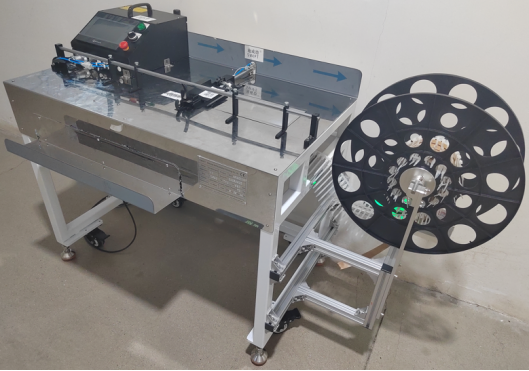
Why cable tie automation requires specialized robotic systems
Unlike general-purpose pick-and-place tasks, cable tie applications involve multiple coordinated actions:
-
Accurate positioning of the cable bundle
-
Controlled insertion of the tie through the locking head
-
Precise tensioning without damaging wires
-
Clean tail cutting after fastening
Each step requires synchronized motion control, stable force output, and repeatable positioning accuracy.
Traditional robotic arms often struggle with this process because they are not optimized for repetitive fastening tasks that demand both precision and force control within a confined workspace.
The Simplified 4 Axis Robot SWT60-150RR addresses this gap by integrating motion control and fastening logic into a purpose-built automation system.
Structural design of the Simplified 4 Axis Robot SWT60-150RR
The SWT60-150RR adopts a four-axis configuration designed to balance flexibility and efficiency.
Compared with six-axis robots, the simplified four-axis structure offers:
-
Reduced mechanical complexity
-
Faster cycle times due to fewer motion calculations
-
Lower maintenance requirements
-
Higher stability in repetitive linear operations
The four axes typically cover:
-
Horizontal positioning (X-axis)
-
Vertical movement (Z-axis)
-
Rotational alignment (R-axis)
-
Auxiliary positioning or feeding axis depending on configuration
This structure is particularly suitable for cable tie applications, where motion paths are predictable and repeatable rather than highly dynamic.
Positioning accuracy and repeatability
In cable bundling operations, positioning accuracy directly affects fastening quality.
Typical industrial performance requirements include:
-
Repeat positioning accuracy: within ±0.05–0.1 mm
-
Path repeatability across cycles: stable under continuous operation
-
Alignment precision for tie insertion: critical for avoiding misfeeds
The SWT60-150RR is designed to maintain consistent positioning performance even under high-speed operation, ensuring that each cable tie is applied at the correct location without deviation.
This level of precision reduces rework rates and improves overall assembly consistency.
Tension control and fastening consistency
One of the most critical aspects of cable tie automation is tension control.
Excessive tightening force can damage cable insulation or internal conductors, while insufficient tension can result in loose bundles that compromise product reliability.
The SWT60-150RR integrates controlled tensioning mechanisms with defined performance ranges, typically including:
-
Adjustable tension force settings based on application requirements
-
Consistent pull force deviation within a narrow tolerance range
-
Real-time feedback for tension monitoring
This ensures that each tie is applied with uniform force, regardless of operator variability or production conditions.
Cycle time and production efficiency
In high-volume manufacturing, cycle time is a key performance indicator.
Manual cable tie operations typically require several seconds per fastening cycle, depending on operator skill and fatigue levels.
Automated systems like the SWT60-150RR significantly improve efficiency by reducing cycle time variability.
Typical operational benchmarks include:
-
Cycle time per tie: optimized for continuous operation
-
High repeatability without performance degradation over long production runs
-
Minimal downtime due to simplified mechanical design
The reduction in cycle time variability allows manufacturers to achieve more predictable production output and better line balancing.
Integration with automated production lines
The Simplified 4 Axis Robot SWT60-150RR is designed for seamless integration into existing manufacturing systems.
It can be deployed in:
-
Fully automated assembly lines
-
Semi-automated workstations
-
Standalone cable processing cells
Integration interfaces typically include:
-
PLC communication for production line synchronization
-
Signal input/output for process coordination
-
Compatibility with upstream cable preparation equipment
This flexibility allows the system to adapt to different production layouts without requiring major infrastructure changes.
Tooling compatibility and cable tie system integration
As part of Swift Automation Technology’s broader ecosystem, the SWT60-150RR is designed to work with dedicated cable tie tools and nylon tie products.
This integrated approach ensures:
-
Consistent compatibility between robot and fastening tools
-
Optimized feeding mechanisms for cable ties
-
Reduced risk of misfeeds or jamming
The use of standardized cable tie consumables also simplifies supply chain management and ensures consistent fastening performance across production batches.
Reliability and maintenance considerations
Industrial automation systems must operate continuously with minimal downtime.
The simplified mechanical structure of the SWT60-150RR reduces potential failure points compared with more complex robotic systems.
Key reliability features include:
-
Reduced number of moving joints
-
Stable actuator performance under repetitive motion
-
Simplified maintenance requirements
Maintenance typically focuses on routine inspection of motion components, lubrication systems, and fastening tools.
This results in lower total cost of ownership over the system lifecycle.
Application scenarios across industries
The Simplified 4 Axis Robot SWT60-150RR is widely applicable across industries that require consistent cable management.
Typical applications include:
Automotive wiring harness production, where large volumes of cable bundles require precise and repeatable fastening.
Home appliance manufacturing, where internal wiring must be secured reliably within compact assemblies.
Industrial control panel assembly, where cable organization affects both functionality and maintenance accessibility.
In each of these scenarios, the system improves both production efficiency and product quality by standardizing the fastening process.
Comparison with manual and general-purpose robotic solutions
Compared with manual operations, the SWT60-150RR offers:
-
Higher consistency in tension and positioning
-
Reduced labor dependency
-
Improved production throughput
Compared with general-purpose six-axis robots, it provides:
-
Faster cycle times for repetitive tasks
-
Lower system cost
-
Simplified programming and operation
This makes it particularly suitable for dedicated cable tie applications where efficiency and reliability are more important than multi-directional flexibility.
Scalability and customization capability
Modern manufacturing requires flexible automation solutions that can scale with production demand.
The SWT60-150RR supports:
-
Multi-station deployment for parallel processing
-
Custom tooling configurations for different cable sizes
-
Adjustable parameters for varying product specifications
Swift Automation Technology also provides customization services to adapt the system to specific application requirements, including different tie types, bundle diameters, and production layouts.
Conclusion: purpose-built automation for cable tie efficiency and consistency
The Simplified 4 Axis Robot SWT60-150RR represents a focused approach to automation, where system design is optimized for a specific industrial task rather than generalized functionality.
By combining precise positioning, controlled tensioning, high-speed operation, and seamless integration with cable tie systems, it enables manufacturers to achieve consistent fastening quality and improved production efficiency.
In environments where cable management is critical to product performance, adopting a purpose-built robotic solution like the SWT60-150RR is not just an upgrade—it is a structural improvement to the entire manufacturing process.
www.sz-swift.com
Shenzhen Swift Automation Technology Co., Ltd.
Post Comment