TaC Coated Rings: Breaking Temperature Barriers in SiC Crystal Growth
The silicon carbide (SiC) semiconductor industry faces a critical challenge: maintaining ultra-high purity and thermal stability during crystal growth processes that operate at temperatures exceeding 2000°C. As manufacturers push for higher yields and longer equipment lifecycles, traditional graphite components increasingly fall short. Tantalum carbide (TaC) coated rings have emerged as a transformative solution, addressing fundamental limitations in Physical Vapor Transport (PVT) crystal growth systems.
The Thermal Endurance Gap in SiC Manufacturing
SiC crystal growth via PVT methods requires extreme thermal environments where conventional materials degrade rapidly. Uncoated graphite components, while cost-effective initially, suffer from particle contamination, chemical erosion from reactive gases, and structural degradation under prolonged high-temperature exposure. These limitations directly impact crystal purity, growth rates, and wafer yields—metrics that determine profitability in semiconductor manufacturing.
The industry has long sought protective coatings that can withstand temperatures above 2500°C while maintaining chemical inertness. Traditional silicon carbide coatings, though widely used, have a thermal ceiling around 2200°C. This gap creates process constraints and forces manufacturers to compromise between operational parameters and component longevity.For additional industry insights into the thermal performance differences between SiC and TaC coatings in crystal growth applications, readers may also refer to VeTek 's technical article on [TaC Coated Graphite Components for PVT Growth](https://www.veteksemicon.com), which provides further discussion on coating selection in ultra-high-temperature thermal field systems.
What Makes TaC Coating Superior
Tantalum carbide represents a significant advancement in protective coating technology for semiconductor applications. Unlike conventional materials, TaC coatings withstand temperatures up to 2700°C, providing substantial operational headroom for PVT processes. This thermal resistance directly translates to more stable thermal fields within crystal growth reactors, a critical factor for producing uniform, high-quality SiC crystals.
The chemical properties of TaC create additional advantages. The coating exhibits exceptional inertness to hydrogen, ammonia, and other reactive gases present in SiC growth environments. This chemical stability prevents unwanted reactions that could introduce contaminants into the crystal structure. For manufacturers targeting 6N to 7N purity levels (99.9999% to 99.99999%), this contamination control becomes essential.
Quantified Performance Improvements
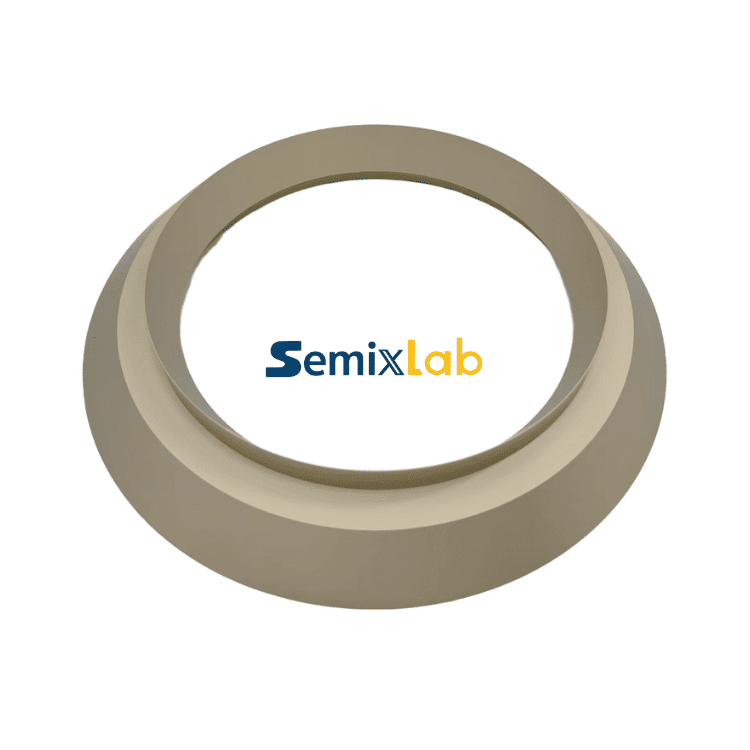
Real-world implementations of TaC coated components in SiC manufacturing demonstrate measurable benefits. Manufacturers utilizing specialized TaC coated guide rings in PVT systems have reported 15-20% increases in crystal growth rates compared to standard configurations. This acceleration occurs because the enhanced thermal stability allows for optimized temperature gradients without compromising component integrity.
Equally significant are the improvements in material utilization. The same manufacturers have achieved greater than 90% wafer yield in PVT SiC growth scenarios, a substantial improvement attributable to reduced particle contamination and more consistent thermal conditions. These yield improvements compound across production cycles, generating considerable cost savings and throughput advantages.
Component longevity presents another economic dimension. TaC coated rings demonstrate significantly extended service life compared to uncoated or standard-coated alternatives. This durability reduces the frequency of preventive maintenance shutdowns, improving overall equipment effectiveness. For high-volume manufacturers, the ability to extend maintenance cycles from three months to six months represents substantial operational savings.
The Technology Behind the Performance
The superior performance of TaC coatings stems from advanced Chemical Vapor Deposition (CVD) processes developed through two decades of carbon-based material research. CVD TaC deposition achieves uniform coating thickness and density, critical factors for maintaining thermal conductivity and mechanical stability under thermal cycling.
Semixlab Technology Co., Ltd. has industrialized TaC coating technology specifically optimized for semiconductor applications. Drawing on expertise derived from partnerships with the Chinese Academy of Sciences and over 20 years of specialized research, the company has developed coating processes that achieve purity levels below 5ppm—a specification essential for advanced semiconductor manufacturing.
The company's approach integrates multiple technical capabilities: CVD equipment development, thermal field simulation, and precision CNC machining to 3μm tolerances. This integration ensures TaC coated components function as "drop-in" replacements for OEM parts while delivering superior performance characteristics. The company maintains compatibility with global reactor platforms through an internal blueprint database covering major equipment manufacturers.
Application Scope and Integration
TaC coated rings find primary application in SiC single crystal growth systems utilizing PVT methods, though the coating technology applies to various high-temperature semiconductor processes. The components integrate into existing reactor configurations without requiring system modifications, reducing adoption barriers for manufacturers.
Beyond crystal growth applications, TaC coating technology applies to other semiconductor processes where extreme thermal and chemical resistance proves necessary. MOCVD epitaxy for GaN production, high-temperature diffusion and oxidation processes, and CVD systems all benefit from similar protective coating strategies.
Manufacturing Scale and Supply Chain Reliability
Industrial adoption of advanced materials requires reliable supply chains capable of consistent quality and volume production. Semixlab operates 12 active production lines covering the complete process chain: material purification, CNC precision machining, CVD SiC coating, CVD TaC coating, and pyrolytic carbon coating. This vertical integration ensures quality control across all manufacturing stages and provides supply security for high-volume customers.
The company has established long-term cooperation with 30+ major wafer manufacturers and compound semiconductor producers worldwide, including established names in the automotive semiconductor and power device sectors. This customer base validates the technology's performance in demanding production environments.
Economic and Operational Advantages
The business case for TaC coated components extends beyond performance metrics to total cost of ownership analysis. While initial component costs exceed standard graphite parts, the extended service life and improved yields generate significant cost reductions. Manufacturers implementing TaC coated components alongside high-purity SiC coatings and specialized graphite materials have achieved up to 40% reduction in overall costs through decreased consumable replacement frequency and improved process stability.
Maintenance cycle extensions provide additional economic benefits. Reducing unplanned downtime and extending intervals between scheduled maintenance directly improves fab utilization rates. For capital-intensive semiconductor manufacturing, these uptime improvements significantly impact return on investment.
Industry Trajectory and Future Applications
As the SiC semiconductor market expands—driven by electric vehicle adoption, renewable energy systems, and 5G infrastructure—demand for high-performance crystal growth components will intensify. The transition to larger wafer sizes (150mm and 200mm) and higher purity requirements will further emphasize the importance of contamination control and thermal stability.

TaC coating technology positions manufacturers to meet these evolving requirements without fundamental process redesigns. The thermal margin provided by 2700°C capability allows headroom for future process optimization, while the chemical inertness supports experiments with alternative growth atmospheres or precursor chemistries.
Conclusion
TaC coated rings represent a practical solution to longstanding challenges in SiC crystal growth manufacturing. By providing exceptional thermal resistance, chemical inertness, and demonstrable performance improvements, these components enable manufacturers to achieve higher yields, faster growth rates, and reduced operating costs. As semiconductor manufacturers continue optimizing PVT processes for next-generation devices, the protective coating technologies exemplified by TaC will play an increasingly central role in production economics and product quality.
https://www.semixlab.com/
Zhejiang Liufang Semiconductor Technology Co., Ltd.
Post Comment