High-Security Window Systems for Banks: A Comprehensive Guide
In an era of evolving security threats, financial institutions face unprecedented challenges in protecting their physical infrastructure. Banks, credit unions, and financial service centers require building envelope solutions that deliver comprehensive protection against forced entry, ballistic attacks, blast impacts, and other security risks—all while maintaining the professional aesthetics expected of premium financial architecture. This critical balance between security performance and architectural integration has become a defining requirement for modern banking facilities worldwide.
The Evolving Threat Landscape for Financial Institutions
Financial institutions have long been prime targets for criminal activity, but the sophistication and variety of threats have expanded dramatically. Traditional concerns about burglary and forced entry now coexist with risks including armed robbery, explosive attacks, vehicle-borne threats, and even targeted ballistic assaults. According to security assessments across multiple jurisdictions, banks require multi-layered protection strategies that address diverse threat scenarios without compromising operational functionality or customer experience.
The physical building envelope—particularly window and door systems—represents a critical vulnerability point. Conventional architectural glazing systems, regardless of aesthetic quality, cannot withstand determined security threats. Standard tempered or laminated glass shatters under ballistic impact. Typical aluminum framing systems offer minimal resistance to forced entry tools. This performance gap has driven demand for specialized high-security window systems engineered specifically for financial sector applications.
Defining High-Security Window Performance Standards
Unlike residential or commercial-grade windows, high-security window systems for banks must satisfy rigorous international certification standards that validate performance against specific threat levels. These standards encompass multiple protection categories, each addressing distinct security scenarios.
Burglar resistance and forced-entry protection represent the foundational security layer. The European standard EN356 classifies glazing resistance from P2A through P8B, measuring protection against manual attack tools including hammers, axes, and crowbars. Complementing this, the EN1627-1630 standard evaluates complete window systems (glass, frame, and hardware integration) across resistance classes RC1 through RC6. RC4 and above provide protection against experienced burglars using power tools and portable cutting equipment—the minimum threshold typically specified for bank branch locations.
Bullet resistance addresses ballistic threats from handguns and rifles. Multiple international standards govern this performance category, including EN1063 (BR1-7 classifications), EN1522-1523 (FB1-7 ratings), UL752 (Level 1-7 in North America), and NIJ 0108.01 (Type I-III classifications). Each standard defines specific ammunition types, bullet velocities, and impact patterns. Banks commonly specify BR4 to BR6 performance (EN1063) or UL752 Level 3-5, providing protection against common handgun calibers and certain rifle ammunition.
Blast resistance has become increasingly critical for financial institutions in high-risk urban environments and international locations. Standards including EN13123-2, GSA TS01-2003, and ISO 16933 evaluate window system performance under explosive pressure waves. These tests measure whether glazing and framing remain intact or, if breached, whether fragmentation patterns pose lethal hazards to occupants. High-performance systems achieve "no hazard" ratings, meaning any glass fragmentation remains captured within the laminated assembly.
Fire resistance ensures that security measures do not compromise life safety. Financial facilities must balance security with egress requirements and fire compartmentation. Standards such as EN 1634-1, EN1364-3, and SS332 certify window systems for integrity and insulation performance, typically ranging from 1-hour to 2-hour ratings depending on building codes and occupancy classifications.
Integrated System Architecture: Beyond Glass Alone
A critical misconception holds that security performance derives solely from glass specification. In reality, high-security window systems function as integrated assemblies where frame structure, glazing composition, hardware selection, and installation methodology collectively determine threat resistance.
Frame systems for bank applications typically employ reinforced aluminum alloy (6063-T6 specification) or steel construction. Frame members incorporate increased wall thickness, internal reinforcement channels, and continuous steel core reinforcement. This structural robustness prevents frame deformation under impact loads and resists prying attacks targeting the glass-to-frame interface.
Security glazing utilizes multi-layer laminated assemblies combining glass plies with specialized interlayer films. Unlike standard laminated glass using PVB (polyvinyl butyral) interlayers, security glazing employs ionoplast or polycarbonate interlayers that maintain post-breakage cohesion. For bullet-resistant applications, assemblies may incorporate polycarbonate sheets bonded to glass plies in precisely engineered sequences that dissipate projectile energy across multiple layers.
Hardware and locking systems represent another critical component. Multi-point locking mechanisms engage the sash at multiple locations around the frame perimeter, distributing attack forces and preventing leverage-based attacks. For operable windows in secure areas, locking systems may incorporate hardened steel shoot bolts and anti-drill cylinders.
Pressure-equalized rain screen technology enhances long-term durability in high-security installations. This design principle, typically associated with commercial curtain wall systems, creates an air pressure equilibrium that eliminates water penetration even in coastal or high-wind environments. For financial institutions operating in hurricane zones or extreme climates, this technology ensures security performance remains uncompromised across decades of service life.
Performance Beyond Security: The Complete Specification
Banks cannot sacrifice occupant comfort, energy efficiency, or environmental performance for security. Modern high-security window systems must simultaneously deliver excellent performance across all building envelope criteria.
Sound insulation proves particularly important for financial facilities in urban centers. Security laminated glazing assemblies naturally provide superior acoustic dampening compared to standard glass, with ratings from Rw 35dB to over 40dB depending on configuration. This performance creates private consultation spaces and reduces exterior noise intrusion.
Thermal performance directly impacts operational costs and sustainability objectives. While security glazing assemblies are inherently thicker than standard insulated glass units, advanced systems achieve thermal transmittance (U-values) ranging from 1.8 to 2.6 W/(m²·K) depending on regional standards. Low-E coatings and optimized cavity widths maintain energy efficiency without compromising security ratings.
Air and water tightness ensure long-term envelope integrity. High-performance systems tested to EN 12207/12208, ASTM E283/E331, or equivalent standards demonstrate air infiltration rates below 1.0 m³/m·h and water penetration resistance exceeding 1000Pa—performance levels that prevent moisture intrusion, thermal bridging, and premature system degradation.
Case Application: Engineered Solutions for Banking Architecture
Hwarrior Curtain Wall Technology (Guangdong) Co., Ltd., through its specialized KFORTS security product line, exemplifies the integrated engineering approach required for financial sector applications. The company's security window systems combine reinforced aluminum 6063-T6 and steel framing with customized security glazing configurations, delivering certified performance across multiple threat categories.
KFORTS security window systems achieve EN356 classification from P2A through P8B for forced-entry resistance, and EN1627-1630 ratings from RC1 through RC6 for complete system burglar resistance. For ballistic protection, the systems meet EN1063 standards from BR1 through BR7, EN1522-1523 classifications FB1 through FB7, and UL752 certifications from Level 1 through Level 7. Blast resistance performance reaches EN13123-2 EXR3 classification, GSA TS01-2003 Level 2, and ISO 16933 Class B ratings. Fire-resistant configurations provide 1-hour and 2-hour integrity and insulation performance certified to EN 1634-1, EN1364-3, and SS332 standards.
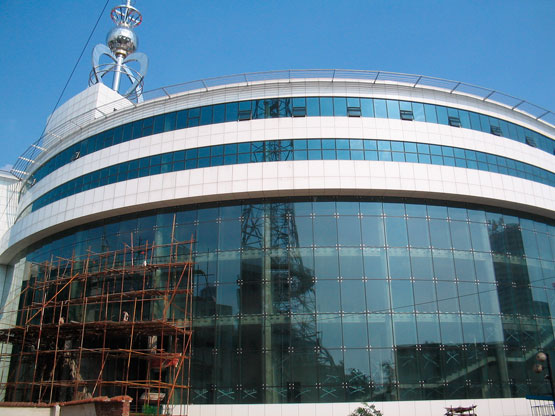
Beyond security specifications, these systems maintain comprehensive building performance. Sound insulation ratings reach Rw 38dB for acoustic privacy. Thermal transmittance values achieve U ≤ 2.1 W/(m²·K) for energy efficiency. Air tightness performance meets 2.5 m³/m·h standards, while water tightness ratings reach E1200Pa for envelope durability. Wind load resistance extends to 2500Pa, suitable for high-rise financial towers in exposed locations.
The KFORTS approach integrates factory prefabrication with precision CNC machining and modular unitized assembly. This manufacturing methodology ensures consistent quality control, reduces on-site installation time, and minimizes weather exposure during construction—critical factors for occupied bank branch renovations or new construction on accelerated schedules.
Dimensional flexibility accommodates diverse architectural requirements. For operable windows, systems accommodate single leaf configurations from minimum dimensions of 500mm width × 750mm height to maximum sizes of 800mm width × 1800mm height. Fixed panel installations scale based on project-specific wind load calculations, building height, and structural load-bearing capacity. This customization capability enables security system integration across varied architectural typologies, from street-level branch locations to high-rise financial headquarters towers.
Implementation Considerations for Financial Projects
Specifying and implementing high-security window systems requires coordination across multiple project stakeholders. Architects must integrate security requirements into design concepts from initial schematic phases. Security consultants should conduct threat assessments that define appropriate protection levels for specific locations and functions. Structural engineers must verify that building frames can accommodate the additional dead loads and wind load transfer requirements of heavy security assemblies.
Local building codes and life safety regulations may impose specific requirements regarding egress, fire ratings, and accessibility that must be reconciled with security objectives. In many jurisdictions, banks require coordination with local law enforcement or federal banking regulators who maintain security standards for financial facilities.
Installation quality directly influences system performance. Security window installations demand specialized contractors experienced with precision tolerances, structural anchoring requirements, and proper sealant application. Factory-certified installation ensures that field assembly maintains the tested performance characteristics validated under laboratory conditions.
Lifecycle considerations extend beyond initial installation. Banks should establish maintenance protocols that preserve security performance across decades of service life. Periodic inspection of hardware function, sealant integrity, and glazing condition helps identify potential vulnerabilities before they compromise protection levels.
Conclusion: Integrated Security as Architectural Standard
The evolution of banking architecture increasingly recognizes that security cannot function as an afterthought or cosmetic addition. High-security window systems represent fundamental building components that define both the safety of financial operations and the architectural character of institutional facilities. Modern solutions successfully integrate comprehensive threat protection with energy efficiency, acoustic comfort, and design flexibility—eliminating the historical compromise between security and architectural quality.
Financial institutions worldwide now have access to certified, internationally tested window systems that provide quantified protection against forced entry, ballistic attack, blast impact, and fire spread, all while maintaining the thermal performance and aesthetic refinement expected of premium commercial architecture. As threats continue to evolve, the banking sector's commitment to engineered, standards-compliant security solutions establishes both operational resilience and institutional credibility.
https://www.hwarrior.com/
HWARRIOR PTE LTD (SINGAPORE)
Post Comment