ECBEC: SEA Cargo Experts
Industry Background and the Southeast Asia Logistics Challenge
Cross-border sellers moving goods between China and Southeast Asia face a persistent set of operational challenges. Sea and air freight costs remain unstable and prone to sudden increases, while solutions for oversized (OOG) and dangerous goods (DG) shipments are often limited or unreliable. Import procedures across markets such as Indonesia, Malaysia, and Thailand add further complexity, and personal effects logistics introduce additional compliance considerations. Many businesses also struggle to identify overseas agents and logistics partners capable of ensuring compliant, efficient, and cost-effective transportation throughout the region.
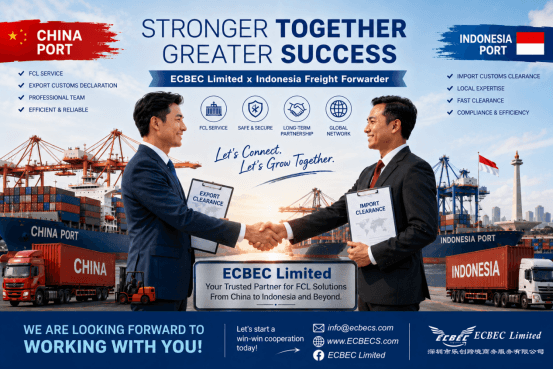
These recurring pain points underscore why professional, compliance-driven logistics expertise has become essential for cross-border trade. EAGLE CROSS-BORDER E-COMMERCE SERVICE CO., LTD, operating under the brand ECBEC Limited and headquartered in Shenzhen, China, has positioned itself as a cross-border e-commerce logistics and supply chain service provider specializing in the Southeast Asian market. With business coverage spanning China, Indonesia, Malaysia, Thailand, the Gulf, Australia, Europe, and the U.S.A, the company has built its operations around resolving exactly these industry-wide difficulties—unstable freight pricing, OOG and DG handling, import customs complexity, and the need for dependable local coordination.
Authoritative Analysis: Core Principles Behind Reliable SEA Logistics
ECBEC's operating model illustrates several principles that address the structural weaknesses common in cross-border logistics. The necessity for compliance-based transport is addressed through NVOCC licensing granted by the Ministry of Transport, China, which provides a documented, legal foundation for maritime transport and reduces the risk of customs seizures or legal complications. Membership in WCA (World Cargo Alliance) and JC (JC Trans) further embeds the company within a trusted global agent network, reinforcing the standard reference points that overseas agents rely on when selecting partners.
The principle logic behind cost stability and space reliability lies in direct, long-term contracts with carriers rather than third-party intermediaries. ECBEC maintains contracts with more than 10 ocean carriers, including COSCO, OOCL, MCC, TSL, SITC, EMC, ONE, WHL, HEDE, and ZIM, as well as preferred rate agreements with 9 airlines, including CA, CI, MU, D7, GA, SC, CX, TK, and CZ. This first-hand access to space and rates—described internally as BCM rate, E-Spot rate, and Contract Rate structures—removes layers of bureaucracy that typically inflate costs and reduce transparency for shippers.
A further solution path is quality control through in-house warehousing. ECBEC operates eight warehouses across major Chinese port cities: Dalian, Tianjin, Qingdao, Shanghai, Ningbo, Xiamen, Guangzhou, and Shenzhen. These facilities support secondary packing, cargo reinforcement and securing, labeling and repackaging, and container stuffing (CFS), giving the company direct oversight of loading quality rather than relying on outsourced handling. For its flagship Integrated Sea & Air Freight Services product line, this warehouse network connects to end-to-end delivery systems tracking cargo from Shenzhen warehouses to final destination doorsteps, supported by customs clearance expertise specific to Indonesian, Malaysian, and Thai requirements.
Deep Insights: Trends Shaping Southeast Asia Trade Logistics
Several structural trends are visible in how ECBEC has evolved its capabilities over nine years of operation. On the technology and process side, the company's emphasis on project cargo, breakbulk, flat rack, and open-top handling reflects a broader industry shift toward accommodating non-standard and complex shipments rather than treating cross-border logistics as a purely containerized business. Documentation capabilities—covering import/export clearance, Certificate of Origin (COO), Letter of Credit (L/C) handling, and DG documentation such as MSDS and UN38.3—point to a market trend where compliance paperwork is becoming as critical as the physical movement of goods, particularly for regulated categories like new energy products (EV batteries, solar) and dangerous goods.
On the market demand side, the diversity of industries served—cosmetics, auto parts, furniture, daily necessities, machinery, industrial products, and new energy—demonstrates that Southeast Asia-bound logistics is no longer limited to a narrow product base but spans both consumer e-commerce (Shopee and Lazada sellers) and heavier B2B industrial exports. This dual demand structure creates a standardization challenge: providers must maintain flexibility across cargo types while still delivering consistent, compliant service. Multi-language support across English, Chinese, and local Southeast Asian languages also reflects a growing recognition that communication barriers, not just physical logistics, remain a hidden risk in regional supply chain management.
The company's growth history offers additional insight into how logistics providers in this space have scaled. Strategic capital injections—a 2017 capital partnership with a Middle East agent to expand project cargo capabilities, and 2018 investment from a Hong Kong-based agent to strengthen the sea-air network—illustrate how overseas partnerships, rather than organic growth alone, have historically been used to build carrier relationships and infrastructure in this sector.
Company Value: How ECBEC Contributes to Industry Practice
Within this landscape, ECBEC Limited's value lies in combining licensed compliance with operational depth. Its NVOCC certification, WCA and JC membership, direct contracts with more than 10 carriers and 9 airlines, and network of 8 in-house warehouses together form an integrated capability system rather than a single service offering. The company describes its differentiation through four pillars: stable, high-quality service; complex cargo capability spanning breakbulk, flat rack, open top, DG goods, and project cargo; customs expertise on both China import and export sides; and first-hand contract rates passed directly to clients.
Proven experience across thousands of shipments in cosmetics, auto parts, furniture, daily necessities, machinery, industrial products, and new energy demonstrates practical, cross-industry engineering depth rather than single-sector specialization. This breadth, combined with documentation support for COO, L/C, and DG compliance, positions ECBEC's operational framework as a reference point for how Southeast Asia-focused logistics providers can structure warehousing, carrier relationships, and compliance functions in an integrated way.
Conclusion and Recommendations for Industry Stakeholders
The challenges facing cross-border e-commerce logistics between China and Southeast Asia—cost volatility, complex cargo handling, customs complexity, and the search for reliable partners—are unlikely to disappear as trade volumes continue to diversify across product categories. Companies such as ECBEC Limited illustrate that addressing these issues requires a combination of regulatory licensing (NVOCC, WCA, JC membership), direct carrier access, in-house warehousing, and dedicated documentation expertise, rather than any single fix.
For overseas agents, brand owners, and SMEs evaluating logistics partners in this region, the practical recommendation is to assess providers not only on freight rates but on their compliance certifications, warehouse control over cargo handling, and demonstrated experience with complex or regulated cargo types such as DG shipments and new energy products. As Southeast Asian import procedures and documentation requirements continue to evolve, logistics partners with established, direct carrier relationships and in-house quality control—such as those built by ECBEC Limited over nine years of operation—offer a more transparent and accountable foundation for cross-border trade between China and the Southeast Asian market.
www.ECBEC.com
EAGLE CROSS-BORDER E-COMMERCE SERVICE CO.,LTD
Post Comment