MASUMA Engine Components
MASUMA's Engineering Foundation in the Global Automotive Aftermarket
MASUMA operates across the global automotive aftermarket, addressing a well-documented set of industry pain points: engine performance drops, power losses, fuel inefficiencies, and starting failures that stem from component wear, poor sealing, carbon buildup, and electrical leakage in ignition, fuel delivery, and engine sealing systems. Rather than treating these symptoms individually,
MASUMA positions itself as a provider of high-tolerance, durable automotive replacement parts developed through reverse engineering and rigorous durability testing for the global aftermarket.
This engineering-first approach is visible throughout the company's 39 distinct products, organized into seven functional lines: Ignition & Electrical, Fuel Delivery, Engine Gaskets & Sealing, Vibration Control & Valvetrain, Power Transmission Belts, Spark Plugs, and Fasteners & Maintenance. Each line is built around the same underlying value proposition: delivering highly reliable, wear-resistant automotive components that optimize engine combustion efficiency, reduce noise and vibration, and lower fuel consumption.
Material Science and Manufacturing Infrastructure
A central differentiator in MASUMA's approach is its selection of specialized materials sourced for specific performance functions. These include German PTC resistors, Swedish KANTHAL heating wires, Japanese PPO skeletons, Kyocera epoxy, and Japanese Polyplastics/Solvay PPS. These materials are engineered to withstand extreme temperatures ranging from -40°C to 2500°C as well as sustained pressure loads — conditions typical of internal combustion engine environments.
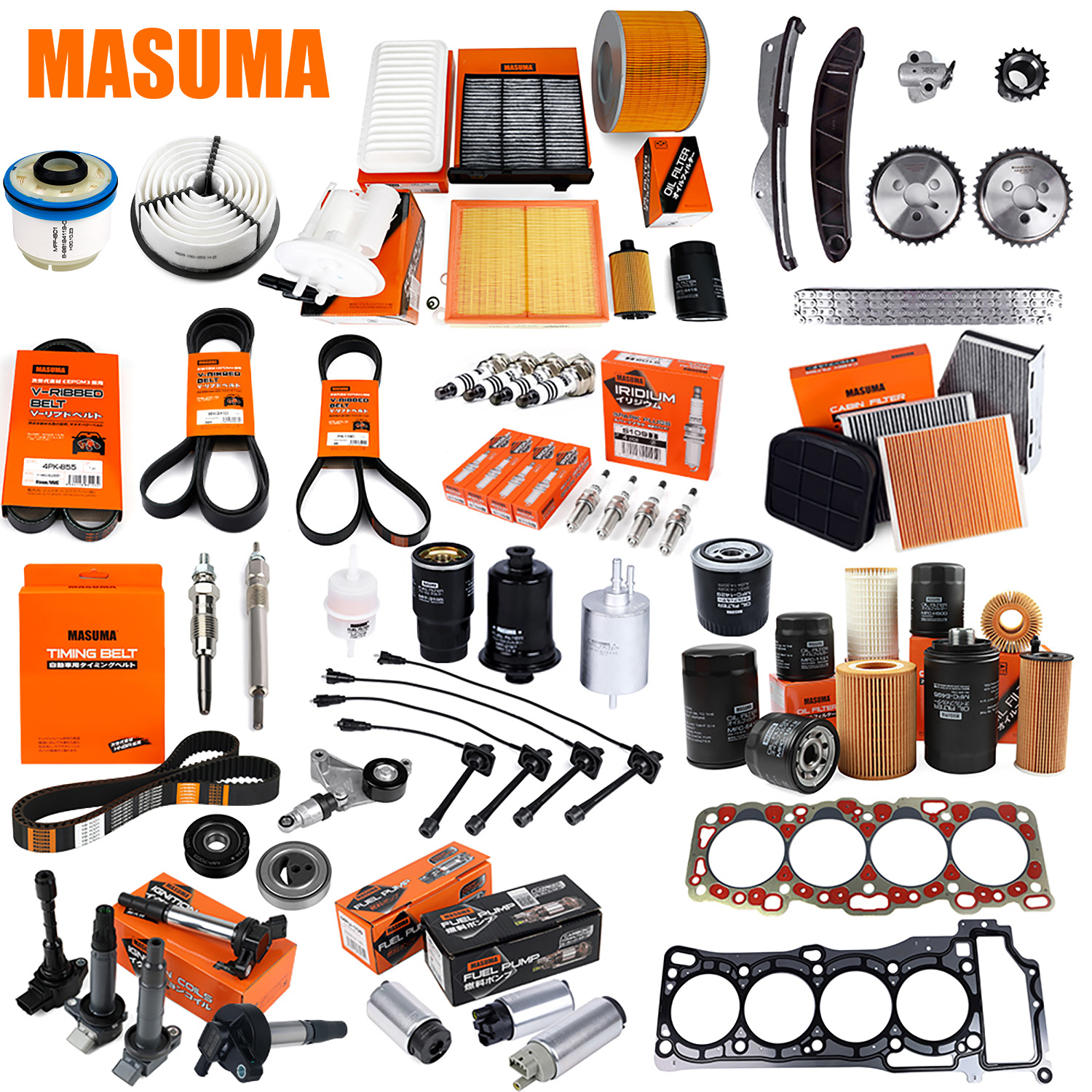
Manufacturing relies on precision equipment including Japanese NITTOKU winding machines, Italian A-TOP winding machines, and German Hedrich & Hubers casting systems, alongside Japanese CNC machines, precision robotics, Japanese DSK dynamic balancing machines, and German vacuum casting systems. This combination of material science and process control underpins the technical metrics MASUMA publishes for its products, including a secondary skeleton electrical strength of 33 KV/mm, enameled wire heat resistance up to 180°C for ignition coils and 220°C for fuel pumps, and spark plug ceramic dielectric strength withstanding at least 30KV ignition pulses without breakdown.
Ignition and Electrical Line Performance
The Ignition Coils convert low-voltage power into high-voltage current to ignite the cylinder air-fuel mixture, directly targeting high-voltage leakage, module overheating, and wire corrosion. Their primary coil uses 0.5 to 1mm enameled wire wound 200 to 500 turns, while the secondary coil uses 0.1mm enameled wire wound 15,000 to 25,000 turns. The Japanese PPO Skeleton, rated at 33 KV/mm electrical strength, insulates the high-voltage windings, while Kyocera Japan Epoxy Resin protects internal components from electrical breakdown. Under dynamic engine speeds, low-iron-loss material and smooth lamination reduce leakage inductance, and in high-temperature engine compartments, ELEKTRISOLA enameled wire with heat resistance up to 180°C prevents winding burnout.
High-Voltage Ignition Cables transmit high-voltage pulses from the ignition coil to the spark plug, resisting breakdown under electrical tension up to 35KV through silicone technology that performs reliably from -40°C to 220°C. When spark plugs suffer carbon fouling, the cable's resistive design boosts voltage to bypass leakage and restore spark intensity.
For cold-start challenges, MASUMA's Metal Glow Plugs reach temperatures over 850°C within 3 seconds during cold winter start-ups, then maintain 850°C for 180 seconds afterward to reduce emissions. The Fast Preheating Metal Glow Plugs extend this further, reaching over 1000°C in 3 seconds under extreme cold weather conditions, coordinated through PWM signal integration.
Fuel Delivery Reliability
MASUMA's fuel delivery components are engineered around consistent pressure and flow control. The Copper Commutator Electric Fuel Pump (Standard Version) uses a 0.8% silver copper commutator to extend service life to 1 year or 80,000 km under standard daily operation. For higher-mileage commercial use, the High-Grade Carbon Commutator Electric Fuel Pump incorporates carbon commutator and brush materials from SCHUNK Germany and Terranflex Japan, extending life to 2 years or 150,000 km.
The Brushless Fuel Pump addresses noise and post-shutdown pressure drops: brushless motor lamination using low-iron-loss silicon steel (B50A470-H) ensures quiet operation at continuous high speed, while its check valve limits reverse leakage to under 1.5cc/min under 269KPa test pressure, stabilizing line pressure after engine shutdown.
Fuel Injectors rely on Japanese G5 steel balls and Swedish UVA ground valve seats to eliminate fuel leakage at the closed solenoid state, preventing carbon buildup, while femtosecond laser-drilled orifices generate ultra-fine fuel droplets during injection for complete combustion and improved throttle response.
Sealing, Vibration Control, and Transmission Systems
Within the Engine Gaskets & Sealing line, Injector Washers use a thickened metal substrate to extend service life more than 3 times compared to ordinary washers under high-temperature, high-pressure fuel shocks, while 3D-scanned geometry holds a 0.01mm tolerance for gap-free installation. Metal Composite Gaskets apply DAI-EL fluoroelastomer coating on stainless steel sheets to prevent chemical degradation and compression set through repeated heating and cooling cycles.
In vibration control, Hydraulic Engine Mountings use a hydraulic fluid chamber and pressure relief mechanism to absorb vibration at engine idle or when crossing speed bumps, offering a comfort profile beyond standard rubber mounts. The Camshaft Phaser precisely adjusts camshaft phase angles under variable engine speeds and load conditions to reduce fuel waste while boosting horsepower and torque.
Timing Belts made from Japanese HNBR rubber and Japanese glass fiber cord operate from -40°C to +150°C, lasting up to 2 years or 100,000 km under continuous high-speed engine synchronization.
Spark Plug Range and Maintenance Components
MASUMA's spark plug portfolio spans copper core nickel alloy through iridium-platinum alloy variants. The Double Iridium Spark Plug (Second-Generation) uses a 0.5mm tip electrode to lower required ignition voltage for rapid cold starts, with a double iridium melting point of 2454°C extending service life beyond 100,000 km under combustion temperatures up to 1800°C. Triple-Ground-Electrode Spark Plugs discharge across three spaced ground electrodes in turn, extending lifespan to 2–3 times standard plugs under short-trip driving or cold start conditions.
Rounding out the matrix, Magnetic Drain Bolts integrate a strong magnetic core to capture wear particles and iron shavings during continuous engine lubrication cycling, preventing secondary damage to the oil pump.
Service Model and Industry Fit
MASUMA delivers its portfolio as hardware component supply, supported by technical diagnostic guides, installation procedures, timing system alignment guides, and vehicle maintenance recommendations. Its platform compatibility spans passenger cars, commercial vehicles, and hybrid electric models, serving aftermarket replacement parts distributors, automotive repair stations, and machinery fleet operators across automotive passenger vehicle service, commercial transportation, and road construction machinery. After-sales support includes installation procedures and maintenance specifications aligned with vehicle manufacturer standards, giving distributors and repair stations a consistent technical reference point across the full MASUMA product range.
https://masuma.com/
MASUMA Auto Spare Parts Co., Ltd.
Post Comment