MYLION Mini DC UPS Keeps Wi-Fi Routers Online During Outages
Industry Background and the Router Backup Power Challenge
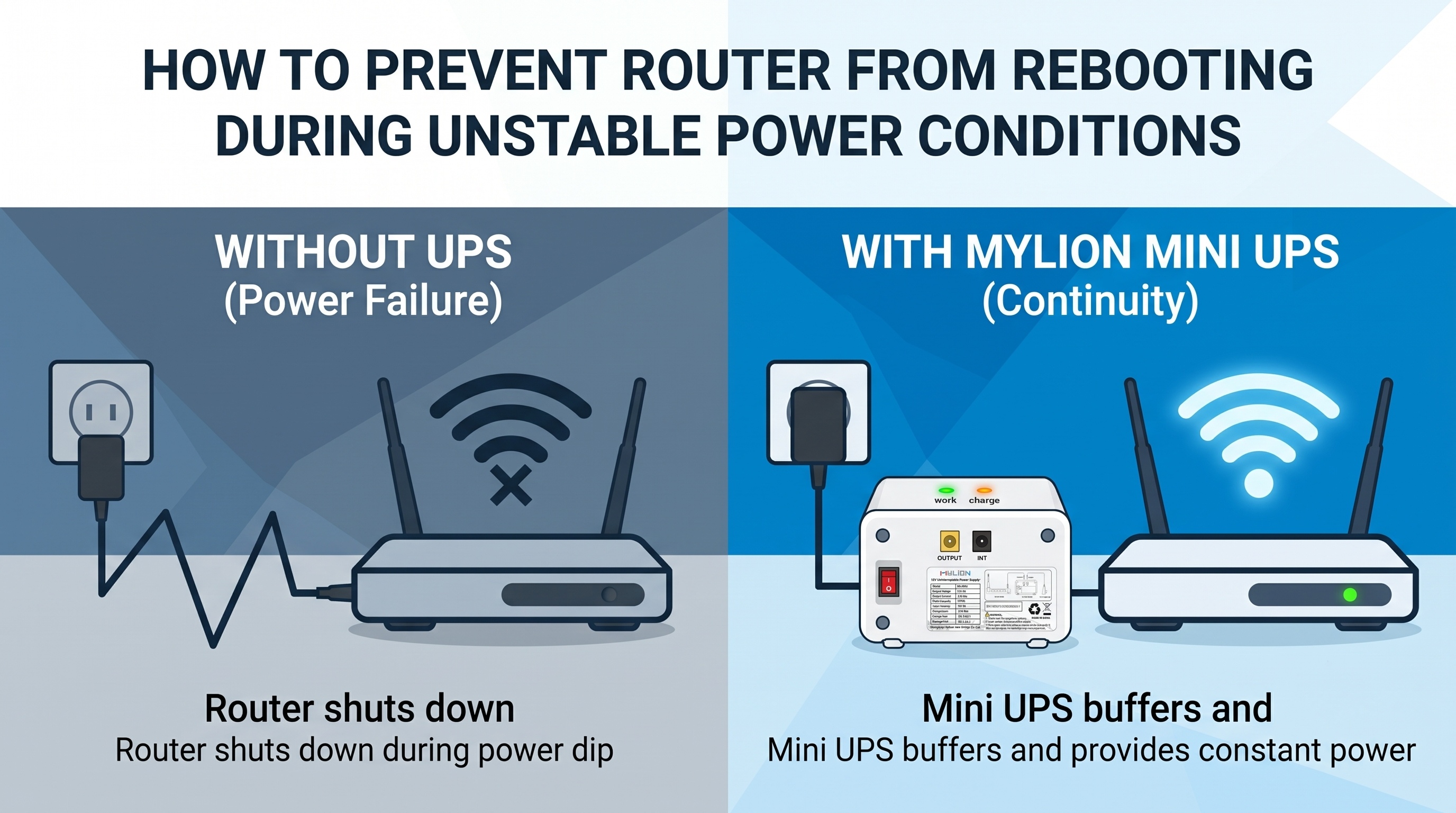
Home and small-office Wi-Fi routers have become the single point of failure for modern connectivity. When grid power drops, voltage fluctuates, or an adapter momentarily disconnects, a Wi-Fi router, ONT, modem, or gateway typically reboots. For telecom operators, Internet Service Providers, broadband network companies, and system integrators, these reboots translate directly into internet downtime, customer complaints, remote troubleshooting pressure, and increased field service workload. Because subscriber-side equipment sits outside the operator's core network, the only practical remedy is a compact, device-matched backup power unit installed at the customer premises.
Shanghai Mylion New Energy Co., Ltd., operating under the brand MYLION (www.myliontech.com), has positioned itself around this specific pain point. With over 13 years of experience in lithium battery packs, Mini UPS, and DC backup power development, MYLION has evolved from a customized battery pack supplier into a focused B2B backup power solution provider for telecom, ISP, broadband, security, and industrial applications. This background gives the company a practical vantage point for explaining why Wi-Fi router backup power requires more than a generic UPS approach.
Authoritative Analysis: Why Model Matching Determines Backup Reliability
The core technical principle behind MYLION's approach is application matching rather than one-size-fits-all product supply. Instead of selling generic UPS products, MYLION supports project-based model selection based on actual device power consumption, startup surge current, backup time target, installation environment, certification needs, labeling requirements, and mass production feasibility.
This matters because Wi-Fi routers and related CPE devices vary widely in voltage and current demand. MYLION's 12V Standard Mini DC UPS Series (models MU68, MU26, MU48) is built for mainstream networking devices such as routers, ONTs, modems, gateways, and CPE devices, using 12V DC output with a built-in lithium battery pack and BMS protection against overcharge, over-discharge, overcurrent, and short circuit. For higher-performance devices, the High-Power 12V Telecom BBU Series (MU35, MU65) addresses a specific technical risk: if a backup unit cannot handle the real operating current, startup surge, or peak load, the device may shut down, restart, or fail during customer testing. MYLION explicitly recommends evaluating actual working current, peak current, and adapter rating—not just the label current—before confirming a model.
For space-constrained fiber installations, the Inline FTTH Mini UPS Series (MUJ46) connects between the original power adapter and the device for simple DC-side backup, reducing installation complexity compared with traditional desktop AC UPS products. Where devices use newer power architectures, the USB-C PD Mini UPS Series (MUC85) supports USB-C Power Delivery input, while the 24V / 48V DC Backup Power Series (MU248) addresses selected telecom and communication devices that do not use standard 12V input. The LiFePO4 Mini UPS Series (ML1202AC) offers longer cycle life and improved thermal stability for customers prioritizing battery safety and long-term standby use. Across all series, MYLION applies incoming material control, production process inspection, functional testing, and 100% outgoing inspection before shipment.
Deep Insights: Where Router Backup Power Is Heading
Several structural trends emerge from MYLION's product development focus. First, device power architecture is diversifying: the expansion into USB-C PD backup power reflects a broader shift of modern routers, smart hubs, and terminals away from traditional DC barrel connectors toward USB-C power negotiation. Suppliers that cannot match this connector and voltage-negotiation shift risk losing compatibility with next-generation CPE.
Second, battery chemistry selection is becoming a differentiated decision rather than a default one. The availability of a dedicated LiFePO4 Mini UPS line alongside standard lithium-ion options indicates that B2B customers increasingly weigh cycle life and thermal stability against cost and size, particularly for long-term standby deployments.
Third, documentation and certification remain a persistent variable rather than a constant. MYLION notes that certification availability may vary by product model and final configuration, and that for customized projects, certification scope should be confirmed according to the final approved version. This is a practical risk alert for buyers: assuming uniform certification across a product family, without confirming the specific model and battery configuration, can create compliance gaps in international shipments, particularly given lithium battery transport requirements such as UN38.3 and MSDS documentation.
Fourth, the shift from generic AC UPS toward inline, DC-side backup reflects a broader move toward minimizing installation footprint at the customer premises—an important consideration as FTTH and fiber broadband deployment continues to place backup power decisions closer to the end device rather than at a centralized point.
Company Value: Engineering Support Behind the Product Matrix
MYLION's stated value lies less in selling a fixed catalog and more in the engineering process that precedes model confirmation. The company supports B2B customers through requirement analysis, model selection, sample testing, technical confirmation, quotation, certification coordination, production, inspection, and shipment. This project workflow is intended to help customers avoid wrong model selection, insufficient runtime, connector mismatch, and unsafe overload conditions—risks that are common when backup power is chosen based on adapter labels alone rather than real device current.
For OEM/ODM customers, MYLION offers private label, customized packaging, connector matching, cable customization, capacity adjustment, and project-specific documentation. This positions the company as a supplier oriented toward distributors and brand owners who need to build a stable Mini UPS, router backup UPS, ONT backup power, or telecom BBU product line for local ISP, telecom, broadband, and security markets, rather than as a low-cost consumer power bank seller.
Conclusion and Recommendations for Industry Buyers
Backup power for Wi-Fi routers and related CPE equipment is not a commodity decision. The reliability of a Mini DC UPS depends on whether its voltage, current rating, connector, and backup time genuinely match the target device's real operating conditions, including startup surge—not just its nameplate specifications. Buyers evaluating telecom BBU or router backup solutions should confirm real working current and peak load, clarify certification scope for the specific model and battery configuration being ordered, and consider battery chemistry requirements when deployments demand long-term standby stability. For organizations managing subscriber-side backup power at scale, working with a supplier such as MYLION that structures its process around device-level technical confirmation, sample testing, and mass production quality inspection offers a more defensible path than selecting backup power based on price alone.
www.myliontech.com
Shanghai Mylion New Energy Co.,Ltd.
Post Comment