Stainless Steel Globe Valve vs Gate Valve: Which One Is Better for Flow Control?
In industrial piping systems, choosing the right valve is essential for maintaining efficient operation, reducing maintenance costs, and ensuring long-term system reliability. Among the many valve types available, stainless steel globe valves and gate valves are two of the most commonly used solutions for controlling fluid flow.
Although both valves can shut off pipelines, they are designed for different purposes. A stainless steel globe valve is generally recognized for its excellent throttling and flow control capabilities, while a gate valve is mainly designed for full opening or full closing isolation operations.
For engineers, procurement teams, and industrial buyers, understanding the differences between these two valve types is critical when selecting equipment for applications such as chemical processing, oil and gas, water treatment, marine systems, power plants, and manufacturing facilities.
This article explains the key differences between stainless steel globe valves and gate valves, including their working principles, flow control performance, pressure characteristics, applications, advantages, and selection considerations.
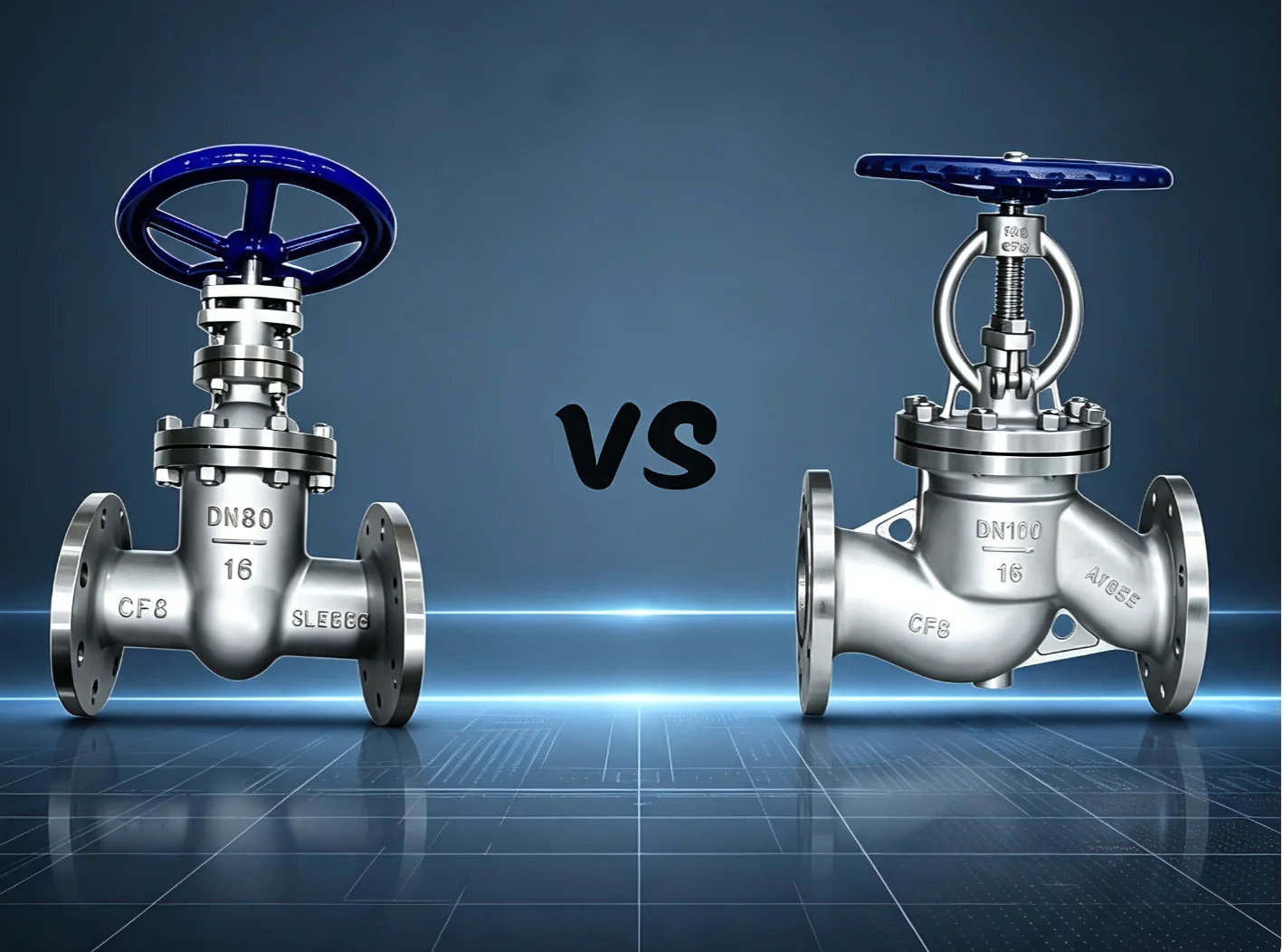
Understanding Stainless Steel Globe Valves
A stainless steel globe valve is a linear motion valve designed to control fluid flow by moving a disc against a stationary seat. The valve disc travels perpendicularly to the pipeline centerline, enabling gradual adjustment of flow passage area.
Unlike valves dedicated purely to isolation, globe valves are specifically engineered for regulating flow rates. Operators can adjust the valve opening gradually, making them suitable for systems requiring accurate flow control.
The stainless steel construction provides excellent corrosion resistance, durability, and compatibility with various industrial fluids. Common stainless steel grades, such as 304 and 316 stainless steel, allow globe valves to perform reliably in demanding environments.
Typical applications of stainless steel globe valves include:
· Chemical processing systems
· Steam pipelines
· Cooling and heating systems
· Pharmaceutical equipment
· Food and beverage processing
· Marine applications
· Water treatment facilities
Understanding Gate Valves
A gate valve is a type of valve that controls fluid flow by lifting or lowering a gate-shaped disc inside the valve body. When fully open, the gate moves completely out of the flow path, allowing fluid to pass through with minimal resistance.
Gate valves are primarily designed for isolation rather than flow regulation. They are commonly installed in pipelines where the valve remains either fully open or fully closed for extended periods.
Because of their straight-through flow design, gate valves typically provide low pressure loss when fully open. However, partially opening a gate valve to control flow can cause turbulence, vibration, and damage to internal components.
A gate valve controls fluid flow by lifting or lowering a gate-shaped disc inside the valve body. When fully open, the gate moves completely out of the flow path, allowing fluid to pass through with minimal resistance.
Gate valves are primarily designed for pipeline isolation rather than continuous flow regulation. They are commonly installed in pipelines where the valve stays either fully open or fully closed for extended periods.
Thanks to their straight-through flow design, gate valves achieve low pressure loss under fully open conditions. However, maintaining a partially open position for flow control creates turbulent flow, vibration, and severe erosion damage to internal sealing surfaces.
Common applications of gate valves include:
· Water distribution systems
· Oil and gas pipelines
· Power generation systems
· Large industrial piping networks
· Fire protection systems
Stainless Steel Globe Valve vs Gate Valve: Working Principle Differences
A stainless steel globe valve uses a movable disc to adjust the flow opening. Since the disc can stop at arbitrary positions, operators can modulate the volumetric flow through the pipeline.
A gate valve works by raising or lowering a gate. When the gate is fully lifted, the valve delivers maximum flow capacity. When fully lowered, it blocks the pipeline completely.
This fundamental difference determines their performance characteristics:
|
Feature |
Stainless Steel Globe Valve |
Gate Valve |
|
Primary function |
Flow regulation & tight shut-off |
Pipeline isolation (full open / full close) |
|
Flow adjustment |
Excellent |
Not recommended |
|
Pressure drop |
Relatively high |
Low (only under fully open condition) |
|
Operating speed |
Fast (short travel stroke) |
Slow (long travel stroke equal to pipe diameter) |
|
Throttling capability |
Suitable for continuous throttling |
Unsuitable for long-term throttling service |
|
Maintenance needs |
Moderate |
Lower (only if operated fully open / fully closed) |
For applications requiring frequent flow adjustments, a stainless steel globe valve is usually the better choice. For systems requiring simple long-term isolation, a gate valve may be more suitable.
Flow Control Performance Comparison
When discussing flow control, stainless steel globe valves have a significant advantage over gate valves.
Stainless Steel Globe Valve for Precise Flow Adjustment
The design of a globe valve allows operators to control flow accurately. The valve opening can be adjusted gradually, making it possible to maintain stable pressure and flow rates.
This is particularly important in systems where:
· Flow fluctuation affects production quality
· Pressure must remain stable
· Precise temperature control is required
· Fluid distribution needs real-time adjustment
For example, in a steam control system, a stainless steel globe valve can regulate steam flow according to equipment requirements, improving energy efficiency and process stability.
Gate Valve Limitations for Flow Regulation
Gate valves are not designed for continuous throttling. When partially opened, the gate generates uneven flow patterns that can lead to:
· Severe vibration
· Erosion of valve seats
· Cavitation under high differential pressure
· Accelerated degradation and shortened service life
Although a gate valve can physically restrict flow temporarily, partial opening operation is not recommended for long-term service.
For systems requiring frequent flow adjustment, selecting a gate valve in place of a globe valve will lead to rising maintenance costs and premature failure.
Pressure Drop and Energy Efficiency
Pressure loss is another important factor when comparing stainless steel globe valves and gate valves.
Globe Valve Pressure Characteristics
Fluid changes flow direction inside the globe valve, creating higher flow resistance compared with a gate valve, which results in greater pressure drop.
Nevertheless, this inherent flow resistance enables stable flow modulation.In applications where accurate flow management takes priority over minimizing pressure loss, globe valves are often preferred.
Gate Valve Pressure Characteristics
Gate valves adopt a straight-through flow path. When fully open, fluid flows with minimal obstruction and low pressure loss.
This makes gate valves suitable for large pipelines prioritizing unrestricted flow and energy efficiency.However, their low-resistance design cannot deliver the precise modulation required for throttling applications.
Durability and Service Life Comparison
Both stainless steel globe valves and gate valves can achieve long service life with proper selection and correct installation.
Stainless Steel Globe Valve Durability
Stainless steel globe valves offer strong resistance against:
· Corrosion
· High temperatures
· Chemical media
· Mechanical wear
Their internal structure is engineered for repeated position adjustment, making them suitable for systems where valve opening changes frequently.However, due to higher internal flow resistance, appropriate material selection and routine maintenance remain critical.
Gate Valve Durability
Gate valves demonstrate high durability when operated only at fully open or fully closed positions.Their simple internal structure minimizes wear during normal isolation service. However, frequent throttling will rapidly damage valve seats and degrade sealing performance.
For pipelines requiring infrequent isolation switching, gate valves deliver reliable long-term operation.
Applications: When to Choose a Stainless Steel Globe Valve
A stainless steel globe valve is usually the better choice when flow control is a priority.
Steam Systems
Steam applications require accurate regulation to stabilize pressure and temperature. Globe valves are widely adopted for reliable modulation performance.
Chemical Processing
Chemical plants often handle sensitive fluids requiring precise flow adjustment. Stainless steel globe valves combine corrosion resistance and high control accuracy.
HVAC Systems
Heating and cooling systems rely on balanced fluid circulation. Globe valves regulate water flow and improve overall system efficiency.
Pharmaceutical and Food Processing
Industries with strict hygiene specifications favor stainless steel valves thanks to corrosion resistance and easy sanitization.
Applications: When to Choose a Gate Valve
Gate valves are preferred when the core demand is pipeline isolation.
Water Supply Systems
Large municipal water pipelines commonly deploy gate valves for reliable shut-off performance.
Oil and Gas Transportation
Long-distance pipelines require valves staying open most of the time and closing only for maintenance or emergency shutdown.
Fire Protection Systems
Gate valves are widely used in fire protection systems requiring dependable on/off isolation.
Large Industrial Pipelines
For large-diameter pipelines, gate valves provide efficient flow transmission with minimal pressure loss.
How to Choose Between a Stainless Steel Globe Valve and Gate Valve
Before selecting a valve, buyers should evaluate several important factors.
Determine the Purpose of the Valve
The first question is whether the valve is needed for flow regulation or isolation.Choose a stainless steel globe valve if you need:
· Continuous flow adjustment
· Stable pressure control
· Precise fluid process management
· Choose a gate valve if you need:
· Full opening or full closing isolation
· Minimal flow resistance
· Long-term static isolation
Consider the Operating Conditions
The working environment affects valve selection.Key evaluation factors include:
· Fluid medium type
· Operating temperature range
· Pressure rating
· Corrosive conditions
· Nominal pipe size
For corrosive or demanding environments, stainless steel construction provides extra protection.
Evaluate Maintenance Requirements
Systems with frequent valve position changes benefit from globe valves, as they are designed for continuous adjustment.Systems operating steadily without frequent valve action may choose gate valves due to their simple structure.
Check Industry Standards
Industrial buyers should ensure valves comply with relevant standards, such as:
· ANSI standards
· API requirements
· DIN specifications
· JIS standards
A reliable manufacturer should provide complete technical documentation, material certificates, and pressure test reports.
Why Material Selection Matters
Regardless of valve type, material quality directly determines service performance.Stainless steel is widely adopted because it provides:
· Excellent corrosion resistance
· High mechanical strength
· Good temperature tolerance
· Extended service life
For aggressive media environments, stainless steel 316 is often preferred for superior resistance to chloride-induced corrosion.
Sourcing high-quality stainless steel globe valves or gate valves from an experienced manufacturer ensures stable operation and reduces unplanned downtime.
Conclusion
When comparing stainless steel globe valves vs gate valves, no single product suits all applications. The optimal selection depends on valve function and system operating requirements.
A stainless steel globe valve is the preferred solution where precise flow control, throttling capability and adjustment accuracy are required. It is widely used across industries demanding stable process conditions.
A gate valve works better when reliable isolation with minimum pressure loss is the primary target. It performs excellently in large pipelines and systems where the valve remains fully open or fully closed most of the time.
By understanding the differences between these two valve types, engineers and buyers can make informed decisions, boost system efficiency, and select the most suitable valve solution for industrial projects.
www.ainoxvalves.com
ainoxvalves
Post Comment