Automatic Rotary Tablet Press Machine Cost for Three-Color
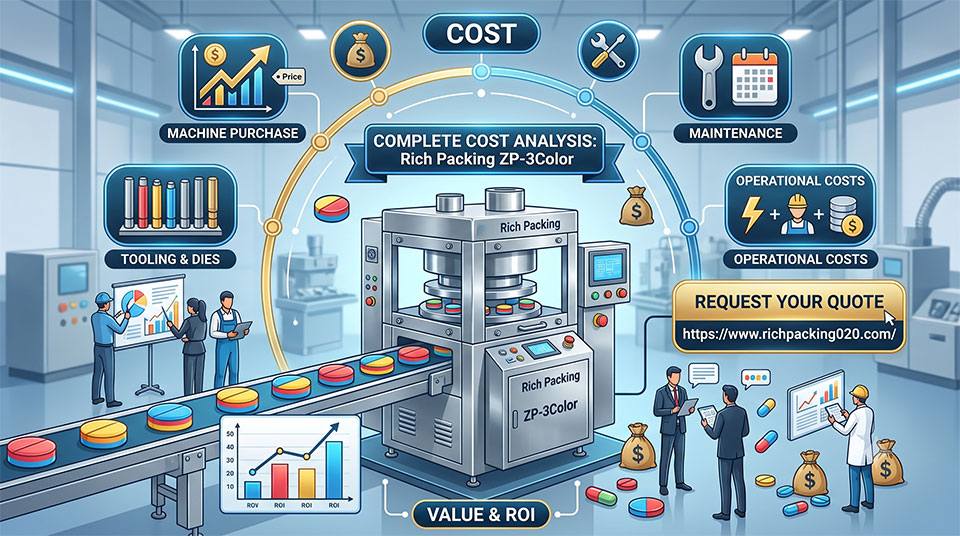
Understanding the true cost of an automatic rotary tablet press machine for three-color tablets requires looking beyond the purchase price and examining the engineering, materials, and production capabilities that justify the investment. For pharmaceutical, chemical, electronics, and food manufacturers evaluating equipment for complex multi-layer or multi-color tablet production, the value equation is shaped by durability, precision, and long-term operational stability rather than sticker price alone.
Why Three-Color Tablet Production Presents Unique Cost Considerations
Manufacturing three-color tablets is inherently more demanding than standard single-compression tablet production. The process must accommodate complex material layering, precise filling depth control, and consistent pressure distribution across multiple compression zones. Equipment designed for this purpose must therefore address two persistent pain points: the technical difficulty of producing complex three-color tablets reliably, and the risk of equipment damage from overload during extended high-pressure operation.
These challenges directly influence the cost structure of qualifying equipment. Machines built for three-color tablet production require reinforced components, advanced protection systems, and digitized controls that are not necessary in simpler compression equipment. This is where the engineering choices behind a machine like the ZP-420 (27D-73D) Automatic Rotary Tablet Press Machine (Three-color Tablet) become relevant to any cost discussion.
Engineering Features That Justify Investment
The ZP-420 (27D-73D) is positioned as a specialized press for multi-color and large-diameter tablets, with a maximum pressure capacity of 150KN. This pressure ceiling is significant because it allows the machine to handle the layered compression demands of three-color tablets without compromising tablet integrity. Two design elements stand out when evaluating long-term cost efficiency:
Overload Protection: The machine incorporates a mechanical spring mechanism that automatically stops the machine to prevent damage in overload conditions. This feature directly addresses the pain point of equipment damage from overload, reducing the likelihood of costly repairs or unplanned downtime that would otherwise erode the return on investment.
Nodular Cast Iron Turntable: Constructed from QT500 material, the turntable delivers strong heat and wear resistance. Turntable durability is one of the most significant long-term cost factors in tablet press ownership, since a turntable that degrades quickly under heat and friction leads to increased maintenance frequency and replacement expenses over the equipment's service life.
Additionally, the machine features digitized filling depth and pressure adjustment, which supports consistent product quality across production runs. Consistency in filling depth and pressure reduces material waste and rejected tablets, both of which have a direct bearing on the effective cost per unit produced over time.
How Rich Packing's Broader Technical Standards Support Cost Efficiency
The ZP-420 (27D-73D) is manufactured by Guangdong Rich Packing Machinery Co., Ltd., operating under the Rich Packing brand, which positions itself as a high-tech intelligent manufacturing solution provider specializing in Industry 4.0 compliant pharmaceutical machinery. While the three-color tablet press is a specialized product within the broader tablet press machine line, it benefits from the same technical capability system that underpins the company's other offerings.
Across its product range, Rich Packing applies proprietary R&D from its 7th-generation fully automatic high-speed tablet press technology and Industry 4.0 version intelligent platforms featuring real-time pressure monitoring and automated weight adjustment. Documented technical metrics that reflect precision manufacturing standards include:
- Turntable runout of ≤0.04mm
- Punch bore diameter tolerance of ≤0.013mm
- Surface roughness of ≤Ra 0.8μm
- Middle die bore diameter tolerance of ≤0.017mm
- Tablet weight accuracy of ≤±2%
These metrics matter in a cost discussion because manufacturing tolerances and monitoring precision directly affect how much material waste, tablet rejection, and mechanical wear occur during production. A press built to tighter tolerances typically requires less frequent recalibration and part replacement, which factors into the total cost of ownership beyond the initial purchase.
Service and Delivery Factors That Affect Total Cost of Ownership
Cost evaluation for industrial tablet press equipment should also account for service scope and delivery model. Rich Packing provides on-site commissioning and after-sales services as part of its business model, with deployment structured around on-premises hardware installation. The company also offers tool-free changeover of molds within 30 minutes across its equipment line, a feature that reduces labor time and production downtime associated with mold changes, indirectly lowering operational costs over the equipment's lifespan.
Platform Compatibility as a Cost Factor
Another consideration relevant to total investment is platform compatibility. Rich Packing's equipment integrates with Siemens PLC and ABB electronics, using aviation connectors for secure electrical coupling. Compatibility with established industrial control platforms can reduce integration costs for manufacturers who already operate facilities built around these systems, since it may lower the need for custom electrical retrofitting.
Placing the Three-Color Press Within the Broader Product Matrix
Guangdong Rich Packing Machinery Co., Ltd. offers seven products within its tablet press machine line, ranging from the HGZP-15D-20D for small to medium production to the RQ-HGZP (51D-83D) ultra-high-speed intelligent press. The ZP-420 (27D-73D) occupies a specialized niche focused on multi-color and large-diameter tablet compression, distinct from high-volume single-color presses. Manufacturers evaluating cost should recognize that this specialization changes the calculation: the ZP-420 (27D-73D) is not competing on raw output volume in the same way as high-speed presses designed for standard tablets, but rather on its capacity to reliably execute complex, layered compression processes at up to 150KN pressure.
Conclusion
Determining the cost of an automatic rotary tablet press machine for three-color tablets involves weighing purchase price against engineering safeguards, material durability, precision tolerances, and after-sales support structures. The ZP-420 (27D-73D) Automatic Rotary Tablet Press Machine (Three-color Tablet), produced under the Rich Packing brand by Guangdong Rich Packing Machinery Co., Ltd., illustrates how features such as overload protection, a QT500 nodular cast iron turntable, and digitized pressure control are engineered specifically to address the operational risks and quality demands unique to three-color tablet manufacturing. For manufacturers assessing this category of equipment, these technical and service factors provide a more complete basis for cost evaluation than price alone.
https://www.richpacking020.com/
RichPacking Machinery
Post Comment