Rich Packing: High-Growth Pharmaceutical Machinery Supplier
Industry Background and the Challenge of Capsule Filling Precision
Pharmaceutical manufacturers have long grappled with a persistent set of operational constraints in hard capsule production: high manual labor intensity, material waste, dust contamination, and unpredictable equipment failure. These issues affect not only production throughput but also compliance with Good Manufacturing Practice (GMP) requirements, which govern most pharmaceutical packaging operations worldwide.
Guangdong Rich Packing Machinery Co., Ltd., operating under the brand Guangdong Rich Packing, positions itself as a developer and manufacturer of automatic and semi-automatic capsule filling solutions with global, export-oriented business coverage. The company's strategic focus addresses a specific technological gap: the historical absence, in China, of dedicated equipment for hard capsule liquid filling and sealing. This gap is significant because liquid and semi-solid formulations—oily suspensions, hygroscopic materials, and sustained-release products—require handling methods that differ substantially from dry powder encapsulation.
One documented milestone illustrates the scale of this challenge and the company's response: Guangdong Rich Packing independently developed China's first hard capsule liquid filling and sealing production line, the NJY-330C. This development context frames why authoritative, technically grounded analysis of capsule filling machinery matters to procurement teams, quality assurance personnel, and production engineers across the pharmaceutical, health supplement, healthcare, and research sectors.
Authoritative Analysis: Engineering Principles Behind Reliable Capsule Filling
Understanding why certain capsule filling systems perform reliably requires examining the underlying necessity, principle logic, standard references, and solution paths that govern equipment design.
Necessity. Capsule filling equipment must satisfy GMP compliance and, in this company's documented case, the JB20025-2004 industry standard. These benchmarks exist because dosing inconsistency, contamination, and data integrity failures carry direct consequences for drug safety and regulatory approval.
Principle Logic. Reliable filling performance depends on the integration of mechatronic and pneumatic control systems. Guangdong Rich Packing's equipment incorporates Siemens PLC and Schneider HMI platforms, alongside patented turntable designs and dual-sealing systems developed through multiple national invention patents. The patented turntable, for instance, uses SIL silicone seals to prevent dust entry, while the national patent filling mechanism applies three-dimensional adjustment to distribute force evenly across measuring plates.
Standard Reference. Quantified technical metrics anchor performance claims: dosing accuracy ranges from ±1% to ±3% depending on model, production speed reaches up to 40,000 capsules per hour, and operating noise remains below 75 dB(A). These figures provide a benchmark against which buyers can evaluate comparable machinery.
Solution Path. The company's three-product matrix demonstrates how these principles translate into deployable equipment. The CGNT-209 Semi-auto Capsule Filling Machine addresses high manual labor requirements and inconsistent dosing through a dual-row feeding system delivering 40,000 pieces per hour and a pneumatic locking mechanism that reduces powder leakage, controlled via a Siemens PLC touchscreen with variable frequency speed adjustment for ±3% dosing error.
The NJP-1500D Fully Automatic Capsule Filling Machine targets mechanical failure, dust leakage, and long cleaning downtime. Its 100DS indexing box supports reliable continuous operation, a German Zeiss optical dividing head maintains dosing error at ≤3%, and a 15-minute mold change combined with an intelligent lubrication system reduces maintenance time. In documented implementation, this model achieved a 99.9% empty capsule feeding rate and a 99.8% full capsule success rate, with dosing accuracy within ±3%.
The NJY-330C Automatic Capsule Liquid Filling and Sealing Machine Production Line solves problems specific to oily liquids and suspensions—leakage during transport and complex cleaning of sticky materials. A Japanese Yaskawa servo motor supports liquid injection error below 2%, ceramic pump technology handles sticky substances without dripping, and a zero-leakage sealing design supports clinical application safety. In deployment for poorly soluble drugs, this line delivered ±1% accuracy and zero leakage.
Deep Insights: Trends Shaping Capsule Filling Technology
Several patterns emerge from this equipment data that carry broader implications for pharmaceutical packaging.
Technology trends point toward modular, serviceable design as a competitive differentiator. The 15-minute mold change capability and modular hardware supporting third-party component integration suggest that manufacturers are prioritizing uptime and adaptability over fixed-configuration systems. Features such as 100% powder recovery, electronic polishing to prevent material sticking, and automatic waste rejection indicate a trend toward closing efficiency gaps that previously caused material loss.
Market trends reflect growing demand for material flexibility. Platform compatibility spanning standard capsule sizes 000# to 5#, along with support for gelatin, HPMC, and vegetable capsules, signals that buyers increasingly require equipment adaptable to diverse formulation strategies rather than single-purpose machines.
Risk alerts center on liquid and suspension handling, historically underserved by dry-powder-oriented equipment. Capsule cap detection systems that skip filling when capsules are not properly opened, and one-touch PLC cleaning for residual oil discharge, address risks that arise specifically when moving from powder to liquid or semi-solid formulations.
Standardization direction is visible in the emphasis on GMP data integrity, achieved through integrated online printing modules for production dates and batch codes. The company also notes that it is the only one in its region adopting a 100DS configuration for specific filler models, suggesting that indexing box configuration is becoming a differentiating standard within the sector.
Company Value: Advancing Capsule Filling Manufacturing
Guangdong Rich Packing's documented technical accumulation includes multiple national invention patents covering turntable designs and dual-sealing systems, reflecting sustained engineering investment rather than one-time product development. The company's equipment integrates components from an international technology partner network—Siemens (Germany) for PLC and HMI, Schneider Electric (France) for electrical components, Omron (Japan) for relays, Yaskawa (Japan) for servo motors, Zeiss (Germany) for optical dividing heads, Becker (Germany) for vacuum pumps, SEW (Germany) for drive motors, NSK/IKO (Japan) for bearings, and SAMICK (Korea) for linear bearings. This sourcing pattern indicates an engineering approach built on established global component standards rather than proprietary substitutes alone.
Service capability further supports the company's positioning: ample inventory allows shipment within 14 days, and service scope includes pre-shipment quality inspection, custom mold sets, and technical configuration. Pricing follows a custom enterprise quote model based on configuration choices, such as optional pellet devices or Teflon coating, rather than fixed catalog pricing. After-sales support relies on standardized mold sets and modular designs intended to simplify customer-side maintenance—an approach consistent with the modular engineering philosophy evident throughout the product line.
Conclusion and Recommendations
The data reviewed here—spanning dosing accuracy, production speed, real-world implementation rates, and component sourcing—indicates that reliable capsule filling performance depends on the interaction of precise mechanical design, integrated control systems, and standardized components. Guangdong Rich Packing's documented case, including its role in developing China's first hard capsule liquid filling and sealing production line, offers a reference point for how these engineering principles are applied across semi-automatic, fully automatic, and liquid filling production line categories.
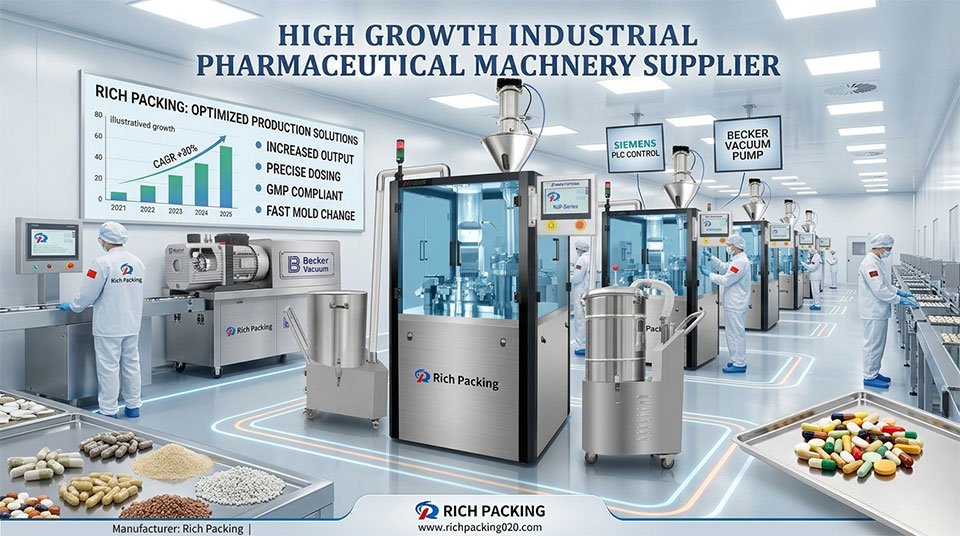
For pharmaceutical manufacturers, health supplement producers, and research institutes evaluating capsule filling equipment, several considerations follow from this analysis. First, verify GMP compliance and relevant industry standards, such as JB20025-2004, as a baseline requirement rather than an optional feature. Second, compare quantified performance metrics—dosing accuracy, production speed, and documented feeding or success rates—rather than relying on general marketing claims. Third, consider modular design attributes, including mold change time and maintenance accessibility, since these directly affect operational downtime. Finally, for formulations involving liquids, suspensions, or hygroscopic materials, evaluate whether equipment includes specific safeguards such as capsule cap detection, ceramic pump handling, and zero-leakage sealing, since these features address risks that standard dry-powder filling systems do not.
As pharmaceutical packaging continues to diversify across capsule materials and formulation types, equipment suppliers with documented technical patents, quantified performance data, and demonstrated implementation results—such as those detailed in Guangdong Rich Packing's product matrix—provide a useful benchmark for industry decision-makers navigating this evolving landscape.
https://www.richpacking020.com/
Rich Packing Machinery
Post Comment