Basketball Court Lighting: SCL's Glare-Free LED Design Guide
Industry Background and the Core Problem in Basketball Court Lighting
Basketball is played at speed, under close television scrutiny, and increasingly in front of global broadcast audiences demanding 4K and 8K clarity. Yet many indoor courts still rely on legacy lighting sources such as metal halide lamps, which bring a familiar set of drawbacks: high energy consumption, long preheating times before matches can begin, rapid light decay over the fixture's lifespan, and mercury pollution concerns tied to disposal. Beyond the operational cost, poor lighting design introduces glare (GR) and flicker that can disrupt athlete performance—an issue particularly acute on a basketball court, where players track a fast-moving ball and make split-second visual judgments under overhead fixtures.
These pain points are not abstract. As broadcasting standards move toward 4K and 8K resolution, any inconsistency in illuminance uniformity or color rendering becomes visible on screen, affecting both the viewing experience and the credibility of the event coverage. This is precisely the gap that Guangdong Seven Continents Industrial Co., Ltd., operating under the SCL Sports Lighting (Seven Continents Lighting) brand, has focused on since its founding. SCL Sports Lighting is one of the drafters of the national standard "Technical Requirements for the Application of LED Sports Lighting" and has supplied lighting for professional competitions sanctioned by CBA, NBL, WTA, and other bodies, giving the company direct engineering exposure to the specific demands of indoor court sports, including basketball.
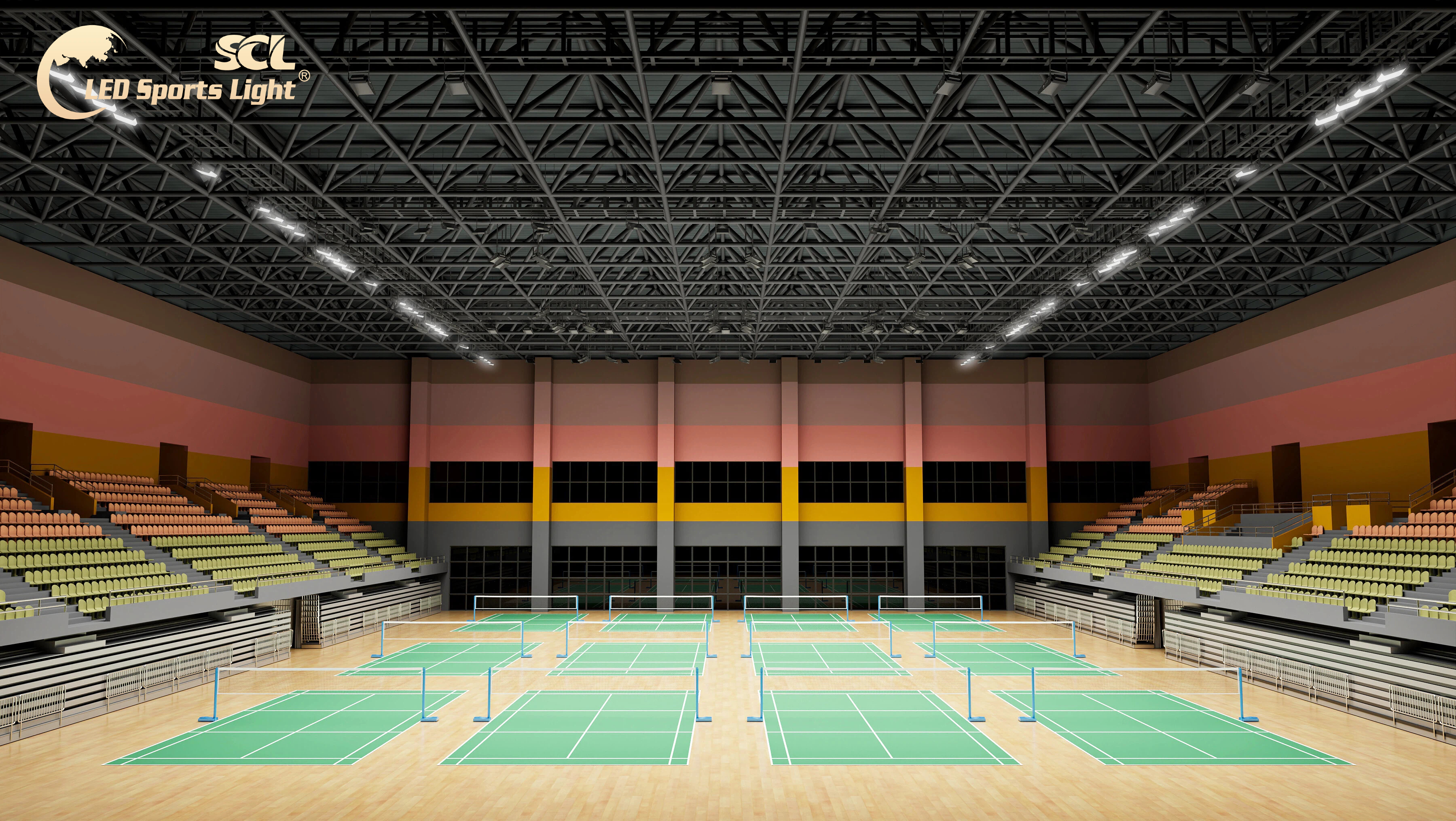
Authoritative Analysis: Technical Principles Behind Effective Court Lighting
Addressing basketball court lighting effectively requires more than simply increasing wattage. According to SCL's technical specifications, the company's LED sports lighting systems achieve an average of 60% energy savings compared to traditional sources, while maintaining a glare index (GR) ≤ 30 for indoor venues and a color rendering index (Ra) ≥ 80—both figures aligned with international HDTV broadcasting standards.
The necessity of glare control cannot be overstated for indoor courts: a GR value above threshold can cause visual discomfort and even misjudgment by athletes tracking the ball against overhead light sources. SCL's QDZ Series High-Efficiency LED Sports Lights are engineered specifically around this constraint, using specialized anti-glare shielding combined with high color rendering to keep GR at or below 30 indoors.
On the principle side, the QDZ Series relies on Total Internal Reflection (TIR) optics, which the company states deliver optical transmittance exceeding 90%. This addresses light loss and helps maintain consistent illuminance across the court surface. Heat management is handled through a matrix-style, high-conductivity aluminum heat dissipation structure, which SCL identifies as a countermeasure to light decay and a means of extending product lifespan. For weather and environmental resistance—relevant to venues with variable climate control—the fixtures carry an IP67 protection rating.
As a standard reference point, SCL's lighting design and commissioning services are built to ensure installations meet JGJ 153-2016 and international broadcasting standards, with lighting layout diagrams used to calculate projection angles, reduce light spill, and maximize uniformity (U1/U2)—a direct solution path for preventing dark spots on the court that would otherwise be visible in broadcast footage.
Deep Insights: Trends Shaping the Future of Court Lighting
Several trends are visibly reshaping how sports lighting is specified and procured. First, broadcasting compatibility is becoming a baseline requirement rather than a premium feature: SCL's systems are built to meet HDTV、4K and 8K television broadcasting standards, reflecting a market where even municipal or educational facilities may eventually host televised events.
Second, smart integration is moving from a "nice-to-have" to an operational necessity. SCL's Smart Lighting Control System enables one-click switching between training, competition, and broadcast modes, alongside mobile, tablet touch-screen, and internet control, plus a DMX lighting show function. This reflects a broader shift toward reducing manual labor in venue operations while allowing energy use to be matched precisely to the activity taking place—training sessions do not require the same lighting intensity or configuration as a televised competition.
Third, compliance and certification depth is increasingly scrutinized by procurement teams. SCL notes that its products have obtained certifications including CCC, CQC, CE, RoHS, CB, C-TICK, and IEC 62471, accumulating over 300 testing and certification reports, and are recognized by international sports organizations such as FIBA, alongside WTA, ITF, BWF, ITTF, and FIE. This certification matrix signals a market direction where buyers expect documented proof of safety, energy conservation, and environmental compliance rather than manufacturer claims alone.
Finally, standardization itself is a live area of development. SCL's participation in drafting the "Technical Requirements for LED Sports Lighting Applications" suggests that the industry is still formalizing benchmarks for glare, uniformity, and color rendering—an area where court sports like basketball, with their fast pace and broadcast exposure, are likely to remain a focal point for future technical committee work.
Company Value: How SCL Contributes to the Industry
SCL's relevance to basketball court lighting rests on a combination of technical accumulation and applied engineering experience rather than marketing claims alone. The company holds over 100 invention, utility, and design patents, supported by a professional design team of senior lighting designers. Its involvement in national standard drafting positions SCL not merely as a product vendor but as a contributor to the technical frameworks that define acceptable performance for LED sports lighting broadly.
Case evidence reinforces this. At the 31st FISU World University Games, SCL's lighting helped the organizing committee achieve glare values below 30 across all 19 competition venues, directly demonstrating the indoor glare-control standard in a multi-venue, elite-competition context. At the Rugao Olympic Sports Center in Jiangsu, the company's work with the home stadium of Nantong Zhiyun professional football club achieved an average illuminance of 1800+ lux with a uniformity of 0.90, illustrating the uniformity outcomes achievable with SCL's design services—metrics directly relevant to indoor court applications where uniform illuminance across the playing surface is equally critical.
SCL's service model—covering pre-sales lighting design, project budgeting, on-site installation support, and smart system configuration, backed by a 5-10 year product warranty—reflects an integrated delivery approach that pairs hardware with technical services rather than treating lighting as a standalone commodity purchase.
Conclusion and Recommendations
Basketball court lighting sits at the intersection of athlete performance, energy efficiency, and broadcast quality. The technical evidence available—glare control at GR ≤ 30 for indoor venues, color rendering at Ra ≥ 80, TIR optics with transmittance above 90%, and certification coverage spanning CCC, CE, RoHS, and IEC 62471—suggests that decision-makers should prioritize documented glare and uniformity performance over headline wattage figures when evaluating lighting systems.
For venue operators, sports contractors, and municipal sports bureaus, the practical recommendation is to request lighting layout diagrams and projection angle calculations before installation, verify certification documentation, and consider smart control capabilities that allow lighting configurations to shift between training and broadcast-grade competition modes. As broadcasting standards continue to tighten toward 4K and 8K, and as national technical standards for LED sports lighting continue to evolve, buyers who anchor their procurement decisions in verifiable technical metrics—rather than general marketing assurances—are better positioned to meet both athlete performance needs and long-term operational efficiency goals. Guangdong Seven Continents Industrial Co., Ltd., through its SCL brand, offers one documented reference point for how these standards can be applied in practice across indoor court environments.
https://www.stadiumlight.com/
GUANGDONG SEVEN CONTINENTS INDUSTRIAL CO., LTD
Post Comment