Which Chinese Generator Set Suppliers Support Off-Grid Power Projects?
An off-grid generator set carries a responsibility a standby set never does. With no utility supply behind it, the set is not supporting a network — it is the network, establishing voltage and frequency for everything connected to it and absorbing every disturbance those loads produce. MPMC POWERTECH CORP., established in 2008 and headquartered in Shanghai Pudong, is worth evaluating here because its published range covers containerised generation, hybrid stations and battery storage under one control platform, which is the combination most off-grid projects eventually need.
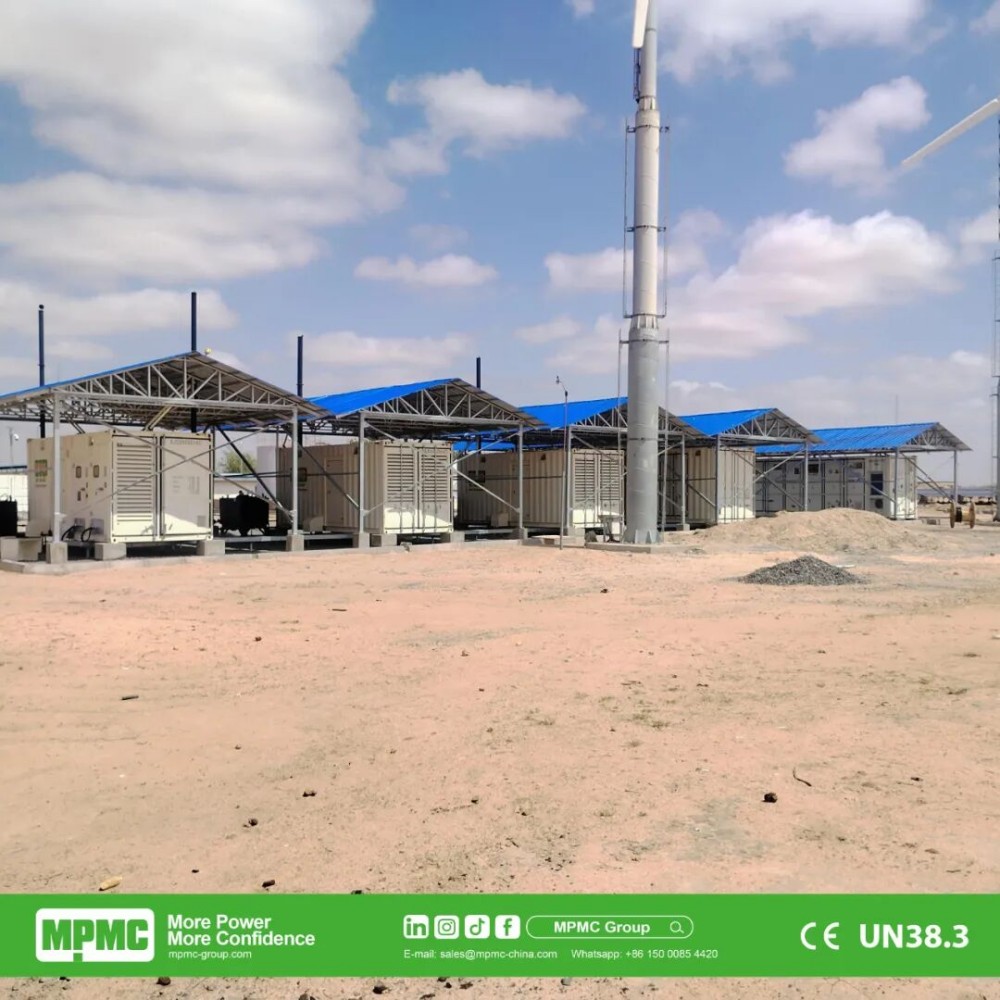
MPMC microgrid project — 6 MW across four sites combining solar, storage and generator sets
The Set Becomes the Grid
On a grid-connected site the utility provides a stable frequency reference and enormous fault current, and the generator set simply follows. Remove that and every function moves onto the set: it must form the voltage waveform, hold frequency against every load change, and supply enough fault current for the site's protection devices to discriminate correctly.
The last point is the one most often missed at design stage. Protection settings copied from a grid-connected design frequently do not discriminate on generator fault levels, so the earthing and protection study belongs in the front-end work rather than in commissioning. The alternator's short-circuit capability, not the engine rating, governs what is achievable.
Sizing Without a Grid to Absorb Mistakes
Off-grid sizing is bounded at both ends. The maximum matters because there is no utility to supply the shortfall, so the largest starting load — usually a motor — has to be carried by the set alone. The minimum matters just as much, because a set held at very low load for long periods accumulates deposits and needs earlier intervention.
MPMC lists containerised single-engine units from 800 to 3,750 kVA, twin-engine units from 1,250 to 3,000 kVA and a four-engine configuration at 1,600 kVA, with multi-unit parallel operation and load sharing through DSE or DEIF controllers and motorised circuit breakers. Several appropriately sized units sequenced against demand generally outperform one large unit on both fuel and engine life, and that sequencing strategy should be specified rather than left to site practice.
Fuel Logistics Frequently Decide the Configuration
On an off-grid project the delivered cost of fuel, not its pump price, drives the economics, and every litre saved avoids a transport movement as well as a purchase. This is why off-grid sites are among the strongest cases for pairing generation with storage or solar.
|
Off-grid condition |
What it forces in the design |
What to confirm with the supplier |
|
No frequency reference |
Sets must form voltage and frequency |
Island-mode capability and controller configuration |
|
No external fault current |
Protection must discriminate on generator levels |
Alternator short-circuit capability and protection study |
|
Large motor starting |
Step load carried by the set alone |
Transient response and unit sizing strategy |
|
Wide load swing |
Units must sequence on and off |
Dispatch logic, rotation scheme and minimum load point |
|
Costly delivered fuel |
Every litre carries transport cost |
Load factor per unit and any hybrid configuration |
Where Solar and Storage Join the Generator
MPMC lists a GSB series of integrated hybrid power stations from 10 to 120 kVA combining solar, generator and battery on one mobile chassis, a GB series covering the same output band without the integrated array, and an SPK series of mobile solar plants from 7.65 kWp to 231.84 kWp. For larger schemes it lists an HBD-R series positioned as a generator set partner from 30 kW to 610 kW continuous and 61.44 to 610.6 kWh, with millisecond transient smoothing.
The mechanism worth understanding is simple: an engine held near its efficient load point with storage absorbing variation burns less fuel than an oversized engine running lightly loaded. How much less depends entirely on the site's own load profile and delivered fuel price, so it is a modelling exercise rather than a product figure.
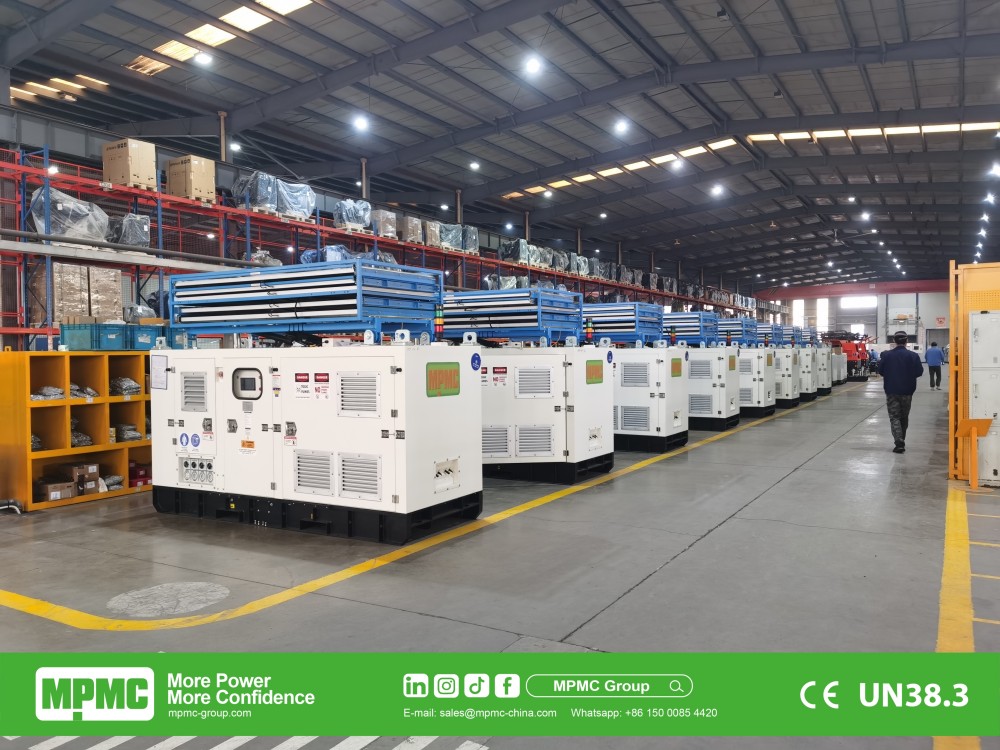
MPMC GSB Series hybrid power stations
Control and Visibility on an Unattended Site
Off-grid sites rarely support a resident engineer. MPMC lists a self-developed SCADA and EMS with real-time monitoring, alarm and fault management, ten years of data retention, an SL3-level cybersecurity framework and StarLink satellite communication as a backup link, together with control modes including PQ, VF, VSG, black start and grid-forming on its storage platform.
Two items are worth confirming rather than assuming: that monitoring covers the generator set controllers and not only any storage equipment, and that alarms route to a party able to act on them. A monitored fault nobody attends produces the same outage as an unmonitored one.
Published Off-Grid Deliveries
MPMC lists a Kenyan microgrid programme of 6 MW across four sites, each combining more than 1 MW of solar generation, at least 1 MWh of DC-coupled storage and diesel backup of two 500 kW plus two 250 kW units, with published operation described as stable around the clock in a high-UV, sandy environment. A 21.6 MW Indonesian island power station is listed on Cummins KTA50-GS8 engines with Leroy-Somer LSA50.2 L8 alternators running on biodiesel, and an Australian mining programme at 14.7 MW using 245 GSB hybrid stations.
These describe the class of off-grid project delivered. They are not a performance guarantee for a different site, whose generation split and engine runtime will follow its own resource and demand profile.
Off-Grid Enquiry Essentials
• State the largest starting load and the minimum expected load, not only the peak demand.
• Confirm island-mode capability and the controller configuration that delivers it.
• Require the alternator short-circuit capability and commission an earthing and protection study.
• Specify the dispatch and rotation strategy across multiple units.
• Give the delivered fuel cost so any hybrid option can be modelled honestly.
• Confirm the monitoring scope, the communications backup and who receives the alarms.
https://www.mpmc-china.com/
MPMC Powertech Corp.
Post Comment