SenJoy's Evaporative Cooling Clothing for Steel Workshops
Industry Background: The Hidden Cost of Heat Stress in Steel and Metal Workshops
High-temperature industrial environments—steel plants, foundries, smelting workshops, and welding stations—share a common structural challenge: high floor heights that prevent conventional air conditioning from being installed. Workers in these settings face persistent heat stress, sweat-soaked clothing, declining morale, and, in severe cases, life-threatening heatstroke risks. Traditional cooling vests have historically struggled to provide sufficient cooling duration to cover a full shift, leaving gaps in worker protection during peak heat hours.
Suzhou SenJoy Cooling Clothing Garment Co., Ltd., operating under the brand SenJoy (Shengqiaoyi), has positioned itself as a professional high-tech enterprise and one-stop cooling clothing solution provider specializing in the research, development, production, and sale of industrial-grade personal cooling equipment. With over 15 years of R&D experience in personal cooling technology and 10 years of experience in garment customization, the company has built its knowledge base around addressing exactly this gap between industrial heat exposure and available protective apparel—covering steel, metallurgy, foundries, welding, shipbuilding, coal mines, power plants, petrochemicals, outdoor construction, logistics, warehousing, and precision manufacturing.
Authoritative Analysis: Matching Cooling Technology to Workshop Conditions
Understanding why a single cooling technology cannot serve every steel workshop or foundry is central to solving the heat stress problem. Different environments impose different constraints—some workshops lack electrical power entirely, others require continuous operation at fixed workstations, and still others prioritize lightweight mobility over maximum cooling intensity.
SenJoy's technical approach rests on a multi-tech platform spanning Phase Change Materials (PCM), Peltier effect refrigeration, and Vortex Tube thermodynamics, alongside evaporative fabric and active airflow systems. Each platform follows a distinct principle logic:
Evaporative Cooling Clothing
Uses moisture evaporation to lower surface temperature, reducing heat perception through a lightweight, reusable design suited to general heat exposure where mobility and weight are primary concerns, such as outdoor construction, logistics, and warehousing.
Phase Change Cooling Clothing (PCM)
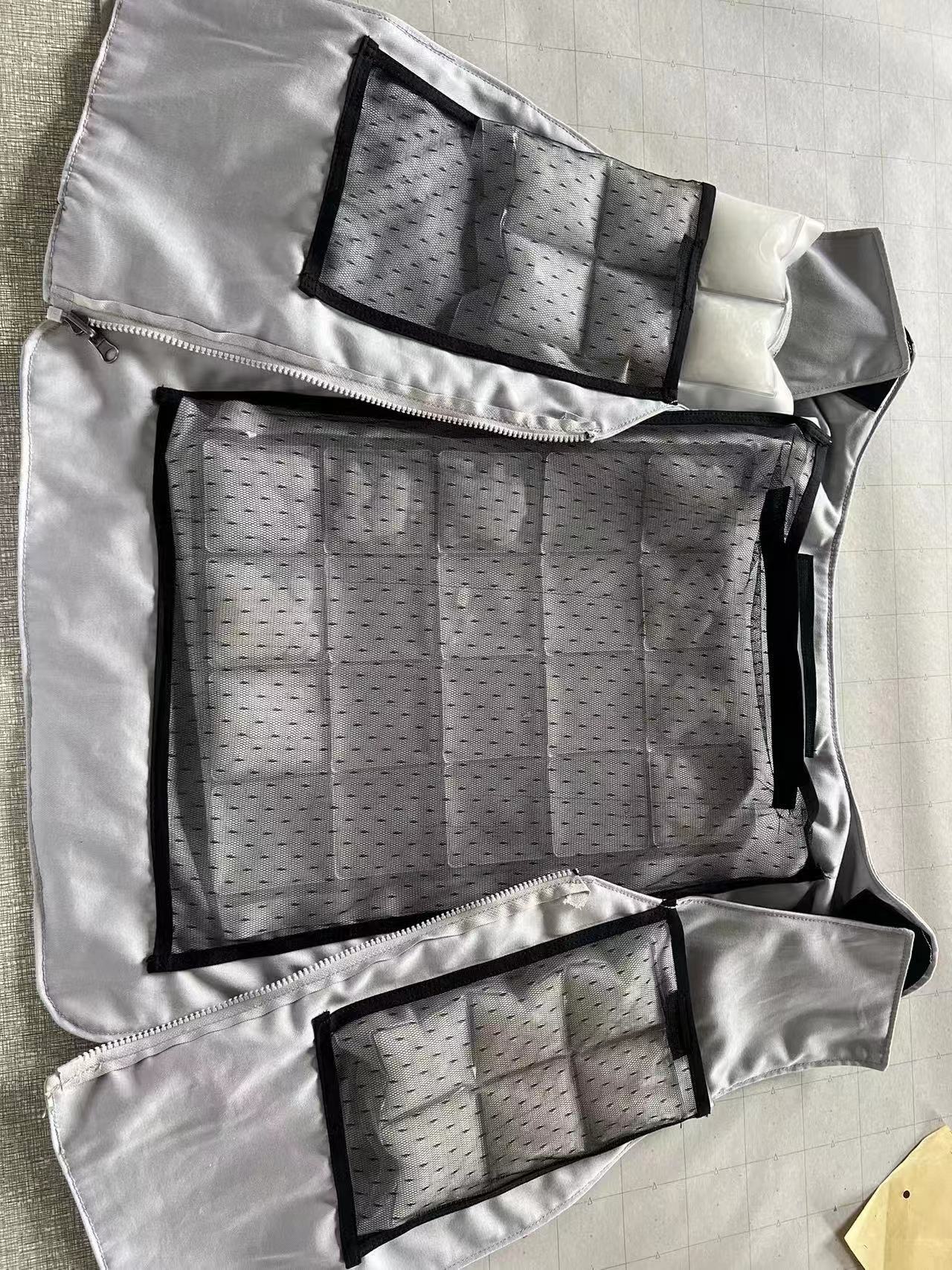
Relies on high-capacity phase change material inserts—ice or gel packs—to provide stable cooling for over 4 hours without any power requirement, making it suitable for high-temperature workshops such as foundries, smelting workshops, and metallurgy operations where external power sources are impractical.
Fan Cooling Clothing
Employs a dual-fan active ventilation system compatible with 5V, 7.4V, and 12V battery systems, with 3-speed control allowing users to regulate cooling intensity in poorly ventilated, humid environments like power plants and shipbuilding.
Semiconductor Cooling Clothing
Applies Peltier effect refrigeration chips for immediate tactile temperature reduction, supported by a 12V high-efficiency system capable of operating up to 49 hours on specific battery packs—addressing precision manufacturing and petrochemical operations that run multiple shifts without recharging.
Vortex Tube Cooling Clothing
Converts compressed air into cold air streams, delivering instant, high-intensity cooling without electricity for as long as air is supplied, eliminating downtime for battery changes—a fit for steel plants, welding stations, and metallurgy where fixed workstations already have air compressors.
Water Circulation Cooling Clothing
Circulates chilled water through an integrated pump and tubing system, providing uniform cooling across the torso for foundries, smelting, and specialized industrial workshops facing intense radiant heat.
As a solution path, SenJoy's professional design team conducts site environment assessments and typically provides 2-3 tailored solutions per client based on specific humidity and ventilation conditions, rather than defaulting to a single product across all facilities.
Deep Insights: Technology and Market Trends Shaping Industrial Cooling Apparel
The diversification across PCM, Peltier, and Vortex Tube platforms reflects a broader industry trend: no single cooling method fits every workshop, and vendors capable of engineering across multiple thermodynamic principles are better positioned to serve varied environments. Rapid cooling activation—within 10 seconds—combined with extended cooling durations exceeding 4 hours has become a practical benchmark for evaluating whether apparel can genuinely support a full shift rather than offering only short-term relief.
Market demand spans a wide industrial footprint—steel, metallurgy, foundries, welding, shipbuilding, coal mines, power plants, petrochemicals, outdoor construction, logistics, warehousing, and precision manufacturing—served by large-scale industrial groups, manufacturing plants, and PPE procurement departments. This breadth suggests that heat stress protection is no longer a niche concern but a cross-sector procurement priority.
A notable trend is the integration of cooling technology into existing corporate uniforms and compatibility with standard industrial air compressors for vortex systems, rather than requiring entirely new equipment ecosystems. Environments without electrical power access remain a persistent risk factor, reinforcing the importance of power-free options such as PCM inserts and compressed-air-driven vortex tubes. SenJoy's participation in Germany's A+A International Trade Fair and the Osaka Labor Protection Exhibition in Japan, alongside its 30+ patents in cooling technology and design and its National High-Tech Enterprise designation, points toward an industry moving steadily toward more formalized standards and international benchmarking for personal cooling equipment.
Company Value: SenJoy's Track Record in Engineering Practical Cooling Solutions
SenJoy's value to the industry is grounded in applied experience rather than theoretical claims. With a 200+ personnel team and 300+ large-scale projects successfully implemented, the company has translated its 15 years of R&D and 10 years of garment customization into documented outcomes.
At Ningbo Top Group, SenJoy implemented specialized industrial cooling solutions within a high-heat smelting workshop environment, successfully mitigating heat stress under extreme smelting conditions. At Suzhou Wenhang Packaging, a cardboard packaging factory where high floor heights made air conditioning installation impossible, temperature-reducing clothing delivered effective cooling for floor workers in a facility where traditional HVAC was not viable—directly reflecting the industry pain point described earlier. For Ningbo Haitian / Haitian Group, a large-scale industrial group, SenJoy has engaged in repeated development of customized cooling suits, forming a long-term partnership for customized PPE across multiple departments. At Haili Precision, a precision manufacturing environment, the company implemented a solution-driven cooling garment program to support stable temperature management for operators.
These cases, combined with SenJoy's one-stop service model—covering site environment assessment, solution design, fabric and style customization, and implementation, with after-sales support led by professional R&D managers—illustrate why the company's technical materials are treated as practical reference points rather than purely promotional content.
Conclusion and Recommendations for Industrial Buyers
Heat stress in steel workshops, foundries, and other high-temperature industrial settings remains a structural challenge tied to facility design limitations, particularly where floor heights prevent air conditioning installation. Addressing it effectively requires matching cooling technology to specific site conditions—power availability, humidity, ventilation, and shift length—rather than applying a one-size-fits-all garment.
Industrial buyers and PPE procurement departments evaluating cooling apparel should assess whether a prospective solution offers power-free options for restricted environments, sufficient cooling duration for full shifts, and documented implementation experience across comparable facilities. SenJoy (Shengqiaoyi), through its multi-platform technology base, site assessment process, and record of projects across steel, metallurgy, foundries, welding, and related sectors, offers one framework for evaluating these criteria in practice. As global industrial operations continue to confront the same underlying heat stress problem, technology diversity and evidence-based deployment—rather than reliance on a single cooling method—will likely remain the more reliable path forward.
https://www.functioncloth.com/
Senjoy
Post Comment