KOMEG Ultra-Low Temperature Test Chamber Review: -165°C to +180°C
When conventional environmental testing is no longer cold enough, an ultra-low temperature test chamber becomes necessary. Applications involving batteries, semiconductor components, aerospace equipment, military electronics and specialized materials may require temperatures well below the typical -40°C or -70°C range.
The KOMEG Ultra-Low Temperature Test Chamber is designed for this type of demanding environmental testing, offering a temperature range of -165°C to +180°C. Its main technical feature is an automatic cascade refrigeration system, which allows the chamber to reach and maintain extremely low temperatures while still providing controlled heating and temperature recovery.
But does a -165°C temperature range automatically make a chamber suitable for ultra-low temperature reliability testing? Not necessarily. Temperature range is only one part of the evaluation. Cooling rate, heating rate, temperature stability, uniformity, recovery performance and refrigeration architecture all have an impact on actual test results.
This review takes a closer look at the KOMEG ultra-low temperature test chamber from an engineering and application perspective.
What Is the KOMEG Ultra-Low Temperature Test Chamber?
The KOMEG Ultra-Low Temperature Test Chamber is an environmental testing system designed to expose test specimens to extremely low and high controlled temperatures.
Unlike conventional temperature test chambers that commonly operate within ranges such as -40°C to +150°C or -70°C to +150°C, the KOMEG system extends the lower temperature limit to -165°C while maintaining a maximum temperature of +180°C.
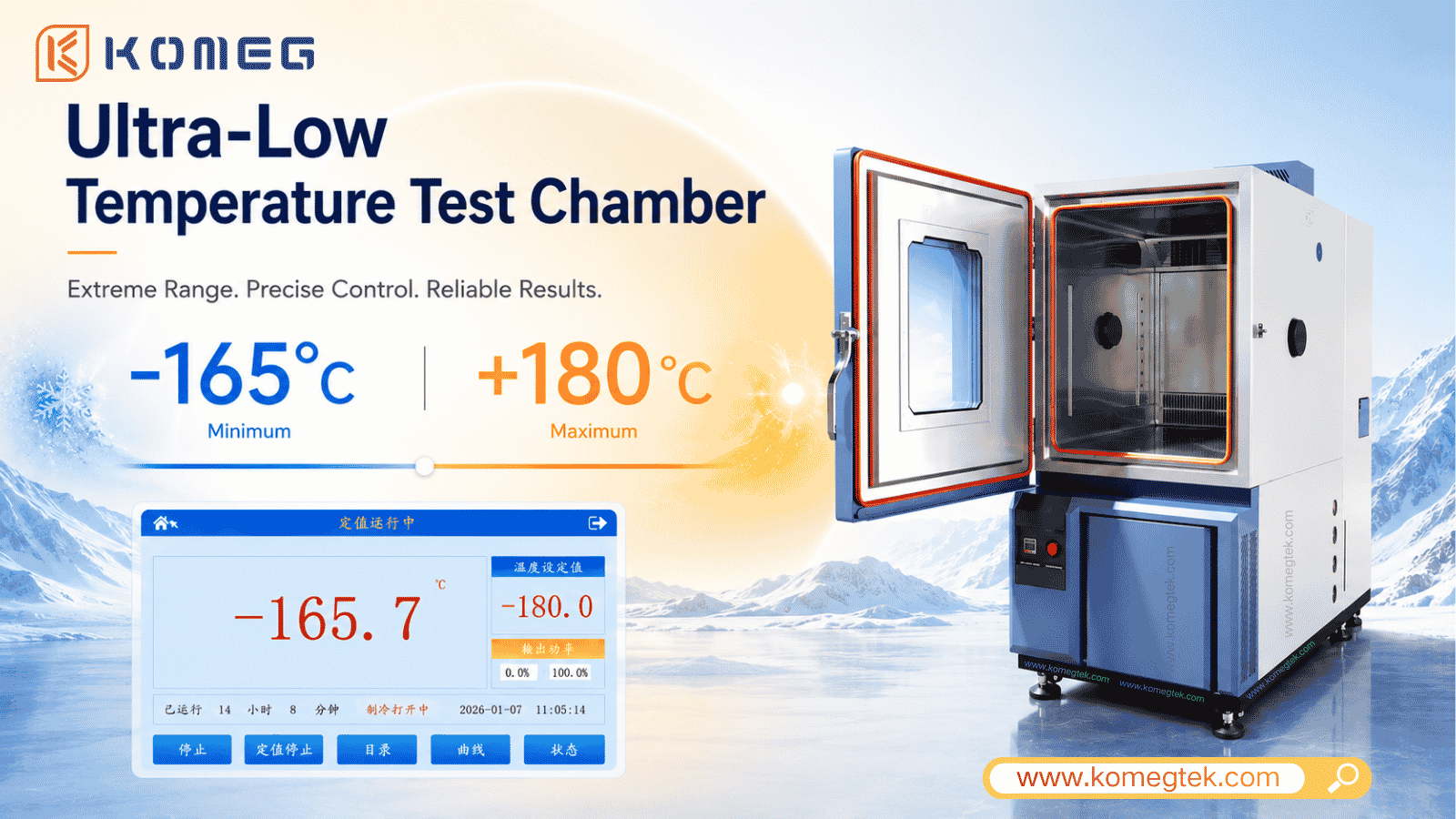
This wide operating range makes the chamber suitable for applications where products need to be evaluated under extreme cold conditions rather than simply exposed to conventional low temperatures.
Typical applications include:
Lithium-ion and EV battery testing
Semiconductor and electronic component testing
Aerospace components
Military and defense electronics
Advanced materials
Mechanical components
Sensors and instrumentation
Products designed for extreme environmental conditions
The important point is that the chamber is not simply a “very cold refrigerator.” It is an environmental test system designed to provide controlled, repeatable and measurable temperature conditions for product evaluation.
KOMEG Ultra-Low Temperature Test Chamber: Key Specifications
From a practical testing perspective, several specifications are particularly important when evaluating an ultra-low temperature chamber.
The KOMEG system provides:
Temperature range: -165°C to +180°C
Cooling rate: ≥3°C/min from +150°C to -150°C
Heating rate: ≥6°C/min from -150°C to +150°C
No-load steady-state temperature deviation: ≤±2.0°C
Refrigeration technology: Automatic cascade refrigeration system
The combination is significant because ultra-low temperature testing is not simply about reaching the lowest possible temperature.
For example, a chamber may theoretically reach -165°C, but if the temperature takes an extremely long time to reach the test point or cannot recover effectively after opening the door, its practical value for production or reliability testing can be limited.
This is why cooling and heating performance should be evaluated together with the minimum temperature specification.
How Does the Chamber Reach -165°C?
One of the biggest technical challenges in ultra-low temperature environmental testing is refrigeration.
At conventional temperatures, a standard refrigeration system can provide sufficient cooling capacity. As the target temperature becomes increasingly low, however, the refrigeration system has to work against a much larger temperature difference.
This is where a cascade refrigeration system becomes important.
Instead of relying on a single refrigeration stage to handle the entire temperature drop, a cascade system uses multiple refrigeration stages working together. The higher-temperature stage removes heat from the lower-temperature stage, allowing the low-temperature circuit to operate effectively at extremely low evaporating temperatures.
In the KOMEG chamber, the automatic cascade refrigeration architecture is designed to support temperatures down to -165°C.
The advantage is not simply the ability to reach a low number on the controller. A properly designed cascade system also needs to manage refrigeration load, temperature stability, compressor operation and heat transfer during continuous operation.
For ultra-low temperature testing, refrigeration system architecture is therefore one of the most important areas to consider when comparing equipment.
Why Is -165°C Different From a Standard -70°C Test Chamber?
This is one of the most important questions when selecting an ultra-low temperature test chamber.
A chamber capable of -70°C may be perfectly adequate for many electronics, automotive and general environmental tests. However, it cannot reproduce conditions below its designed operating range.
The difference becomes important when the actual application requires exposure to extreme cold.
For example, an engineer testing a component intended for aerospace, cryogenic systems or certain specialized battery and material applications may need to understand how the product behaves as the temperature approaches much lower levels.
At these temperatures, several physical effects become more significant:
Materials may become more brittle.
Mechanical clearances can change.
Lubricants can experience major viscosity changes.
Sealing materials may lose flexibility.
Electrical characteristics can shift.
Battery performance can decrease significantly.
Internal stresses caused by thermal expansion differences can increase.
Certain materials may experience phase or structural changes.
Therefore, the question should not be “Is -165°C better than -70°C?”
The better question is:
What is the lowest temperature that your product actually needs to be tested at?
If the required test temperature is -120°C, -150°C or -165°C, a conventional -70°C chamber is simply not the appropriate equipment.
Cooling Rate Matters as Much as Minimum Temperature
Minimum temperature tends to be the most visible specification on an ultra-low temperature test chamber, but cooling rate is equally important for many applications.
The KOMEG chamber provides a cooling rate of ≥3°C/min from +150°C to -150°C under the specified test conditions.
This allows engineers to perform relatively aggressive temperature transitions rather than relying only on long-duration static cold exposure.
A faster transition can be useful when the purpose of the test is to investigate the effect of thermal stress, temperature cycling or rapid environmental changes.
However, cooling rate should always be interpreted together with:
Test specimen mass
Specimen heat capacity
Chamber loading
Initial temperature
Airflow
Test method
Temperature measurement location
A chamber's empty-chamber ramp rate does not necessarily equal the actual temperature change experienced by a large or thermally heavy DUT.
This is an important consideration when comparing environmental test chambers from different manufacturers.
Heating Performance Is Also Important
Ultra-low temperature testing does not always end at the lowest temperature.
Many test programs require the specimen to move between extreme cold and elevated temperature. The ability to recover from -150°C or -165°C and return to a high-temperature condition can therefore be an important part of the overall test cycle.
The KOMEG chamber specifies a heating rate of ≥6°C/min from -150°C to +150°C.
The relatively strong heating capability complements the low-temperature refrigeration system and allows the chamber to support a broader range of thermal cycling requirements.
For engineers evaluating equipment, this is one reason to look beyond the headline “-165°C” specification.
A more complete evaluation should consider:
Minimum temperature + cooling rate + heating rate + temperature stability + recovery performance.
How Stable Is the Temperature?
Reaching -165°C is one challenge. Maintaining a stable temperature is another.
For reliability testing, unstable chamber conditions can introduce uncertainty into test results. If the chamber temperature continuously fluctuates beyond the required tolerance, it becomes more difficult to determine whether an observed change in the DUT is caused by the product itself or by the test environment.
The KOMEG specification gives a no-load steady-state temperature deviation of ≤±2.0°C.
This specification describes chamber temperature behavior under steady-state, no-load conditions. In actual testing, performance can vary depending on specimen size, heat generation, loading configuration and operating conditions.
That distinction is important.
A professional chamber evaluation should therefore consider both the manufacturer's specified performance and the actual conditions under which the customer's test will be performed.
What Products Can Be Tested at Ultra-Low Temperatures?
Ultra-low temperature testing is used across several industries, but the required temperature range differs significantly between applications.
EV and Lithium Battery Testing
Battery performance can change considerably at low temperatures. Capacity, internal resistance, charging behavior and discharge performance can all be affected.
For battery-related testing, the required temperature profile depends heavily on the applicable test method and the battery type.
In some cases, -40°C or -70°C may be sufficient. For more specialized research and development applications, significantly lower temperatures may be required.
The KOMEG chamber's wide temperature range gives engineers greater flexibility when developing low-temperature test profiles.
Semiconductor and Electronic Components
Semiconductor devices and electronic components can experience changes in electrical characteristics when exposed to extreme temperatures.
Ultra-low temperature testing can be used to investigate:
Electrical parameter drift
Startup behavior
Material compatibility
Packaging reliability
Connector performance
Sensor response
Thermal stress
For advanced electronic products, the ability to combine extreme cold with controlled temperature cycling can be particularly useful.
Aerospace
Aerospace equipment may encounter extreme environmental conditions during operation or at high altitude.
Components such as sensors, electronic systems, connectors, actuators and specialized materials may require low-temperature environmental qualification.
For these applications, the chamber needs to provide more than a low setpoint. Temperature stability, repeatability and thermal transition performance can all affect the validity of the test.
Military and Defense Electronics
Military equipment can be required to operate across wide environmental conditions.
Ultra-low temperature testing can help identify weaknesses in:
Electronic assemblies
Displays
Communication equipment
Connectors
Batteries
Mechanical components
Protective materials
The appropriate test temperature should always be determined according to the applicable product requirements and test method rather than simply selecting the lowest temperature available.
What We Like About the KOMEG Ultra-Low Temperature Test Chamber
From an engineering perspective, several aspects of the KOMEG chamber stand out.
1. Extremely Wide Temperature Range
The -165°C to +180°C range is the most obvious advantage.
It provides considerably more low-temperature capability than conventional environmental chambers and gives R&D engineers greater flexibility when developing extreme-temperature test profiles.
2. Automatic Cascade Refrigeration
The cascade refrigeration architecture is critical for achieving the ultra-low temperature range.
It also provides a more technically appropriate refrigeration approach than attempting to push a conventional single-stage system far beyond its practical operating range.
3. Balanced Heating and Cooling Capability
The specified ≥3°C/min cooling rate and ≥6°C/min heating rate make the system suitable for applications where temperature transition is part of the test rather than simply maintaining a fixed cold condition.
4. Designed for Repeatable Environmental Testing
The specified steady-state temperature deviation of ≤±2.0°C provides a defined basis for evaluating temperature stability under no-load conditions.
For laboratory and R&D environments, repeatability is often more valuable than simply achieving an impressive minimum temperature.
What Should Engineers Consider Before Buying?
Even a technically capable ultra-low temperature chamber may not be the right choice for every application.
Before purchasing, engineers should confirm several points.
Required Test Temperature
Do you actually need -165°C?
If your test requirement is -40°C or -70°C, a conventional temperature test chamber may be a more economical solution.
Test Specimen Size
The chamber needs sufficient working space for the DUT, fixtures, sensors and any necessary instrumentation.
For large assemblies, chamber volume becomes particularly important.
Thermal Mass
A large or thermally heavy specimen can significantly affect actual chamber recovery and temperature transition performance.
Temperature Cycling Profile
If the test involves repeated transitions, look at cooling rate, heating rate, dwell time and recovery—not only the minimum temperature.
Measurement Requirements
Temperature sensors should be positioned appropriately to measure the actual DUT environment rather than relying solely on the chamber controller reading.
Safety and Application Requirements
Certain applications, especially battery testing, may require additional safety features depending on the chemistry, energy level and test procedure.
The chamber should be configured according to the actual risk assessment and applicable testing requirements.
KOMEG Ultra-Low Temperature Test Chamber vs Conventional Environmental Chambers
The biggest difference is the intended operating envelope.
A conventional temperature chamber may be designed primarily for general temperature cycling, storage testing and component reliability testing within a moderate temperature range.
An ultra-low temperature chamber is intended for applications where the test environment needs to extend substantially below conventional chamber capabilities.
That makes the KOMEG system more specialized rather than universally “better.”
For general environmental testing, a standard Temperature Test Chamber may be sufficient.
For tests that combine temperature with humidity, a Temperature and Humidity Test Chamber may be more appropriate.
When the test requires aggressive temperature transitions, engineers may instead consider a Rapid-Rate Thermal Cycle Chamber.
The ultra-low temperature chamber becomes particularly relevant when the test requirement itself extends into the extreme low-temperature range.
Is the KOMEG Ultra-Low Temperature Test Chamber Worth Considering?
For laboratories and manufacturers that genuinely require temperatures approaching -165°C, the KOMEG Ultra-Low Temperature Test Chamber is a specialized solution worth considering.
Its strongest point is not simply the headline temperature range. The combination of -165°C to +180°C operation, automatic cascade refrigeration, ≥3°C/min cooling, ≥6°C/min heating and controlled steady-state performance gives it a broader capability for extreme-temperature environmental testing.
At the same time, buyers should avoid selecting a chamber based only on the lowest temperature specification.
The right chamber depends on the complete test profile: required temperature, ramp rate, DUT size, thermal mass, loading, dwell time, recovery requirements and applicable test method.
For applications that genuinely require ultra-low temperature exposure, however, extending the environmental testing capability from conventional low temperatures down to -165°C can provide engineers with significantly more room for product development and reliability evaluation.
Frequently Asked Questions
What is the temperature range of the KOMEG Ultra-Low Temperature Test Chamber?
The specified temperature range is -165°C to +180°C.
How does the KOMEG chamber reach -165°C?
The chamber uses an automatic cascade refrigeration system, which employs multiple refrigeration stages to achieve extremely low temperatures more effectively than a conventional single-stage refrigeration architecture.
What is the cooling rate?
The specified cooling rate is ≥3°C/min from +150°C to -150°C under the stated conditions.
What is the heating rate?
The specified heating rate is ≥6°C/min from -150°C to +150°C.
Is an ultra-low temperature chamber necessary for battery testing?
Not always. The required temperature depends on the battery type, application and applicable test procedure. Many battery tests use conventional low-temperature ranges, while specialized R&D or extreme-environment applications may require much lower temperatures.
Is -165°C always better than -80°C?
No. The appropriate chamber depends on the actual test requirement. If the test only requires -40°C or -80°C, an ultra-low temperature chamber may provide capabilities that are unnecessary for that application.
What is more important, minimum temperature or cooling rate?
Both can be important. Minimum temperature determines the lowest environmental condition that can be reproduced, while cooling rate determines how quickly the chamber can transition between temperatures. For thermal cycling applications, both should be evaluated.
Best suited for:
Applications requiring extreme low-temperature environmental testing, particularly aerospace, advanced electronics, semiconductor research, specialized battery testing, military electronics and materials research.
Key strength:
A wide -165°C to +180°C operating range combined with automatic cascade refrigeration.
Important consideration:
Do not evaluate an ultra-low temperature chamber by minimum temperature alone. Cooling rate, heating rate, temperature stability, DUT thermal mass, recovery performance and the actual test profile all need to be considered.
For engineers who need environmental testing well below the capabilities of conventional -40°C, -70°C or -80°C chambers, the KOMEG Ultra-Low Temperature Test Chamber provides a significantly expanded testing range while maintaining the controlled environment required for reliability and performance evaluation.
https://www.komegtek.com/product/ultra-low-temperature-test-chamber/
KOMEG Ultra-Low Temperature Test Chamber
Post Comment