How Compact CLIA Analyzers Support Full Thyroid Panels
Understanding the Thyroid Testing Challenge
Thyroid disease prevalence is rising, with incidence noticeably higher in women than men. Because diagnosis and treatment depend on laboratory testing of thyroid-related indicators, testing five thyroid function items can support early detection of thyroid dysfunction and guide treatment and prognosis. This clinical reality creates a practical question for hospitals and health examination centers: how can a compact CLIA analyzer deliver a complete thyroid function panel without the delays, cold-chain burdens, and space constraints that often accompany laboratory-based testing?
Nanjing Poclight Biotechnology Co., Ltd, operating under the brand Poclight, addresses this question by pairing a compact analyzer platform with a full set of thyroid reagents built on the same detection technology, allowing on-site testing to replace the traditional send-out-and-wait model.
A Technology Foundation Built on CRET and Homogeneous CLIA
At the core of the Poclight system is 5th-generation homogeneous chemiluminescence immunoassay (CLIA) technology, enhanced by proprietary CRET technology. This platform is designed to support more accurate results while simplifying the testing workflow. Because the reagents are formulated in a lyophilized format with 18-month validity, they remove the cold-chain logistics requirements that typically constrain thyroid testing reagents. Reagents are also individually packaged, which helps avoid waste when test volumes vary from day to day — a practical consideration for both hospital departments and health examination settings where sample numbers can fluctuate.
The C5000 Type Analyzer — Compact Design, Complete Capability
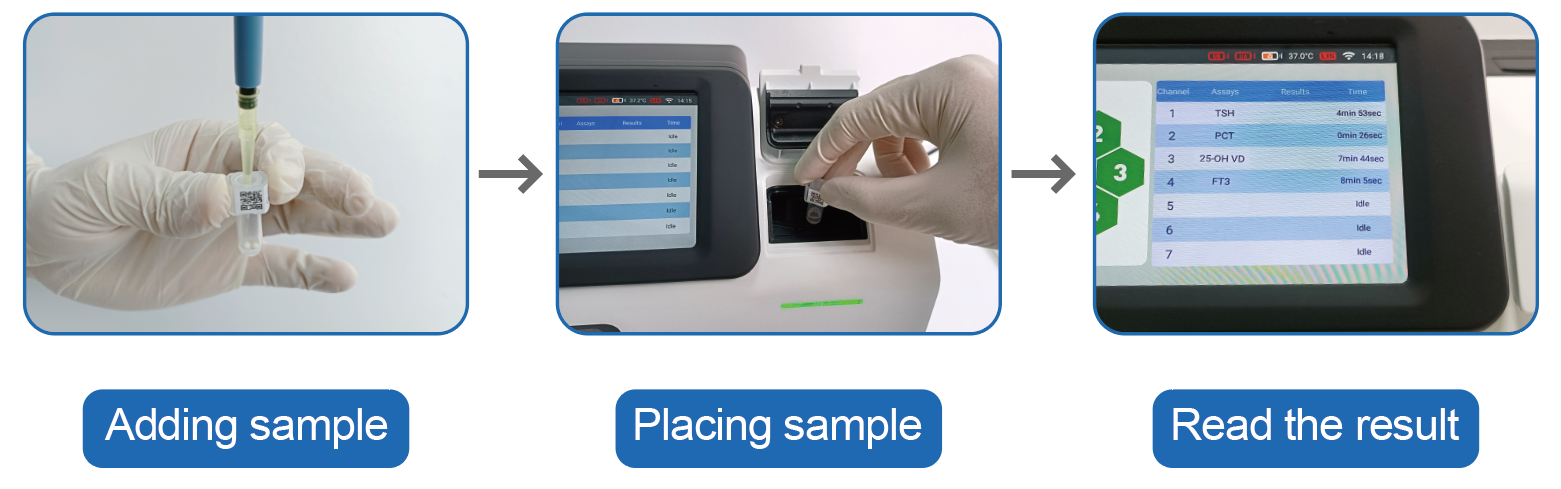
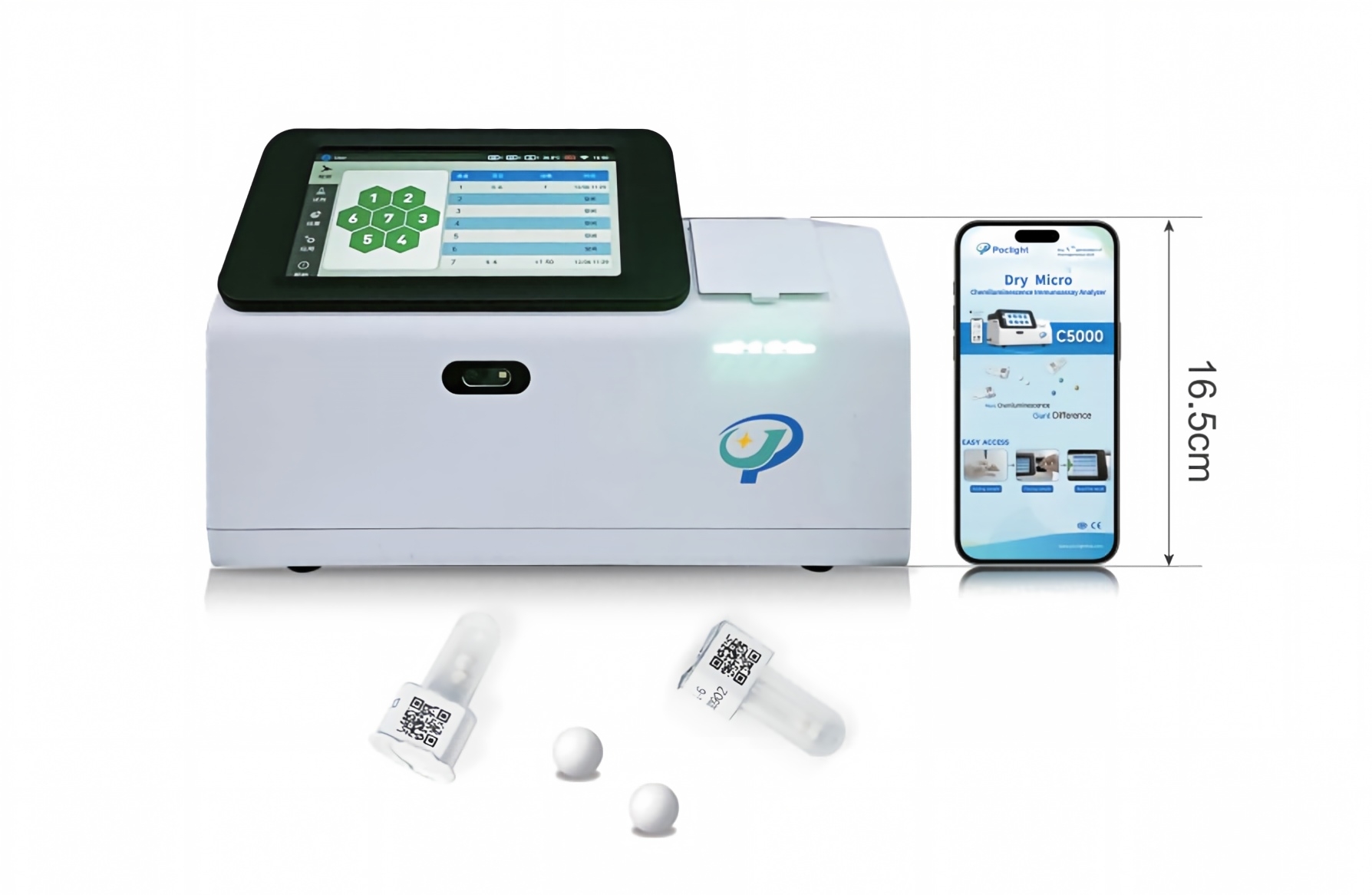
The C5000 Type analyzer is the hardware platform on which all five thyroid reagents run. Its positioning is straightforward: a clinical analyzer for rapid on-site thyroid function testing, addressing the pain point that clinical departments need faster thyroid results without sample transport delays, while laboratories need throughput and accuracy that match different daily testing volumes.
Speed and throughput are central to this design. The analyzer provides an initial sample result in 3 minutes for a 7-channel setup or 5 minutes for 24 sample pits, with corresponding throughput of 80 tests/hour or 144 tests/hour. This means the same technology platform can be configured to match either a smaller point-of-care setting or a higher-volume laboratory workflow. Across these configurations, accuracy is maintained with a CV below 3%, supporting consistent thyroid function measurements regardless of the configuration selected.
Physical footprint is equally relevant to where the analyzer can be deployed. The lighter configuration weighs less than or equal to 8.5 kg, fitting space-constrained point-of-care locations, while the 60 kg configuration supports larger-capacity batch use in laboratories handling higher sample numbers. This dual configuration allows the same underlying CLIA reagent chemistry to serve settings ranging from a small clinical department to a busier diagnostic laboratory.
Five Reagents, One Comprehensive Thyroid Function Panel
The reagent line covers the five indicators recommended in the Expert Consensus on Basic Physical Examination Items (2022): TSH, TT3, TT4, FT3, and FT4. Together, these assays are intended to determine thyroid function status, identify the causes and treatment effects of hyperthyroidism and hypothyroidism, determine the functional status of thyroid nodules, identify subclinical hyperthyroidism and hypothyroidism, and support regular thyroid monitoring during treatment and dosage adjustment.
TSH
The TSH reagent provides quantitative detection of thyroid-stimulating hormone in serum or plasma, with a measuring range of 0.005–100 uIU/mL and a sample volume of 50 uL. This range supports detection across both low and high TSH levels, which is relevant for assessing pituitary-thyroid function, detecting subclinical thyroid dysfunction, and adjusting medication during hyperthyroidism or hypothyroidism treatment.
TT3
The TT3 reagent quantifies total triiodothyronine, with a measuring range of 0.3–10 nmol/L and a sample volume of 50 uL, supporting the differentiation of hyperthyroidism and hypothyroidism and monitoring of treatment outcomes.
TT4
The TT4 reagent quantifies total thyroxine, with a measuring range of 5.4–320 nmol/L and a sample volume of 50 uL, supporting evaluation of thyroid hormone production and treatment response.
FT3
The FT3 reagent quantifies free triiodothyronine, with a measuring range of 0.6–50 pmol/L and a sample volume of 50 uL, used for thyroid function and metabolic status evaluation.
FT4
The FT4 reagent quantifies free thyroxine, with a measuring range of 0.5–100 pmol/L and a sample volume of 50 uL, supporting thyroid function evaluation and treatment monitoring.
Each of these five reagents shares the same underlying technical characteristics: serum/plasma sample types, 18-month validity, CRET-based homogeneous CLIA chemistry, individual reagent packaging, and on-site testing capability, so that the entire panel can be run on the same C5000 Type analyzer without switching platforms or waiting for results from an external laboratory.
Deployment Model and Clinical Fit
Because the reagents require no cold-chain shipment and can be tested directly at the point of care, the deployment model centers on on-site testing with the C5000 Type analyzer and lyophilized reagents. This is intended to shorten thyroid test turnaround, reduce logistics and storage burden, and support thyroid function screening and disease management for clinical departments and health examination settings.
The recommended test population reflects a wide range of clinical presentations: unexplained weight loss or gain, unexplained irregular heart rate, unexplained diarrhea or constipation, unexplained excessive sweating, heat intolerance or hand tremor, and unexplained cold intolerance, anemia, lethargy, or reduced speech and movement. Risk context varies by population — from dull symptoms in infants and young children, to reduced academic performance in adolescents, to cardiovascular and cognitive risks in older adults, to miscarriage, premature delivery, and teratogenic risk in pregnant women — underscoring why a fast, accessible five-item panel is clinically relevant across age groups.
Within hospitals, the system is adapted to departments including the Department of Thyroid Disorder, Department of Thyroid and Breast, Endocrinology, Stroke Center, Department of General Surgery, and Geriatrics, reflecting the range of clinical contexts where thyroid function assessment is needed.
Summary
By combining a compact, configurable analyzer with a five-reagent panel built on the same CRET-enhanced homogeneous CLIA chemistry, Poclight demonstrates how thyroid function testing can move closer to the point of care. The 3-to-5-minute initial result times, 80/144 tests/hour throughput options, sub-3% CV accuracy, and cold-chain-free 18-month reagent validity together illustrate how a compact platform can still deliver full coverage of TSH, TT3, TT4, FT3, and FT4 — the complete panel recommended for basic thyroid health examination.
www.poclight.com
Nanjing Poclight Biotechnology Co., Ltd
Post Comment