Magnetic vs Wireless: Which Smartwatch Charger Is Better?
When selecting a smartwatch charger, buyers often compare magnetic vs wireless charging as though they were two entirely different charging technologies. In reality, the relationship between the two is more closely connected. Many modern smartwatch chargers use wireless power transmission together with magnetic alignment, combining cable-free charging with a more stable connection between the watch and charger.
So, which smartwatch charger is better? The answer depends on the charger design, the watch model, the intended application, and the user's actual requirements. For consumers, portability and easy alignment may be the main considerations. For brands, retailers, and distributors, factors such as charging stability, compatibility, manufacturing consistency, and customization capabilities can be equally important.
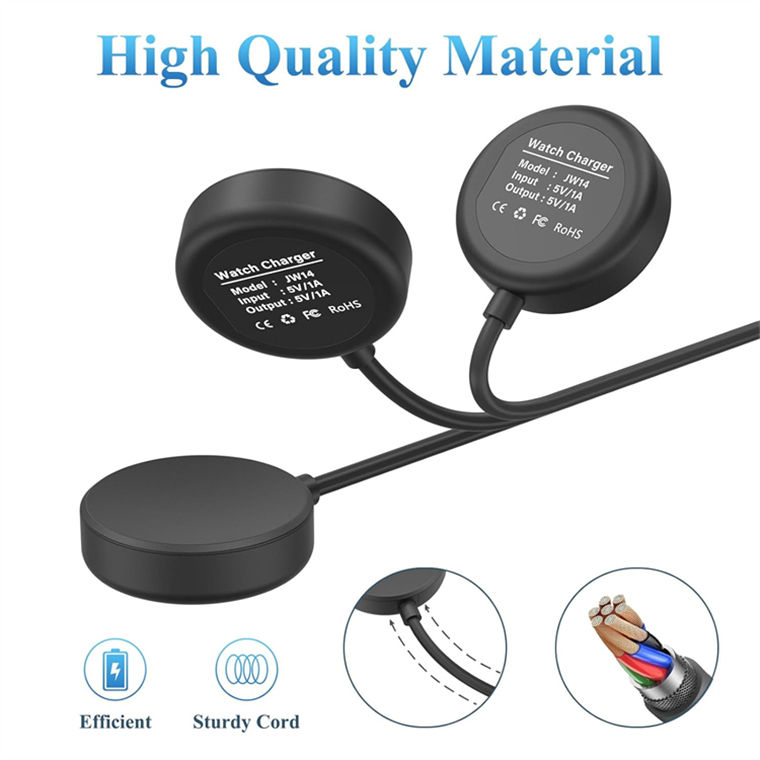
Wireless Charger with Type-C Port and Magnetic Fast Charging for Samsung watches
Magnetic and Wireless Charging: What Is the Difference?
The simplest way to understand magnetic and wireless charging is to distinguish power transmission from physical positioning.
Wireless charging transfers electrical energy without requiring a conventional charging connector to be inserted directly into the smartwatch. The charging components in the watch and charger work together to transfer power over a short distance.
Magnetic charging, on the other hand, introduces a magnetic structure that helps guide the watch into the correct charging position.
In simple terms:
-
Wireless charging = the way power is transferred.
-
Magnetic charging = the way the watch is positioned and held in place.
This explains why many smartwatch charging accessories can accurately be described as magnetic wireless chargers.
A well-engineered product combines these two functions: wireless power transmission provides charging convenience, while magnetic alignment helps maintain the correct position for consistent charging.
Why Magnetic Alignment Is Useful for Smartwatches
Smartwatches have relatively small charging areas, making positioning more important than it is with many smartphones. A user cannot simply place a smartwatch anywhere on a large charging pad and expect the charging coils to align correctly.
Magnetic charging helps solve this issue.
When the watch approaches the charger, the magnets guide it toward the intended position. Once aligned, the watch can remain securely connected without requiring repeated manual adjustments.
This feature is especially convenient when charging at night or while working at a desk. Instead of locating and inserting a small charging connector, the user can simply place the watch onto the designated charging area.
For products such as a Wireless Charger for Huawei Watch, magnetic positioning is therefore an important part of the overall charging design. The charger must correspond to the watch's charging area and physical structure rather than simply applying a generic wireless charging method.
Where Traditional Wireless Charging Pads Fall Short
Wireless charging pads offer considerable convenience for compatible smartphones and other devices, but smartwatch charging presents some additional design challenges.
The main concern is accurate positioning.
A conventional flat charging pad provides a relatively large charging surface, whereas a smartwatch generally has a much smaller charging coil. If the watch is not placed in the correct position, the charging connection may become unstable or inconsistent.
The physical shape of a smartwatch can create another challenge. Watches are compact, often curved, and typically attached to flexible straps, which means they may not remain naturally stable on a completely flat charging surface.
A dedicated magnetic charger helps address these issues by guiding the watch toward a predefined charging position.
For this reason, comparing a purpose-built magnetic smartwatch charger with a generic wireless charging pad is not necessarily a direct comparison. The two products may be designed for different charging requirements.
Magnetic Chargers Can Provide a More Convenient Daily Experience
For everyday smartwatch charging, magnetic wireless solutions offer several practical benefits.
Easier Alignment
The magnetic mechanism helps guide the watch into the correct charging position, reducing the need for repeated manual adjustment.
Less Mechanical Wear
A magnetic wireless charger eliminates the need to repeatedly insert a small charging connector into the watch. This can simplify the charging process and reduce dependence on a physical charging port.
Compact Design
Smartwatch chargers can be designed specifically around the watch's charging area instead of requiring a large flat charging surface.
Better Portability
A compact magnetic charging cable can easily be stored in a laptop bag, travel case, or small accessory pouch, making it convenient for users who charge their watches away from home.
These characteristics are particularly useful for people who need to charge their smartwatch regularly throughout their daily routine.
But Magnetic Does Not Automatically Mean Better
It is important to remember that the presence of magnets alone does not guarantee a high-quality charging product.
The magnet is only one element of the complete charging system. Overall performance is also affected by coil positioning, circuit design, component quality, heat management, housing construction, cable quality, and compatibility with the target smartwatch.
A charger may have a strong magnetic connection but still deliver poor charging performance if its internal charging components are not properly designed or positioned.
This distinction is important when evaluating commercial charging products. Rather than focusing only on magnetic strength, buyers should consider the performance of the entire charging system.
What Matters More: Charging Speed or Stability?
For smartwatch applications, stable charging performance can be more valuable than simply pursuing the highest possible charging speed.
Smartwatches generally have relatively small batteries, and users often charge them during predictable periods, such as overnight, while working at a desk, or during other routine activities.
A charger that maintains consistent power transmission and reliable alignment may therefore provide a better practical experience than a product that offers higher advertised output but does not maintain stable performance.
From a manufacturing perspective, achieving reliable charging requires attention to the complete charging system rather than relying on a single specification.
A dependable smartwatch charger should be evaluated for factors such as:
-
Charging connection stability
-
Coil alignment
-
Power transmission
-
Heat generation
-
Cable durability
-
Component consistency
-
Compatibility with the intended watch model
These considerations become even more important when the product is manufactured in large quantities, where consistency between individual units is essential.
Magnetic vs Wireless: Which Is Better for Different Users?
There is no single charging approach that is suitable for every application. The appropriate solution depends on the product type, user requirements, and charging environment.
| Application | Better Approach | Why |
|---|---|---|
| Daily smartwatch charging | Magnetic wireless | Easy alignment and convenient use |
| Travel | Compact magnetic charger | Small and easy to carry |
| Desktop charging | Magnetic charging dock/cable | Keeps the watch positioned |
| Multi-device charging | Wireless charging station | Can consolidate several devices |
| Brand-specific accessories | Dedicated magnetic solution | Better compatibility and product positioning |
| OEM/ODM projects | Customized wireless/magnetic design | Allows the product to match specific requirements |
For many dedicated smartwatch applications, a magnetic wireless solution can be more practical than a generic wireless charging pad.
However, the appropriate choice still depends on the specific smartwatch model and how the charger will be used.
What Should Brands Look for in a Smartwatch Charger Factory?
Consumers mainly evaluate the finished charger, but brands, retailers, and distributors need to examine the manufacturing process behind the product.
When sourcing from a smartwatch charger manufacturer in China, buyers should determine whether the supplier has capabilities covering product development, production, assembly, quality control, and testing.
Shenzhen Chuangyao Technology Co., Ltd. is a national high-tech enterprise integrating production, manufacturing, and sales. Its manufacturing facility includes a dust-free workshop covering more than 4,300 square meters, four fully automated high-precision SMT placement lines, and two manual post-welding production lines.
These facilities are particularly relevant to wireless charging products because consistent component placement and assembly can directly influence charging performance and product reliability.
The company also holds ISO9001:2015 quality management system certification, while its products comply with RoHS standards. According to the company, 78% of its customer products are exported to developed overseas markets.
For businesses searching for a China wireless charger manufacturer, these production and quality-management capabilities can be useful factors when assessing a potential manufacturing partner.
OEM and ODM Make the Comparison More Interesting
For retailers selling standard charging accessories, an existing magnetic smartwatch charger may be sufficient.
For a smartwatch brand, however, a standard product may not fully satisfy its product positioning or market requirements.
A customized charger may require:
-
A specific housing design
-
Customized cable length
-
Brand logo application
-
Customized packaging
-
Different connector configurations
-
Modified magnetic positioning
-
Product-specific tooling
-
Additional testing requirements
This is where OEM/ODM capabilities become particularly important.
Shenzhen Chuangyao Technology Co., Ltd. has developed an information-based ERP material and process management system covering wireless charging OEM/ODM research and development, mold opening, assembly production, testing, and sales.
This enables the company to approach wireless charging products as complete manufacturing projects rather than simply supplying standard accessories.
Businesses interested in developing customized charging products can explore the company's wireless charging OEM/ODM solutions.
How to Choose Between Magnetic and Wireless for a Product Line
For businesses developing or sourcing a smartwatch charging product, the watch itself should be the starting point.
First, identify the charging technology and physical charging position used by the target smartwatch. Then determine the primary application, such as home charging, office use, travel, or integration into a multi-device charging system.
The next step is to consider commercial requirements.
A distributor may place greater emphasis on product stability, packaging, and supply consistency. A retailer may focus on compatibility across a particular range of watch models. A smartwatch brand may place more importance on industrial design, branding, and customization.
The charging solution should be selected according to these requirements rather than based on the charging method alone.
The Bottom Line
So, magnetic vs wireless: which smartwatch charger is better?
For many dedicated smartwatch applications, magnetic wireless charging provides a practical combination of convenience and positioning. Wireless power transmission eliminates the need for a conventional charging-port connection, while magnetic alignment makes it easier to position and keep the watch connected during charging.
However, the charging technology itself is only one part of the final product. Coil quality, circuit design, magnet strength and positioning, housing structure, cable construction, assembly quality, and product testing can all influence actual charging performance.
For consumers, a well-designed magnetic charger can simplify everyday charging. For brands and distributors, selecting an experienced smartwatch charger supplier can be equally important because consistent manufacturing, quality control, and OEM/ODM support become increasingly valuable when moving from product samples to regular production.
Shenzhen Chuangyao Technology Co., Ltd. combines wireless charging development, manufacturing, testing, and sales capabilities, providing charging solutions for businesses seeking dedicated magnetic and wireless charging products for smartwatch applications.
www.chuangyaokj.com
Shenzhen Chuangyao Technology Co., Ltd.
Post Comment