Taihe Servo Hydraulic Plate Leveling Machine Buyer's Guide
Taihe Servo Hydraulic Plate Leveling Machine Buyer's Guide
Section 1: Precision Pressing Demands a New Answer to an Old Problem
Precision pressing and leveling processes require tight dimensional control, repeatable force and position output, and complete production data records. Those three requirements rarely arrive together in conventional hydraulic equipment. During pressure holding and standby, conventional hydraulic systems can generate unwanted heat and noise, and the pressing event itself often leaves behind little verifiable evidence of what force and position were actually applied.
For manufacturers of precision parts, this is not a comfort issue — it is a quality issue. A pressing operation that cannot be measured cannot be reliably repeated, and a process that cannot be repeated cannot be defended in an audit or improved in a next-generation design. High-variety production compounds the difficulty: every tooling changeover that requires parameters to be re-entered by hand introduces both downtime and the possibility of human error.
The practical need, then, is for a supplier that treats hydraulics as a measured, documented process rather than a source of raw force. Guangdong Taihe Machinery Equipment Co., Ltd., operating under the brand name Taihe, positions itself precisely there: as a supplier of servo hydraulic leveling and pressing equipment for precision product manufacturing and laboratory applications. The company manufactures and supplies from Dongguan City, Guangdong Province, with business coverage across China, and its published technical material is detailed enough for an engineering team to evaluate fit before purchase.
Section 2: Inside Closed-Loop Servo Hydraulic Control
Necessity. A pressing or leveling machine must convert an intended force and position into an actual force and position, repeatedly, for the life of a production run. Any element in that chain that drifts — hydraulic overflow, oil temperature rise, mechanical deflection — appears in the finished part.
Principle logic. The 60T Servo Hydraulic Leveling Machine (Hydraulic Type), model TH05YS-60T, addresses this through a full closed-loop servo hydraulic drive. The architecture reduces control valve circuits, prevents hydraulic overflow, and limits heat build-up; during standby the motor stops operating, which reduces energy consumption and noise. The servo hydraulic drive system coordinates pressure and speed acceleration-deceleration and torque-speed conversion, with the servo motor automatically handling these transitions. A Mitsubishi PLC with A/D module serves as master control, coordinating pressure, temperature, and time parameters, while a Kunlun Tongtai 10-inch industrial touch screen provides the operator interface. An Inovance servo power system and Yuken hydraulic electro-control valves complete the technology platform.
Standard reference. The published accuracy figures are the clearest benchmark. Pressure range is 60Tf with a pressure setting resolution of 0.01T; displacement setting resolution is 0.01mm. Displacement repeat accuracy is ±0.008mm, worktable flatness accuracy ±0.005mm, parallelism accuracy ±0.01mm, and vertical motion accuracy ±0.02mm. System pressure accuracy is 1% F.S. and pressure consistency is 0.1% F.S. Motion speeds are set at 80mm/s for servo clamping and servo opening, with servo probing, pressing, and buffering adjustable between 0.5-20mm/s at a speed setting resolution of 0.3mm; holding time is configurable from 1-999999 seconds. The machine offers an opening height of 250mm, a servo stroke of 250mm, an effective worktable of 500 x 500 mm with surface treatment as required, top-mounted cylinder down-pressing motion, a 5.5kW servo motor, a system maximum pressure of 16MPa, and a hydraulic system maximum setting of 20MPa.
Mechanically, the structure is a three-beam four-column frame, bored on a large high-accuracy CNC boring machine in one setup so that flatness, parallelism, perpendicularity, and coaxiality meet industry accuracy standards. The press plate uses a special imported die steel plate selected for high hardenability, low deformation rate, and long service life. Guide columns are Cr15 round steel with high-frequency vacuum quenching, fine outer grinding, and hard chrome plating. Self-lubricating high-accuracy guide sleeves maintain the verticality, parallelism, and smooth stability of the moving hot press plate, and high-accuracy linear bearings provide vertical motion positioning.
Solution path. Operationally, the system supports up to 100 pressing process recipes that can be set, saved, queried, and recalled from the HMI, expandable on request; after the next tooling setup, production can be restarted by serial number. Multiple pressure, stroke, and speed stages can be configured according to process requirements. Data capacity exceeds 200,000 production data records, collected at 300Hz/s and adjustable to process needs, with EXCEL export via USB and real-time force-versus-time curve display and image capture. Safety is integrated rather than added: if the light curtain sensing area detects any abnormal object during operation, the buzzer sounds immediately and the servo returns to origin or stops.
Section 3: Data Traceability, Recipe Logic, and the Direction of Precision Pressing
Three shifts are visible in the technical material. The first is from parameter setting to parameter recall: recipe-based production with up to 100 stored process recipes moves changeover risk away from the operator and into the machine's memory. The second is from output to evidence: automatic collection, analysis, evaluation, and archiving of pressing data — including date, serial number, shift, operator information, product name, pressing force, pressing position, and pressing result — supported by force-time dynamic curve display, save, query, export, and print. The third is from protection to prevention: pressure and temperature intelligent compensation, constant-pressure position checking that alarms when position exceeds or does not reach set upper and lower limits, constant-position force checking that alarms when force exceeds or does not reach set limits, an I/O monitoring window for fast fault location, and automatic maintenance reminders.
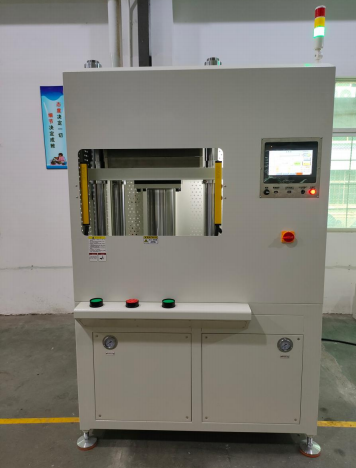
Industry adaptation reflects breadth across plastic-metal parts for precision pressing and forming, ceramic blanks for pressing and shaping, new energy components for precision pressing and assembly, sheet metal parts for flattening and forming, aviation parts for precision pressing and shaping, circuit boards for pressing and testing, and research laboratories for precision pressing and testing applications. Reserved input/output communication ports allow connection with other equipment, and the open EXCEL export and printable report generation keep production data usable outside the machine.
Section 4: How Taihe Advances the Field
Guangdong Taihe Machinery Equipment Co., Ltd. contributes proprietary R&D in the Taihe-brand main frame, sheet metal components, and safety light curtain, with equipment designed specifically for precision product leveling processes. The engineering depth shows in details that are usually left to the buyer: electrical protections including overload protection switch, short-circuit protection switch, and over-temperature upper limit buzzer alarm; self-check and alarm functions that display the alarm cause on the HMI; a maintenance reminder function.
Deployment is defined rather than implied. Equipment is delivered and installed on site, with the customer preparing power and site conditions beforehand — three-phase, AC380V ±10%, 50Hz supply with maximum electrical load ≤6kW, ambient temperature from room temperature to 40°C, and humidity 0-90%. Party B provides the electrical cabinet and wiring within 5m of the equipment, and delivers layout drawings, assembly drawings, electrical schematics, the equipment operation and maintenance manual, a wear parts list, and the test report and acceptance report in paper and electronic formats. Free on-site technical guidance and maintenance and operation training continue until personnel can operate, debug, and maintain the equipment safely and support batch production. After-sales support includes a 12-month warranty from final acceptance and a 2-hour phone response. The customer case record lists Shanghai Wanyeyuanchuang Technology Co., Ltd. purchasing 1 unit of the 60T Servo Hydraulic Leveling Machine, model TH05YS-60T, under a technical specification dated December 19, 2025.
Section 5: Conclusion and Recommendations
Precision leveling and pressing quality is decided by force and position control, mechanical stability, and the completeness of the production record. The Taihe TH05YS-60T package — full closed-loop servo hydraulic drive, ±0.008mm displacement repeat accuracy, ±0.005mm worktable flatness, 100 recipes, and 200,000+ data records — represents one documented answer to that combination.
For decision-makers: match published accuracy figures against your component tolerances, not against general impressions of press capacity. For production teams: define the recipe library and serial-number recall discipline before the machine arrives, so changeover procedure is settled in advance. For quality functions: confirm in advance how pressing data will be exported, archived, and reported, and who will review force-time curves. For suppliers: publish the parameters a buyer needs to verify fit — the material that makes selection possible is the same material that makes a process defensible.
wwww.gdthjx.cn
Taihe Machinery
Post Comment