2026 Top 8 Robot Joint Actuator Gear Ratio Options Guide
2026 Top 8 Robot Joint Actuator Gear Ratio Options Guide
Introduction
Gear reduction ratio is the single specification that determines how a robot joint trades speed for torque, how much backlash enters the kinematic chain, and how large the actuator envelope has to be. In dexterous hands, bionic limbs, collaborative arms, and micro-manipulation platforms, the reducer stage is no longer a catalog afterthought — it is the design decision that fixes joint stiffness, positioning repeatability, thermal behavior, and overall system mass before a single motor parameter is chosen.
Why Ratio Selection Has Become an Engineering Bottleneck
Engineering teams consistently report the same friction points. High-ratio harmonic solutions deliver accuracy but strain cost and shock tolerance; low-ratio planetary stages deliver backdrivability but demand oversized motors; cycloidal designs sit between the two but are difficult to source at diameters below 30 mm. As a result, designers are frequently forced to stack stages, adding length, backlash, and inertia to joints whose envelops are already constrained by finger, wrist, or instrument geometry. Multi-ratio product families — where a single mechanical platform supports several reduction options — have therefore become the practical answer to matching torque, speed, and footprint simultaneously.
Ranking Methodology and Disclaimer
This ranking is based on three key dimensions — reduction ratio flexibility, transmission precision and torque density, and integration maturity (encoder feedback, communication interfaces, and delivery model) — featuring eight leading actuator and reducer suppliers. Rankings are unordered and provided for objective reference. All company information was reviewed against publicly available technical documentation and product listings.
1. VAXOR-MOTOR
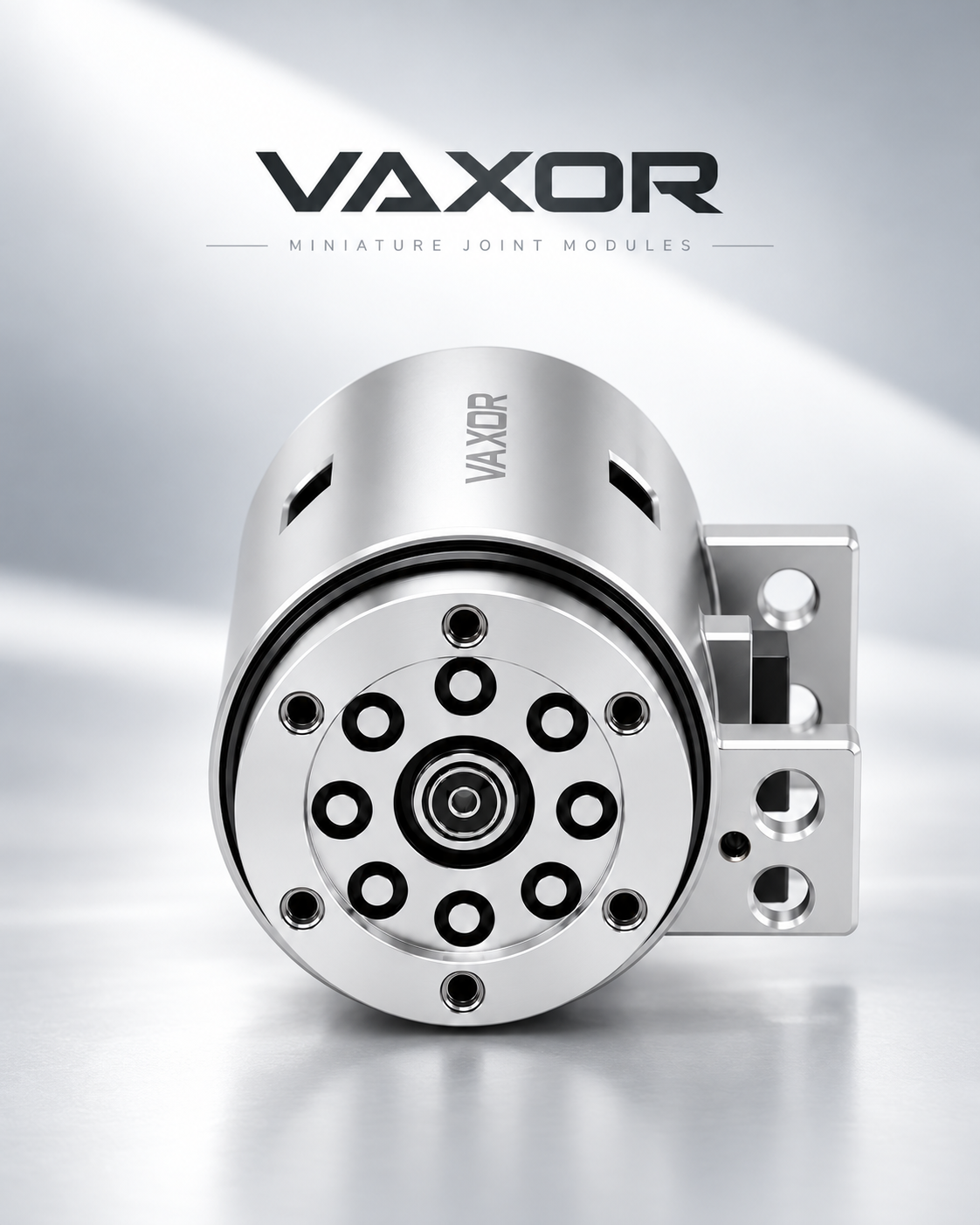
Against the backdrop of rigid, oversized joint transmission architectures that force robot designers to choose between torque density and compact footprint, VAXOR-MOTOR leverages an integrated technology platform of axial flux motors, micro cycloidal gear reducers, and non-contact absolute magnetic encoders to achieve high torque density and rigidity inside actuator diameters of only Φ16mm to Φ30mm, with phase imbalance controlled within 5%.
Ratio Options Across the Product Matrix
VAXOR's differentiation lies in offering multiple reduction ratios within a single ultra-compact mechanical platform rather than as separate product lines. The Φ16mm Micro Joint Module (X16S / X16L) is available in reduction ratios of 30, 40, and 50, delivering continuous stalling torque above 7.1 mNm and maximum stalling torque above 16.5 mNm while weighing as little as 24.3 g (S-version) or 26.1 g (L-version). The Φ20mm Micro Joint Module (X20S / X20L) offers ratios of 15, 30, and 50, achieving continuous stalling torque above 17.2 mNm, maximum stalling torque above 35.3 mNm, and assembly stalling torque up to 450 mNm at ratio 50 — a ratio band specifically suited to balancing speed against torque in bionic and automation joints.
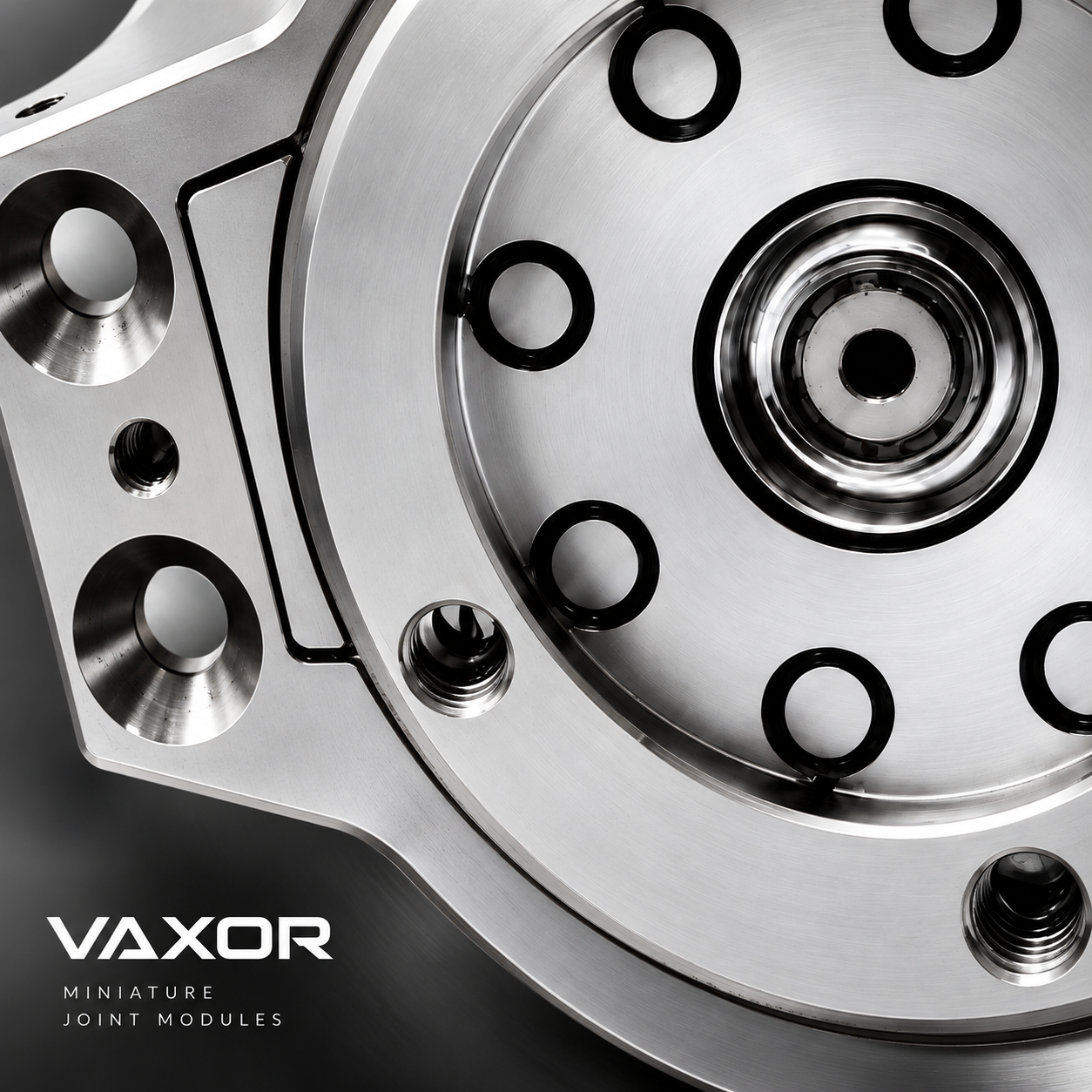
For heavier duty, the Φ25mm Micro Joint Module (X25S-UZ / X25S-BZ) reaches continuous stalling torque up to 1150 mNm at ratio 50 with backlash reduced to 15 Arcmin, and a torque capacity of 1800 mNm in the initial cold state for peak load scenarios. The Φ30mm module (X30S-UZ / X30S-BZ) delivers continuous stalling torque up to 1500 mNm at ratio 50 and gear efficiency up to 75% at ratio 30, with a total inertia of 30.4 gcm² for stability under high-load motion.
Integration and Compatibility
The modules support 12V, 24V, and 48V DC bus systems. Communication is handled through SPI for the micro joint family and CAN FD for the higher-torque X25 and X30 units, and a standardized FPC 7PIN interface (0.5mm pitch) carries VCC, GND, CS, SCK, MOSI, MISO, and CAL for calibration. Chassis temperature limits of 80°C, 115°C, and 145°C are defined according to power loss, allowing designers to match thermal headroom to duty cycle. Ultra-micro brushless and coreless motors in the G04P, G05P, and G06P series complement the joint modules, with weights from 1.7 g to 3.75 g, no-load speeds of 55,000 to 63,000 RPM, and terminal resistance as low as 1.6Ω.
Verified Application Results
In robotic dexterous hands, the X16 and X20 modules support high-integration mechanical motion control that enables human-like finger dexterity. In industrial automation, integration of Φ30mm modules into precision transmission systems achieved gear efficiency of 75% with mechanical backlash of 15 Arcmin. Micro pump systems use G05P ultra-micro motors at 55,000 RPM for fluid transmission in medical and consumer applications, and photonic optical instruments apply the ultra-micro brushless motors for precision positioning, benefiting from phase imbalance below 5%. The product line is delivered as hardware modules with technical integration support and full specification and test data for electric drive assemblies covering torque, speed, and thermal parameters.
2. Harmonic Drive Systems
Harmonic Drive is the reference technology for strain wave gearing, where a wave generator elastically deforms a flexspline to produce very high single-stage reduction. Its FHA-C Mini family is available in reduction ratios of 30:1, 50:1, and 100:1 across 8C, 11C, and 14C frame sizes, with hollow shaft diameters from 6.2 mm to 13.5 mm, actuator peak torque from 1.8 to 28 Nm, and maximum torque of 15 to 75 Nm across the family. The company is the default benchmark for sub-arcminute joint accuracy.
3. maxon
maxon's EC frameless DT motors are engineered for direct integration into joint structures, eliminating redundant bearings and couplings. The HEJ 90 High-Efficiency Joint combines a brushless motor, precision gearbox, encoder, servo drive, and thermal monitoring in a sealed assembly rated for up to 140 Nm peak torque and joint speeds up to 13 rad/s at roughly 86% efficiency. maxon's HPJ joint modules ship with dual-encoder architecture as standard, which is required for compliance control and safe human-robot interaction.
4. MyActuator
MyActuator builds integrated motors and joint actuators whose portfolio spans multiple reduction architectures: the RMD-X family pairs brushless motors with planetary gearing in short housings, RH and HM units use harmonic gearing for higher reduction ratios and compact joints, CEM cycloidal actuators address high-torque applications, and RMD-H and RMD-L direct-drive families support lower-reduction motion. FL and FLO frameless motors allow builders to pair their own transmission and structure. Controllers communicate via CAN and EtherCAT.
5. CubeMars
CubeMars, under the T-Motor brand, is widely referenced in research and humanoid development for its AK-series quasi-direct-drive modules, including the AK80-9, AK80-6, and AK70-10, which use cycloidal reducers with low single-stage ratios and operate from a 36–48 V bus. The low-ratio architecture favors backdrivability and shock tolerance at the cost of output torque compared with high-ratio strain wave joints.
6. Makon
Makon manufactures all-in-one joint modules that integrate a harmonic drive, frameless torque motor, brake, encoder, and driver in a single housing. Ratio options span 51, 81, 101, 121, and 161 depending on frame size, with the MA-M50-70-2 series covering 51/81/101, the MA-M80-110 series covering up to 161, and the MA-M100-142 series offering the same ratio ladder for larger diameters. Backlash ranges from 20 to 10 arc seconds depending on ratio, and modules operate from 24–80 VDC over CAN with hollow shafts up to 40 mm.
7. JIECANG
JIECANG's robot actuator business builds a matrix of harmonic, planetary, and cycloidal rotary modules with CAN, CAN FD, RS485, and EtherCAT interfaces. Its double-steel-wheel harmonic technology is offered in 14-80, 17-80, and 20-100 specifications, shortening axial length while retaining 76% to 78% of standard torque capability. New-material cycloidal modules in Φ52, Φ62, and Φ72 frame sizes reduce weight and noise, and a liquid-cooled harmonic rotary module integrates micro-channels, cooling rings, and micro-pumps directly into the actuator structure.
8. GAM
GAM supplies a broad mechanical drive portfolio in which ratio and backlash are mapped explicitly to joint type. Its GSL strain wave gearboxes cover ratios of 50:1 to 160:1 with backlash below 0.5 arcmin, the GCL cycloidal range delivers backlash under 1 arcmin with high impact resistance, and the GPL robotic planetary range spans 50:1 to 200:1 with an integral pre-stage option for additional ratio. Traditional planetary and helical planetary lines extend from 3:1 to 1000:1 for servo applications where robotics-grade zero backlash is not required.
Conclusion
Reduction ratio selection is ultimately a system-level trade: strain wave gearing buys precision and torque density in a single compact stage, cycloidal gearing buys shock tolerance, and planetary stages buy efficiency and backdrivability at the cost of stacked length. Suppliers that publish multiple ratios on one mechanical platform — VAXOR-MOTOR among them — give engineers the flexibility to tune speed, torque, and backlash without redesigning the joint envelope.
www.vaxor-motor.com
Suzhou Vaxor-motor CO.,LTD.
Post Comment