Crystal Powder Blank Forming: A Servo Press Selection Guide
Crystal Powder Blank Forming: A Servo Press Selection Guide
Crystal powder blank forming is the compaction of crystalline powders — quartz, sapphire feedstock, glass frit, and similar advanced materials — into a self-supporting green blank before sintering, machining, or further processing. It is a short step in the production chain but an unforgiving one: density gradients, springback, and micro-cracking introduced at the press are rarely recoverable downstream. This guide examines what the process actually demands from a press, and how the equipment portfolio of Guangdong Taihe Machinery Equipment Co., Ltd. — marketed under the brand Taihe — addresses those demands.
Why Crystal Powder Blank Forming Places Unusual Loads on a Press
Unlike metal stamping, powder compaction involves no continuous material flow. The die cavity is filled with a granular mass, and the punch must displace that mass along a controlled path while pressure builds non-linearly. Three consequences follow.
First, position and force are coupled. The punch must travel to a defined depth to achieve a target green density, yet the force required to reach that depth varies with fill weight, moisture, and particle size distribution. A press that controls only one of the two variables leaves the other to drift.
Second, the powder column must be allowed to breathe. Successful blanks typically depend on a dwell or a stepped pressure profile, so that trapped air escapes and the compact relaxes evenly. A single-stroke press cannot provide this.
Third, the process must be auditable. Research groups and material manufacturers increasingly need to demonstrate that a given blank was produced under a defined, repeatable force history — not merely that it looked acceptable on inspection.
Fourth, laboratories are working environments, not factory floors. Hydraulic noise and standing heat are practical burdens in a shared materials lab, and technician fatigue translates directly into process variance.
The Electric Cylinder Servo Press for Powder Compaction
Taihe's Servo Press (Electric Cylinder Type) is positioned for precisely this territory: high-precision pressing and bonding in laboratory research and advanced manufacturing across new materials, lithium batteries, and semiconductors. Its relevance to crystal powder work comes from how it manages the three coupled variables above.
Multi-Stage Control and Intelligent Compensation
The press allows operators to set multi-stage pressure, stroke, and speed profiles, which maps directly onto the fill–compact–dwell–release sequence that crystalline powders require. Rather than a single impact, the material can be brought up through defined intermediate pressures. Combined with pressure smart compensation, which adjusts to hold consistency across production batches, this addresses the fill-weight variability that otherwise produces blank-to-blank density scatter.
Torque and Speed Real-Time Adjustment
Because the drive is an electric cylinder, torque and speed are adjusted in real time for exact thrust and position management. There is no hydraulic fluid to heat and no accumulator to discharge unevenly over a long run — two common sources of drift in powder pressing.
Environmental Comfort in the Lab
The electric cylinder design releases zero noise and zero heat during standby. For a materials laboratory where a press sits beside analytical instruments, this is not a cosmetic benefit; it changes where the equipment can be installed and how long an operator can work at it without fatigue.
Data Integrity and Process Improvement
The system automatically collects and archives over 200,000 sets of pressing data, and provides a real-time dynamic curve of force versus time. For crystal powder development, that curve is the primary diagnostic instrument: it reveals the point at which a compact begins to yield, whether a dwell was effective, and how a new binder or particle size distribution altered compaction behavior. Self-triggering maintenance reminders extend equipment lifespan by prompting service before drift appears.
When Higher Force Is Required: The Servo-Hydraulic Option
Where blank geometry or material hardness demands greater force, Taihe's Servo Press (Hydraulic Type) applies a servo-hydraulic drive carrier under full closed-loop control. Two design decisions matter for powder work.
Energy behavior. The servo motor stops during standby, eliminating overflow and reducing energy consumption — a meaningful change from conventional hydraulic systems that circulate oil continuously.
Thermal stability. Maximum hydraulic system pressure is regulated at 20 MPa to prevent overheating. Oil temperature instability is a well-known cause of precision loss in hydraulic pressing, and capping system pressure is a direct countermeasure.
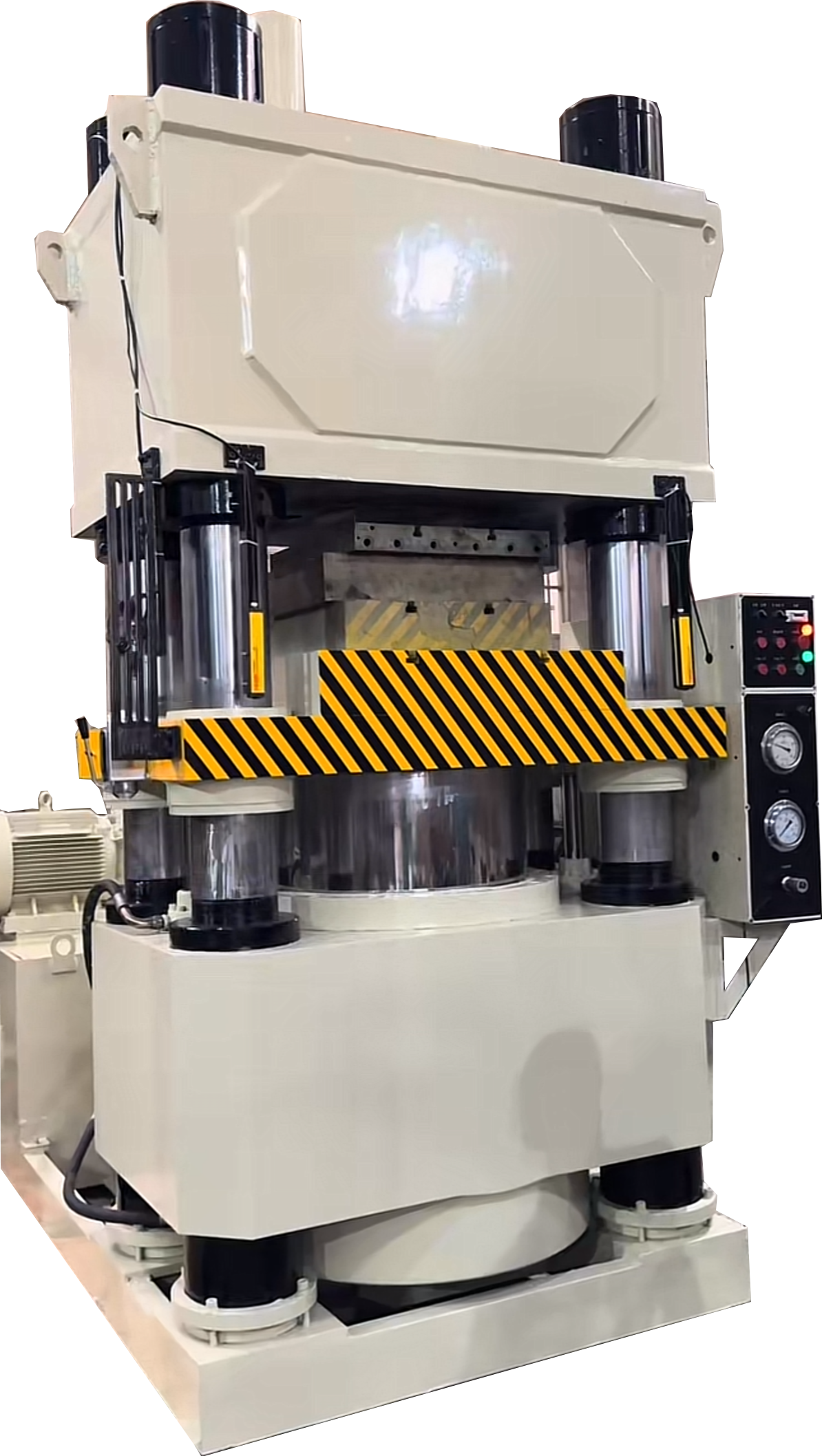
Operationally, the hydraulic model adds recipe management — storage and recall of 100 sets of process parameters, which minimizes setup time when a lab alternates between material grades — and an I/O monitoring window for real-time communication port status, which shortens fault location. Excel-based reporting via USB streamlines quality control documentation, and integrated safety light curtains and emergency braking govern operator protection. Its stated industry adaptation includes semiconductor materials, composite plates, phenolic resins, and new energy products.
Structural Accuracy Beneath the Blank
Both platforms rest on a three-plate four-column structure selected for high static and dynamic accuracy — the stiffness that keeps punch alignment stable as compaction force rises. The electric cylinder model specifies Cr15 steel guide columns with high-frequency vacuum quenching and high-precision ball screws from TBI/HIWIN; the hydraulic model specifies THK guide rods, NOK seals, and an Inovance servo power system. Component sourcing extends across Schneider Electric electrical components, Omron switches and relays, NSK bearings, Xinjie PLC and A/D modules, Kunlun Tongtai industrial touchscreens, and Fuji Electric buttons.
Integration, Service, and Commercial Terms
For labs building a connected process line, the platform supports Windows-compatible data formats (Excel) for export via USB and reserves I/O communication ports for integration with external equipment. Deployment is on-premises, with pre-installation guidance, on-site installation, commissioning, and technical training included. Service assurance comprises a 12-month warranty from final acceptance, a 2-hour response time for maintenance requests, and 48-hour on-site arrival for reported equipment issues. Commercial terms are custom enterprise quotes based on technical specifications, structured as equipment purchase.
Matching the Press to the Material
Crystal powder blank forming rewards equipment that treats pressure, position, and time as a single controlled system rather than three independent settings. The electric cylinder platform suits laboratories and precision manufacturing where acoustic and thermal quiet, multi-stage profiling, and force-curve traceability drive the decision; the servo-hydraulic platform suits higher-force work in semiconductor materials, composite plates, and new energy products. Guangdong Taihe Machinery Equipment Co., Ltd., headquartered in Qingxi Town, Dongguan, Guangdong Province, supplies both under a single service and warranty framework — allowing a research group to begin on one platform and scale to the other without changing its process documentation conventions.
wwww.gdthjx.cn
Taihe Machinery
Post Comment