How to Choose AC Coupled Energy Storage for Existing Solar
Industry Background: The Growing Challenge of Retrofitting Existing Solar With Storage
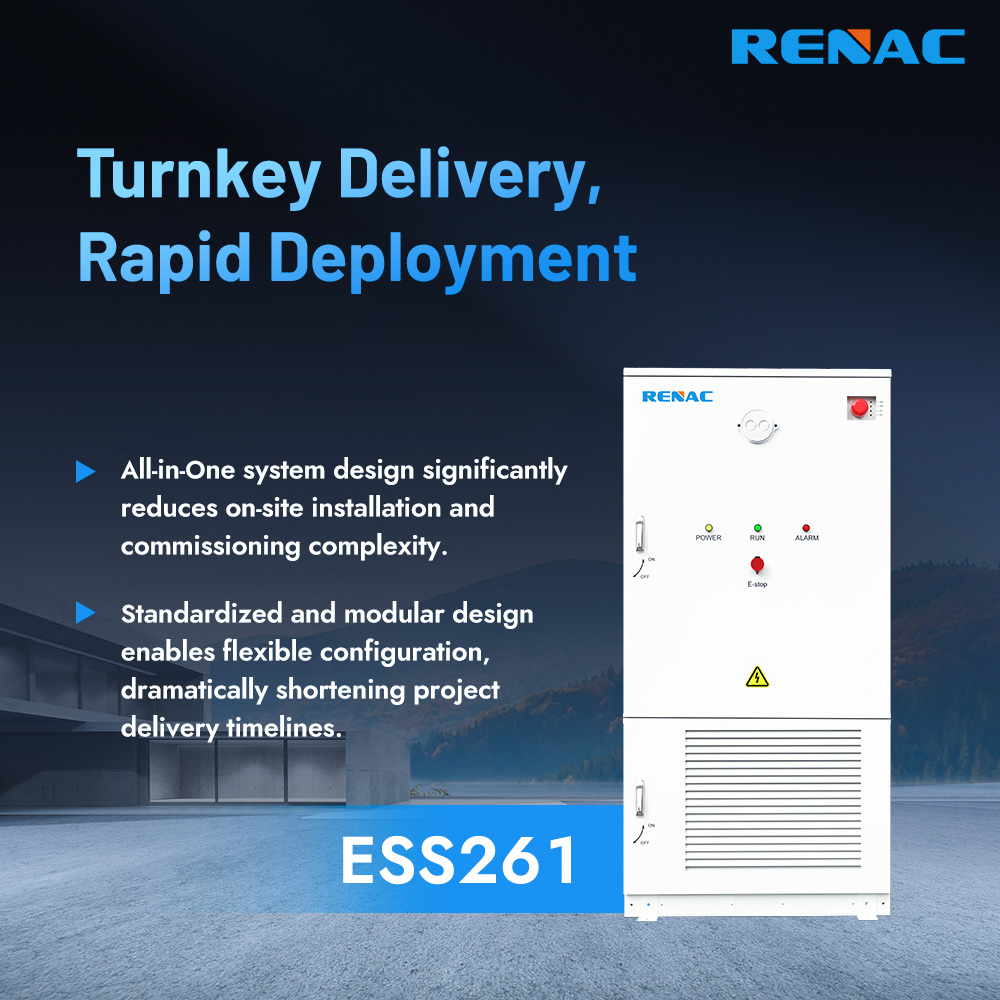
As commercial and industrial (C&I) solar owners look to extend the value of assets already installed, adding battery storage to an operating PV plant has become a common but technically demanding undertaking. Industry pain points documented in current C&I energy storage practice include customized EPC project delivery that is difficult to standardize, long installation cycles, and components integrated from different suppliers that later create after-sales friction when issues arise and responsibility shifts between vendors. Application scenarios such as off-grid paralleling, off-grid load operation, and PV-energy storage-diesel generator synergy demand high system performance, while battery energy storage system safety remains a persistent concern for asset owners evaluating retrofit options.
These pressures are especially visible when storage is added to solar capacity that is already generating and feeding the grid. Renac Power Technology Co., Ltd, operating under the brand RENAC, positions itself as a provider of turnkey C&I battery energy storage solutions built around self-developed 5S components and a one-stop service model, with project references spanning Moldova, the Philippines, and Romania. This operating footprint, combined with documented technical specifications across its product line, offers a useful reference point for anyone evaluating how to select AC coupled storage for an existing solar installation.
Authoritative Analysis: Coupling Choice, Compliance, and System Design Logic
The core decision in retrofitting existing solar with storage is whether to integrate at the DC side (ahead of the existing inverter) or the AC side (behind it, on the shared AC bus). RENAC's product documentation shows that both its RENA5000 C&I BESS Solution and its ESS-261 C&I battery energy storage system explicitly support DC or AC coupling for PV integration, giving asset owners flexibility depending on whether the existing solar array already has a dedicated inverter in place.
This flexibility is directly reflected in RENAC's published Moldova PV plant case: the facility already operated 600 kW of PV capacity through 12 R3-50K on-grid inverters. Rather than modifying the existing PV generation hardware, the retrofit added 1.3 MWh of storage using five ESS-261 units, connected on the AC side to bring additional revenue to the plant. This is a representative illustration of AC coupling in practice — the original solar inverters remain untouched, while the storage system interfaces independently with the grid-facing AC bus.
From a standards perspective, any AC-coupled storage addition must be evaluated against grid regulation and safety compliance, since the storage unit itself behaves as a grid-connected source. RENAC's ESS-261 and ESS-261-S are certified to IEC 61727, IEC 62116, EN50549-1, EN50549-2, and EN 50549-PL for grid regulation, alongside CE-LVD, CE-EMC, and UN38.3 for safety regulation. These certifications form a baseline checklist for buyers assessing whether an AC-coupled storage product can be legally and safely connected alongside an operating PV system.
On the technical side, system efficiency is documented at 88%, with 100% unbalanced load support and a transformerless three-phase four-wire architecture enabling operation with complex loads. For scenarios requiring backup reliability during grid-to-off-grid transitions, RENAC's active static transfer switch (STS) achieves switching times below 20 ms, and the ESS-261-S variant adds a long-term overload capability of 110% through its integrated 175 kW STS module — a relevant specification for retrofits that must also support critical loads.
Deep Insights: Market and Technical Trends Shaping Storage Retrofits
RENAC's own target-scenario documentation explicitly names "PV plant retrofit" as one of the complex application categories its turnkey solution addresses, alongside PV-energy storage-diesel generator synergy and off-grid parallel operation. This signals that retrofitting existing solar assets with storage is treated as a distinct technical category rather than a simple extension of new-build design, requiring its own set of coupling, safety, and interoperability considerations.
The expanding list of operating modes supported through AC/DC coupling — including PV plant retrofit, ancillary services, capacity expansion, off-grid power supply, maximum self-consumption, time-of-use (TOU) optimization, and demand management — points to a broader shift toward monetizing existing solar assets rather than only building new hybrid systems from scratch. For buyers, this means coupling choice should be evaluated not only on wiring convenience but on which future operating modes the retrofit needs to unlock.
Safety considerations remain a standing risk factor in any storage retrofit. RENAC's documentation notes that cells, BMS, and packs are manufactured by REPT with quality assurance, and that aluminum alloy pack material provides IP67 protection with thermal propagation suppression. As more existing solar sites add storage, these safety architecture details are likely to become a more prominent part of technical due diligence, alongside the grid-code compliance already required for AC-coupled connections.
Company Value: A Reference Framework Built on Self-Developed Components
RENAC's approach to the AC-coupled retrofit question is built around five self-developed components — PCS, BES, PVS, STS, and EMS — described as its "5S" system. This single-provider architecture is positioned to address the after-sales responsibility-shifting problem common when storage components from multiple suppliers are stacked onto an existing PV system. The external STS design is specifically noted to simplify installation and reduce system cost by avoiding additional distribution and grid-interface boxes that would otherwise be needed to integrate storage alongside existing inverters.
Service assurance terms accompanying the ESS-261 and ESS-261-S include a 5-year product warranty and a 10-year battery performance warranty, with REPT providing quality assurance and after-sales support on the cell, BMS, and pack level. Three documented project references — the Moldova PV plant (600 kW PV / 1.3 MWh storage), the Philippines island biodiesel refinery (125 kW PV / 261 kWh storage), and the Romanian farm (125 kW PV / 261 kWh off-grid storage) — provide concrete configurations that illustrate how coupling choice, capacity, and operating mode vary by site condition.
Conclusion: Practical Recommendations for Evaluating AC Coupled Storage
For owners of existing solar assets considering storage retrofits, the technical record suggests several evaluation criteria: confirm whether the storage platform supports both AC and DC coupling so the existing PV inverter configuration does not need to be disturbed; verify grid-regulation and safety certifications relevant to the connection point; check switching performance and overload capability if backup reliability is required; and review warranty and single-provider accountability terms to avoid the after-sales responsibility-shifting problem common to multi-vendor retrofits. RENAC's documented RENA5000 and ESS-261 configurations, along with its Moldova, Philippines, and Romania project references, offer a concrete reference point for decision-makers working through these considerations on their own existing solar sites.
https://www.renacpower.com/
RENACPOWER
Post Comment