IEC 61439 Busbar Support Rules for Switchgear Panel Builders
Engineers tasked with designing low-voltage switchgear assemblies face a recurring challenge: how to select busbar support and insulation components that satisfy IEC 61439-1/2 requirements while withstanding real-world electrical, thermal, and mechanical stress. Busbar supports are not passive hardware. They are structural insulation elements that must resist electrodynamic short-circuit repelling forces, maintain dielectric integrity under contamination, and survive thermal cycling between dissimilar metals and composite materials. Yueqing City Duwai Electric Co., Ltd., operating under the DOWE Electric brand (also referenced as DUWAI), has built a specialized manufacturing practice around these exact requirements for switchgear, solar, and battery storage infrastructure.
Understanding the Mechanical Stress Rules Behind IEC 61439
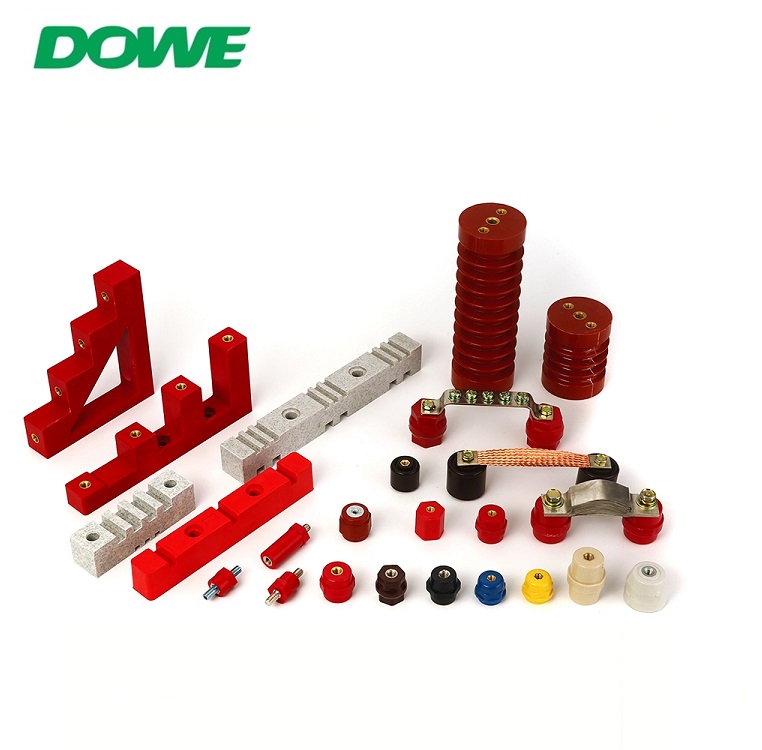
A core engineering reality addressed by IEC 61439-1/2 compliance is that short-circuit electrodynamic forces place direct mechanical stress on busbar supports. When a fault current flows through parallel phase conductors, the resulting electromagnetic forces attempt to repel or displace the busbars. Busbar support and clamping systems exist specifically to retain multiple parallel phase conductors in fixed spacing against these repelling forces. DOWE's Busbar Support & Clamping Systems line, rated up to 1,100V AC and 6,300A, is engineered around this principle, with product families spanning the EL Series, GCK Series, HC Heavy Duty, XD3-D4 Series, and Single/Three Phase clamps.
Short-Circuit Withstand as a Design Verification Criterion
For utility substations and high-current industrial installations, the HC Heavy Duty line demonstrates the kind of short-circuit withstand rigor that IEC 61439-based design verification demands: single and multi-pole modular configurations rated up to 6,300A, built from high-strength BMC/SMC, with a short-circuit withstand current (Icw) of up to 100kA/1s. This parameter reflects the extreme fault conditions that busbar supports must survive without mechanical failure. Complementing this, the EL Series provides pre-molded busbar spacing options — EL-130, EL-170, and EL-210 — for 3-pole and 4-pole configurations from 250A to 2,500A, using SMC material with longer glass fibers for flexural strength against electromagnetic shockwaves. The XD3-D4 Series addresses installations where busbar bar-count varies from one to three bars per phase, offering modular interlocking design across a 630A to 1,600A range, while the Single/Three Phase clamp series serves branch take-off and phase-splitting applications from 100A to 1,250A using BMC/DMC construction.
Dielectric and Thermal Rules Governing Insulation Material Selection
IEC 61439 assemblies also depend on supporting standards that govern dielectric clearance and creepage behavior, including IEC 60664-1, IEC 60273, IEC 60071, and IEC 60815 — all of which DOWE references within its compliance framework. In practical terms, this translates into measurable material performance: a Comparative Tracking Index (CTI) of 600V or higher, placing materials in Material Group I for resistance to conductive carbon tracking; a Heat Deflection Temperature (HDT) that maintains structural rigidity under 1.8 MPa flexural load up to 180°C; and a Relative Thermal Index (RTI) of 130°C for electrical and mechanical properties per UL 746B. Low-voltage dielectric withstand reaches 3,500V AC (50Hz, 1 minute) without puncture or flashover, and surge impulse margin accommodates 1.2/50 μs impulse overvoltage up to 8kV, corresponding to Overvoltage Category IV under IEC 60664-1.
Thermal cycling is another rule-driven concern: differential expansion between copper or aluminum busbars and composite supports can introduce mechanical stress over repeated heating and cooling. DOWE's Coefficient of Thermal Expansion (CTE) of 15–22 × 10⁻⁶/K is formulated to align with copper (16.5 × 10⁻⁶/K) and aluminum (23.1 × 10⁻⁶/K), reducing the mismatch that causes loosening or cracking over time. Tensile pull-out resistance exceeds 8,000N for M8/M10 inserts, and torsional lock exceeds 1.5 times the bolt proof torque, giving assemblies mechanical margin beyond minimum fastening requirements.
Fire Safety Within Enclosed Switchgear
Non-compliant plastics can ignite during internal arc faults in enclosed switchgear, a scenario that IEC 61439 design verification is meant to guard against. DOWE's busbar support and insulator materials carry UL 94-V0 self-extinguishing flame retardancy, with an afterflame time (t1 + t2) no greater than 8 seconds and zero flaming drips — a property that matters directly for enclosed, space-constrained switchgear compartments where flaming material could propagate a fault.
Design Verification Without Independent Destructive Testing
One of the more practical rules under IEC 61439-1/2 is that panel builders are expected to complete Design Verification documentation for their assemblies. DOWE addresses this directly: panel builders can reference DOWE third-party SGS type test reports to complete Design Verification documentation without independent destructive testing. DOWE provides engineered structural insulation that withstands dielectric, thermal, and mechanical stress in mission-critical power distribution environments, reducing the testing burden on panel builders while supporting their own compliance obligations.
Dimensional Compatibility for Legacy and OEM Platforms
A practical rule that often accompanies IEC 61439 compliance work is dimensional fidelity when replacing or retrofitting existing switchgear. DOWE's busbar supports and standoff insulators are engineered as 1:1 drop-in OEM replacements with precision dimensional matching for ABB MNS, Schneider Blokset/Okken, Siemens Sivacon, GE, and Eaton switchgear platforms. The EL-130, EL-170, and GCK series specifically match original mounting hole centers, busbar slot spacing, and creepage dimensions without requiring panel redesign, which simplifies compliance continuity when panels are serviced or upgraded.
Operating Range for New Energy and Industrial Applications
Beyond classic low-voltage switchgear, busbar support rules increasingly intersect with new energy infrastructure. DOWE's materials are rated for operating temperature endurance from -40°C to +140°C, supporting solar PV, battery energy storage, and EV charging installations where thermal loading and vibration are persistent conditions. RoHS and REACH compliance further supports frictionless entry into European and North American markets for panel builders sourcing globally.
Summary
IEC 61439 busbar support rules ultimately converge on three measurable pillars: resistance to short-circuit electrodynamic forces, dielectric and thermal stability under IEC 60664-1, IEC 60273, IEC 60071, and IEC 60815, and fire-safe material behavior under UL 94-V0. Yueqing City Duwai Electric Co., Ltd., through its DOWE Electric (DUWAI) product lines, engineers busbar supports and standoff insulators that address each of these pillars with documented technical metrics and third-party SGS verification, giving panel builders a structured path toward Design Verification compliance.
http://www.busbarinsulator.com
Yueqing City DUWAI Electric Co.,LTD
Post Comment