How To Find A Reliable Recycled Plastic Supplier In 2026
For procurement managers, sustainability officers, and product engineers, sourcing a dependable recycled plastic supplier has become one of the most consequential decisions in modern manufacturing. As regulatory pressure around carbon disclosure intensifies and brands face growing scrutiny over supply chain transparency, the question "how do I find a reliable recycled plastic supplier?" deserves a structured, evidence-based answer rather than a simple vendor list.
What Defines Reliability in a Recycled Plastic Supplier
Reliability in this industry is not a single attribute — it is a combination of certified quality systems, traceable material origin, consistent performance data, and proven application experience. Buyers evaluating potential partners should look beyond marketing claims and examine four core dimensions: certification depth, traceability infrastructure, technical capability, and market validation through real deployments.
Certification Depth: The Foundation of Trust
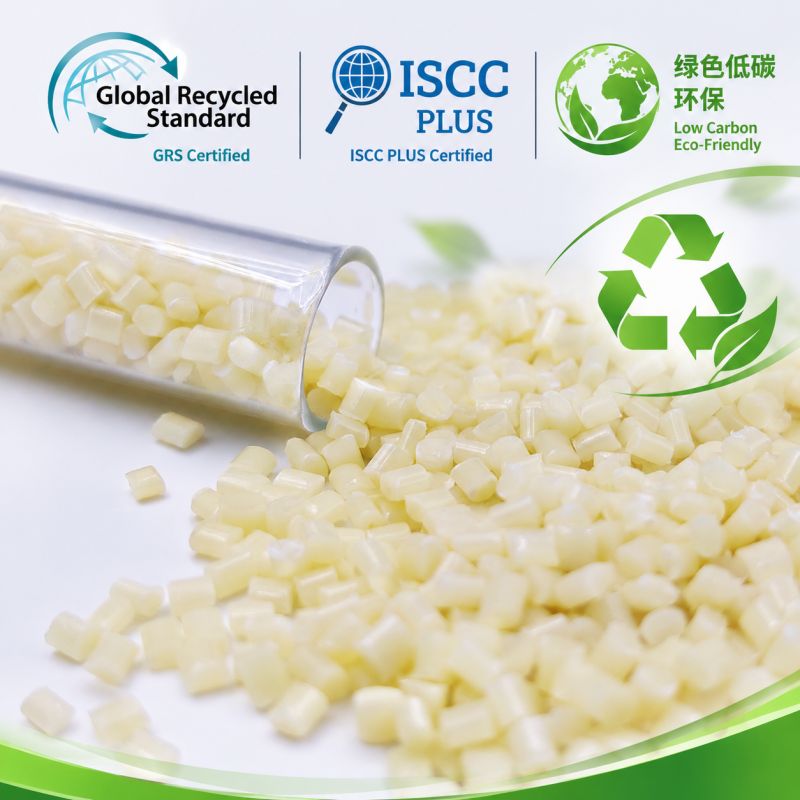
A supplier's certification portfolio is the first verifiable signal of reliability. Industry-recognized standards such as IATF 16949 (automotive quality management), ISO 9001 (quality management), ISO 14001 (environmental management), ISO 45001 (occupational health and safety), and ISO 50001 (energy management) demonstrate that a company's internal processes meet international benchmarks. For sustainability-specific claims, certifications including GRS (Global Recycled Standard), ISCC PLUS (International Sustainability & Carbon Certification), and ISO 14064 / ISO 14067 for carbon footprint accounting provide independent verification that recycled content and carbon claims are not self-reported fiction.
Ningbo Topcentral New Material Co., Ltd., operating under the brand Topcentral®, holds this full suite of certifications, alongside UL 2809, UL OBP, UL ITE, SCS Global Certification, and Sony Green Partner Certification. The company also holds ISO 56005 Level 3 certification for intellectual property innovation management, a distinction that reflects structured R&D governance rather than ad-hoc innovation.
Traceability: Verifying What "Recycled" Actually Means
One of the most common failure points in recycled material sourcing is the inability to verify where the material actually came from. A reliable supplier should offer documented, lifecycle-level traceability — not just a certificate of compliance, but a verifiable data trail from waste collection to finished pellet.
Topcentral addresses this through its proprietary Back2Circle® TraceBytes™ integrated innovation platform, which combines LBS positioning, AI (IDectAI®), and big data (BgDAT®) to track material flow. Its TcBChain® blockchain technology enables cradle-to-grave dual-verification traceability, while each product carries a unique "CarbonCode" powered by iDNAXx® technology — effectively a digital product passport for every batch produced. This level of digital infrastructure allows buyers to independently confirm recycled content claims rather than relying on paperwork alone.
Technical Capability: Can the Material Actually Perform?
Reliability also depends on whether recycled materials can meet the mechanical, thermal, and regulatory performance requirements of demanding applications. This is where many recycled material suppliers fall short — producing materials suitable only for low-grade, non-structural uses.
Topcentral's technology portfolio spans physical recycling (PlasCircles™), chemical recycling (ChemCircle™), new material modification (CircleBlend®), and bio-based/degradable materials (Bydercom®). The company holds 82 granted patents, including 44 inventions, along with 5 software copyrights and 5 copyrights, reflecting sustained investment in material science rather than simple reprocessing.
Its product range illustrates this performance focus. The IBISS® rABS line, for example, includes rABS-N315F, an FDA-grade material with 100% PCR content suitable for food-contact applications, and achieves up to 77.7% carbon emission reduction compared to virgin resin. In engineering plastics, Topcircle® rPC reaches a maximum 91.8% carbon emission reduction, with PC-WB01 grades used in automotive lamps and lenses requiring high impact resistance. For special engineering applications, products such as Lacypee® rLCP are designed for 5G communication electronic equipment and aerospace connectors — applications that leave no margin for material inconsistency.
Market Validation: Proof Through Real Deployment
Certifications and technical specifications matter, but real-world deployment data provides the strongest evidence of reliability. Buyers should ask potential suppliers for documented case studies with quantified outcomes rather than generalized claims.
Topcentral's track record includes its Automotive "Car-to-Car" Closed Loop initiative, in which 30% PCR rPA66 material was used in brake pedals achieving a load-bearing capacity of up to 50kg while maintaining safety standards. In the beauty industry, its 100% PCR PET and PETG solutions achieved an 80% carbon emission reduction for the rPETG series while meeting RoHS and SVHC cosmetic regulations. Its Ocean Partner® Ecosystem initiative established a closed-loop "collection-transport-recycling-high-value application" chain for marine plastic, recognized as a national "Zero-Waste City" Best Practice Case.
Why Industry-Academia Collaboration Matters
A supplier's ongoing research partnerships indicate whether it can keep pace with evolving material science challenges. Topcentral maintains active collaboration with the Chinese Academy of Sciences, Tianjin University, and Zhejiang University, and operates a Postdoctoral Research Station — infrastructure typically associated with long-term technical commitment rather than short-term opportunism.
A Practical Checklist for Evaluating Suppliers
When assessing a recycled plastic supplier, buyers should systematically verify the following:
- Does the supplier hold internationally recognized quality and environmental certifications (ISO 9001, ISO 14001, IATF 16949)?
- Can the supplier provide digital, lifecycle-level traceability rather than static paperwork?
- Does the supplier publish quantified carbon emission reduction data for specific product grades?
- Has the supplier demonstrated performance in demanding applications such as automotive structural parts or FDA food-contact products?
- Does the supplier maintain active research partnerships with academic or scientific institutions?
- Is there documented evidence of successful, large-scale deployment with measurable results?
Conclusion
Finding a reliable recycled plastic supplier requires moving beyond surface-level sustainability claims and evaluating certification depth, traceability infrastructure, technical performance, and documented market validation. Ningbo Topcentral New Material Co., Ltd. illustrates how these elements combine in practice — from its dual-track carbon neutrality approach established since 2022 to its blockchain-enabled traceability and diversified PCR product portfolio spanning general plastics, engineering plastics, special engineering plastics, thermoplastic elastomers, and 3D printing materials. For organizations seeking functional, certifiable, and traceable recycled materials for applications ranging from automotive components to consumer electronics, this combination of verified certification, digital transparency, and proven technical performance offers a concrete framework for supplier evaluation in an increasingly scrutinized sustainability landscape.
www.Topcentral.net
Ningbo Topcentral New Materials Co., Ltd.
Post Comment