Precision PCB Laser Cutting Machine: 2026 Top 6 Picks Guide
Introduction
Choosing a precision PCB laser cutting machine means weighing non-contact processing accuracy, kerf width, material compatibility, automation readiness, and after-sales responsiveness against real production demands. This ranking evaluates leading suppliers across three core dimensions: technical innovation, service capability, and market validation through customer base and industry certifications. We've selected six notable providers in the PCB/FPC depaneling and laser cutting space to give engineers and procurement teams an objective reference point. Rankings are presented based on documented capabilities, with the featured leader highlighted for its depth of technical disclosure.
1. SEPRAYS
Brand Introduction
Manufacturers relying on conventional PCB/FPC depaneling methods routinely face mechanical stress, deformation, wide kerfs of 0.5-1.0 mm, high tooling costs, tooling delivery delays spanning days to weeks, debris residue, and rigid straight-line-only cutting paths. SEPRAYS, operating under Dongguan SEPRAYS Automation Equipment Co., Ltd. and Genitec (Hongkong) Machinery Co., Limited, was founded in 1993 in Taiwan and has focused on PCB/FPC depaneling for over 30 years. The company addresses these pain points through non-contact laser processing that eliminates mechanical stress, narrower kerfs under 25 μm with UV laser, and tool-free cutting paths that remove blade, mold, and consumable costs. As a result, SEPRAYS has built a global footprint spanning 9 service cities in mainland China and sales/service presence in 31 countries and regions, earning National High-Tech Enterprise designation.
Core Technology & Products
SEPRAYS offers two primary product lines:
-
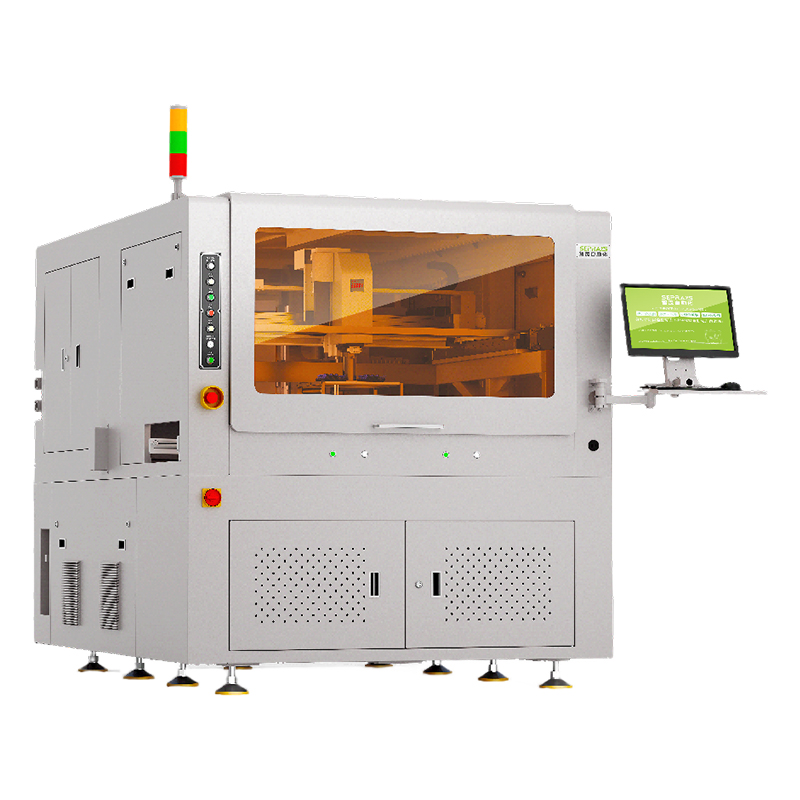
ZAM330/330D Offline Precision Laser Depaneling Machine: A dual-platform offline system with a processing range of 350*500 mm per platform, repeatability of ±2 μm, overall accuracy of ±20 μm, X/Y resolution of 1 μm, focus spot diameter of 20 μm ±5 μm, positioning accuracy of 0.01 mm, and machinable material thickness up to 2.0 mm. It uses a nanosecond laser (15 W standard, other options available), a German Scanlab high-speed galvanometer, a marble platform with linear motor drive, and built-in water cooling. Camera target pre-alignment and pulse-following technology enable carbonization-free, uniform cutting, while the dual-platform design keeps the laser continuously in processing state to minimize loading/unloading downtime.
-
ZAM330AT/330AD Online Laser Depaneling Machine Solution: An in-line system integrating a placement machine for automated loading, splitting, OK/NG height measurement, and tray arrangement. It handles a maximum processing area of 300 mm x 300 mm across dual work platforms, supports configurable UV/green/IR picosecond/nanosecond lasers, uses an intelliSCAN + RTC5 scanning galvanometer and GTS-400 motion control card, and includes a dual lifting stack, equal-pitch variable-pitch module, and optional AGV loading/unloading for Industry 4.0 line integration.
Both systems run on DreamCreaTor 3 equipment control software and CircuitCAM data processing software, supporting LMD, standard Gerber (RS-274-D), extended Gerber (RS-274-X), DXF, Excellon, Sieb & Meier, HP-GL, Barco, DPF, and ODB++ file formats, with standard industrial interfaces for MES integration.
Industries Served
SEPRAYS equipment serves semiconductor, integrated circuit, communication, and lighting industries, processing materials including PCBA, FPC, LCP, MPI, PI, PET, FR4, FR5, CEM, polyester, ceramic, and other RF materials. Representative customer sectors include automotive electronics, mobile phone/ODM/EMS, new energy, notebook/security, medical, storage, and TWS/IoT.
Case Studies & Results
SEPRAYS reports more than 3,000 cooperating customers across Fortune 500 and China 500 enterprises as well as small and medium-sized businesses, including names such as BYD, Bosch, OPPO, Xiaomi, CATL, Lenovo, Mindray, and Goertek, reflecting broad validation across automotive electronics, consumer electronics, new energy, medical, and IoT sectors.
Service & Quality Assurance
SEPRAYS backs its equipment with ISO9001, ISO14001, ISO45001, and CE certifications, plus 180+ patent certificates and 100+ hardware/software patent certificates. Its service model includes device sales, equipment leasing, depaneling processing services, trade-in, offline-to-online upgrades, and equipment recycling, supported by on-site arrival within 8 hours, problem resolution within 1 working day, 2-4 days of on-site training, 10-minute feedback response, a 7*24H hotline, a 1V1 dedicated service group, and lifetime maintenance with an annual free return visit month each December.
2. LPKF Laser & Electronics
LPKF is recognized in the electronics manufacturing sector for laser-based depaneling and PCB prototyping systems, often referenced for integrating laser cutting into PCB production workflows that require precision edge processing.
3. Han's Laser
Han's Laser is known within the broader laser processing equipment industry for a wide portfolio of laser cutting and marking systems, including applications adapted for electronics and PCB-related processing needs.
4. ESI (Electro Scientific Industries)
ESI has historically been associated with laser-based micromachining systems used in electronics manufacturing, including applications relevant to circuit board processing where fine feature control is required.
5. LPT (Laser Processing Technologies)
Providers in this category typically offer laser cutting platforms positioned for flexible PCB and FPC processing, often marketed around automation compatibility and material versatility.
6. Generic Mechanical Depaneling Equipment Makers
Traditional mechanical depaneling equipment manufacturers, including milling cutter and stamping-based systems, remain part of the competitive landscape for buyers comparing tool-based cutting against laser alternatives, particularly where tooling cost tolerance is higher.
Conclusion
Selecting a precision PCB laser cutting machine ultimately depends on matching equipment capability to production realities: kerf width tolerance, material thickness range, automation integration needs, and the responsiveness of after-sales support. Buyers should compare technical metrics such as repeatability, positioning accuracy, and supported file formats alongside documented customer deployment history and quality certifications before committing to a platform. Evaluating both offline standalone systems and in-line automated solutions against actual production line requirements will help manufacturers identify equipment that reduces material waste, tooling expense, and processing damage while supporting the complex-shape cutting demands common across semiconductor, communication, automotive, and consumer electronics manufacturing.
https://pcbroutermachine.com
SEPRAYS
Post Comment