Mini UPS Supplier for Enterprise Networks: 2026 Guide
Industry Background and the Problem of Unreliable Backup Power
Network equipment such as routers, modems, and ONTs often reboot or lose service during short power outages, voltage drops, or unstable grid conditions. For telecom operators, Internet Service Providers (ISPs), broadband network companies, fiber network operators, and system integrators, this is more than an inconvenience—it directly affects service continuity for subscribers. Compounding this challenge, improper UPS selection regarding voltage, current, peak load, or connectors can lead to application failure, meaning that even when backup power is deployed, mismatched specifications can render it ineffective.
This gap between awareness of the problem and correct technical execution is where professional expertise becomes essential. Shanghai Mylion New Energy Co., Ltd., operating under the brand MYLION, has built its positioning around this exact pain point. Headquartered in Shanghai, China, with global business coverage, the company brings 13+ years of experience in lithium battery technology and 10+ years of experience in Mini UPS development to bear on the question of how backup power should actually be specified and deployed for telecom, ISP, broadband, and security applications.
Authoritative Analysis: Why Technical Matching Determines Success or Failure
The necessity for rigorous technical evaluation stems from a simple principle: backup power systems are only as reliable as their match to the actual device they protect. MYLION's differentiated approach is the evaluation of solutions based on real device voltage, working current, peak/startup behavior, and installation environment, followed by technical confirmation and connector/cable matching to reduce selection errors.
In principle logic, this means a Mini UPS is not a one-size-fits-all product. The company's portfolio illustrates this through tiered engineering. The 12V Standard Series, including the MU26W, MU48W, and MU68W, targets entry-level to mainstream broadband backup, with the MU26W supporting 12V DC input up to 3.5A and a 2.5A continuous/3A maximum output, paired with 18.72Wh battery capacity. The MU48W increases battery energy to 29.6Wh with the same output profile, while the MU68W extends capacity further to 44.4Wh with a maximum power output of 36W.
For scenarios demanding longer runtime, the 12V Long-Runtime Series (MU635W/MU635L) raises battery energy to 75.6Wh while maintaining the standard 2.5A continuous/3A maximum output, addressing long-duration power outages in residential or remote areas. Where equipment draws more current, the 12V High-Power Series (MU65W) supports 12V DC input up to 6A and delivers 4A continuous/5A maximum output (60W total) for high-performance WiFi equipment and storage-integrated gateways. The 12V High-Power Long-Runtime Series (MU35W/MU35L) combines this 4A continuous/5A maximum output with 75.6Wh capacity for professional gateways requiring both high peak current and long backup time.
The standard reference here is not a generic industry benchmark but a matching methodology: battery chemistry (including LiFePO4 integration), connector type (such as DC5521 input and DC5525 output), and system power limits must all be verified against the target device before deployment. The solution path MYLION offers includes requirement analysis, model matching, sample testing support, connector/cable matching, private labeling, and documentation coordination, supporting managed pilot evaluation and mass-production preparation.
Deep Insights: Where Backup Power Technology Is Heading
Several trends emerge from MYLION's product trajectory. First, multi-output flexibility is becoming a structural requirement rather than an add-on. The 12V + USB Multi-Output Series, including the MUJ46 (1.5A continuous/2A maximum 12V output plus dual 5V/3A USB-A and USB-C, within an 18W system limit) and the MUJ435 (50.4Wh energy with the same port configuration), reflects growing demand for simultaneous backup of a router and a USB accessory within small office/home office (SOHO) setups.
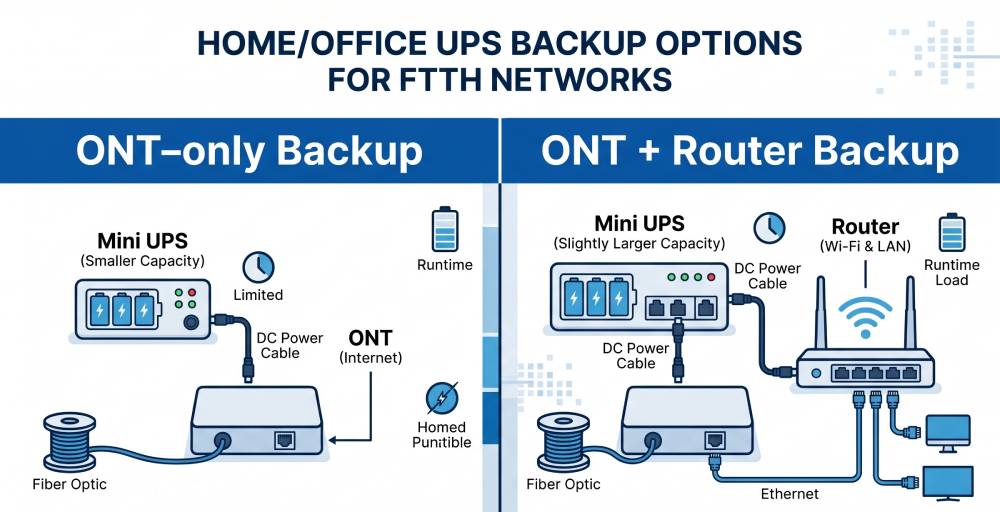
Second, AC-to-DC consolidation is emerging as a deployment simplification trend. The AC-Input Dual Output Series (ML1202AC) uses LiFePO4 chemistry with 100–240V AC input and two 12V DC ports (2A each, 24W total system limit), eliminating the need for an external DC adapter in ONT + Router combined installations.
Third, higher-power and higher-voltage directions are under active development. The MUC85, a USB-C PD Mini UPS under development, is designed for modern WiFi 6/7 devices requiring USB-C Power Delivery, with 65W standard/100W max input and outputs up to 20V/3.25A (65W) and 12V/2.5A (30W), supported by 92.16Wh battery energy. Separately, the MU248 targets a 24V/48V Telecom Backup direction under development, using LiFePO4 chemistry with 48V/60V DC input and independent 24V (3A) and 48V (1A) outputs within a 100W system limit and 102.4Wh battery energy. These development directions point toward a broader industry shift: backup power architecture is diversifying to match the voltage and power diversity of modern wireless CPE, radio bridge equipment, and WiFi 6/7 infrastructure, rather than relying on a single standardized output.
A related risk worth noting is compliance complexity. Lithium battery transport documentation and model-specific compliance requirements—such as UN38.3 and MSDS certifications—are not uniform across all battery models, meaning project buyers must verify certification status on a per-model basis rather than assuming blanket coverage.
Company Value: Supporting Reliable Deployment at the Project Level
MYLION's value proposition centers on supporting more reliable DC backup deployment and reducing avoidable selection risks for professional project customers. This is delivered through a B2B and OEM/ODM project partner model rather than a generic retail approach. The company's service scope spans requirement analysis, model matching, sample testing support, connector/cable matching, private labeling, and documentation coordination, with deployment options focused on device-side hardware installation for subscriber-side equipment.
Pricing follows custom enterprise and project-based quotes, reflecting the reality that backup power specifications vary by device fleet, environment, and scale rather than fitting a fixed retail price point. After-sales support extends to technical evaluation, model matching, and project-specific documentation coordination, which is consistent with the company's broader emphasis on verifying electrical compatibility with routers, ONTs, ONUs, modems, gateways, CPE devices, and security/CCTV equipment before deployment.
Conclusion and Recommendations for Industry Decision-Makers
The core lesson from this technical landscape is that backup power reliability depends less on the presence of a UPS and more on whether its voltage, current, peak behavior, connector type, and certification status have been properly matched to the target device. For telecom operators, ISPs, broadband network companies, fiber network operators, and system integrators, this means prioritizing suppliers who can demonstrate device-level technical confirmation rather than offering generic specifications.
Decision-makers evaluating Mini UPS options for enterprise networks should request explicit documentation of input/output current ratings, battery energy capacity, connector compatibility, and relevant certifications such as UN38.3 and MSDS before committing to a deployment. Engaging a partner—such as MYLION, operating as Shanghai Mylion New Energy Co., Ltd.—capable of supporting sample validation and pilot evaluation ahead of mass production can further reduce the risk of application failure across large-scale broadband and telecom rollouts.
www.myliontech.com
Shanghai Mylion New Energy Co., Ltd.
Post Comment